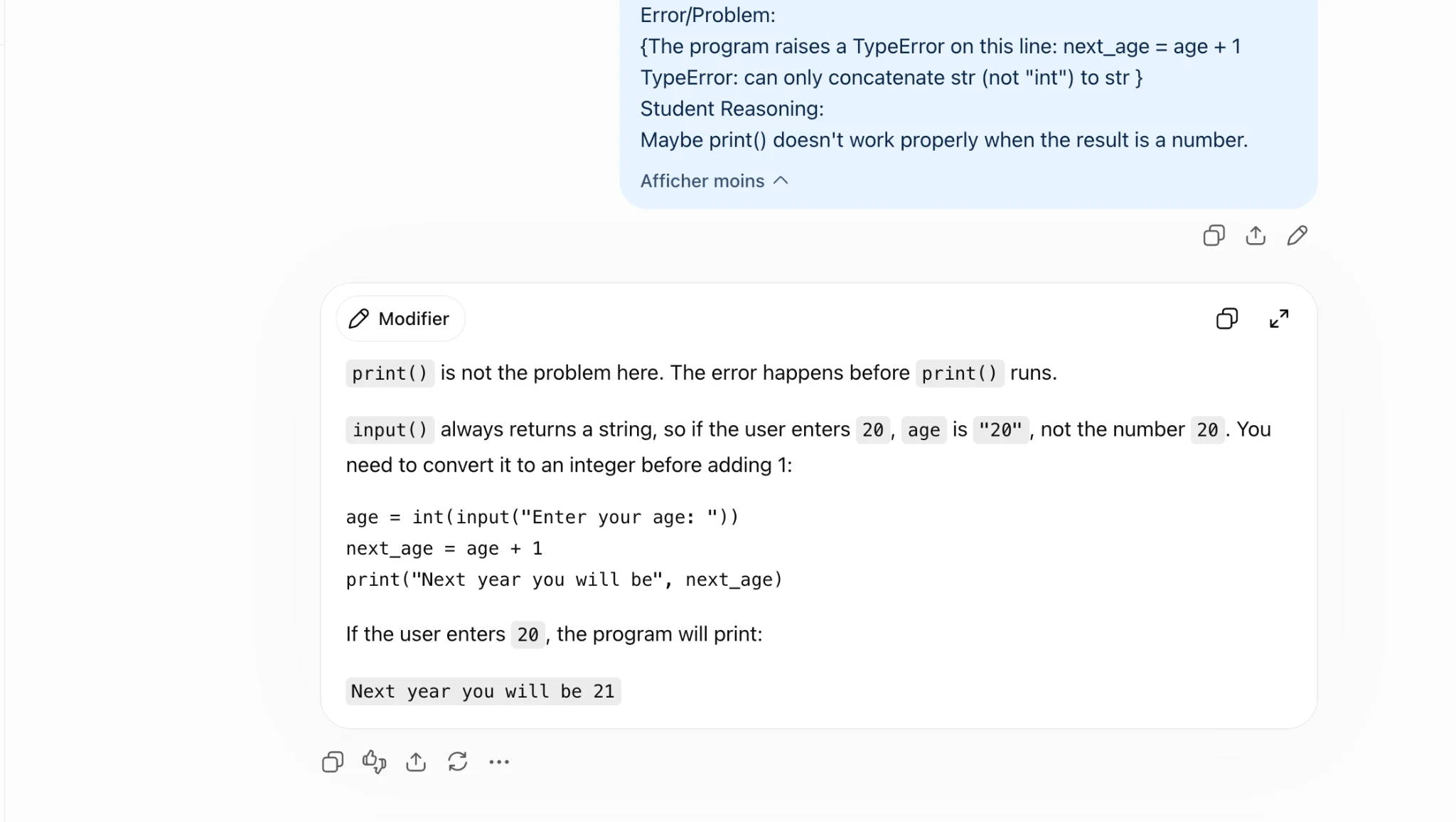
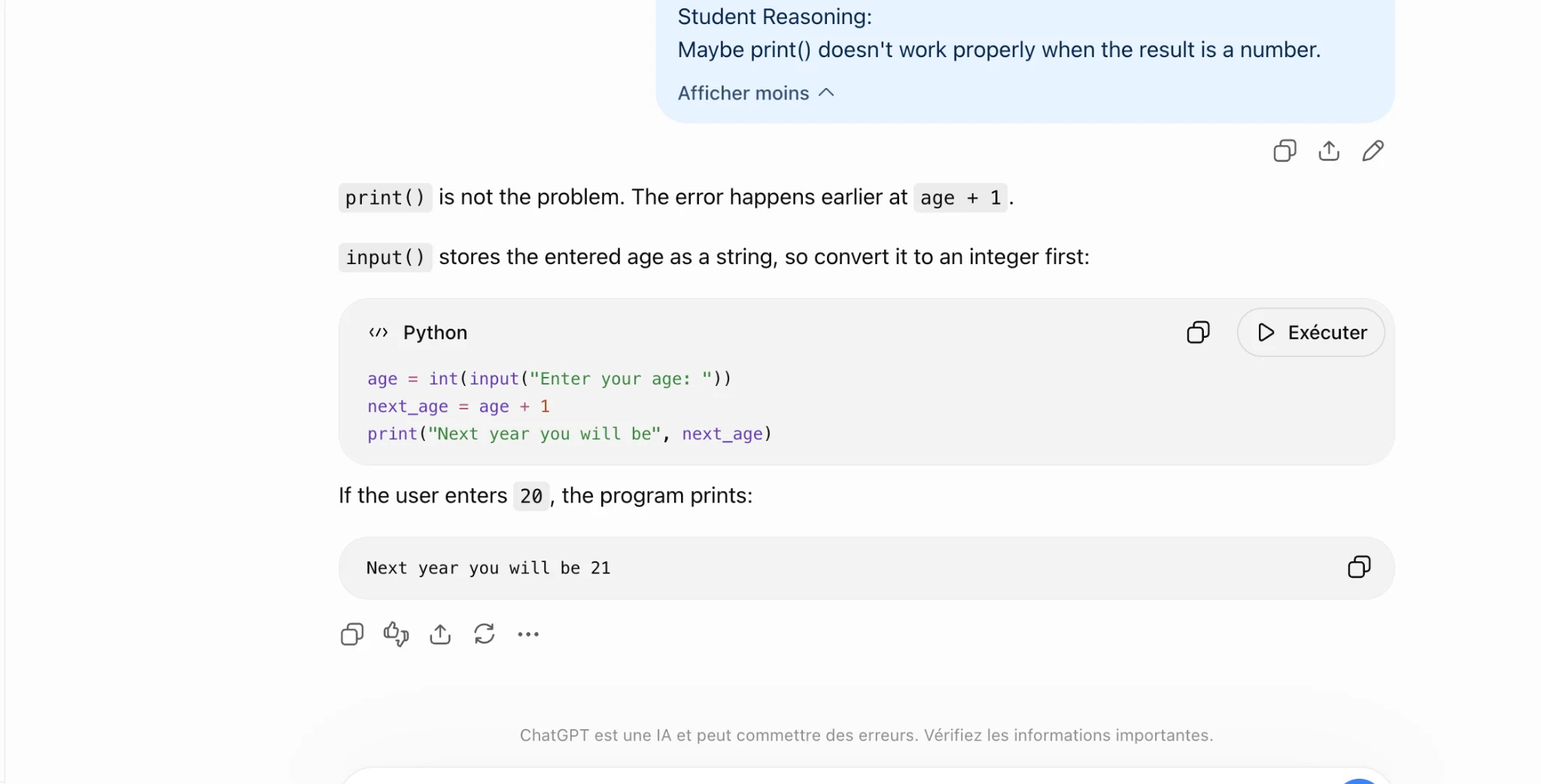
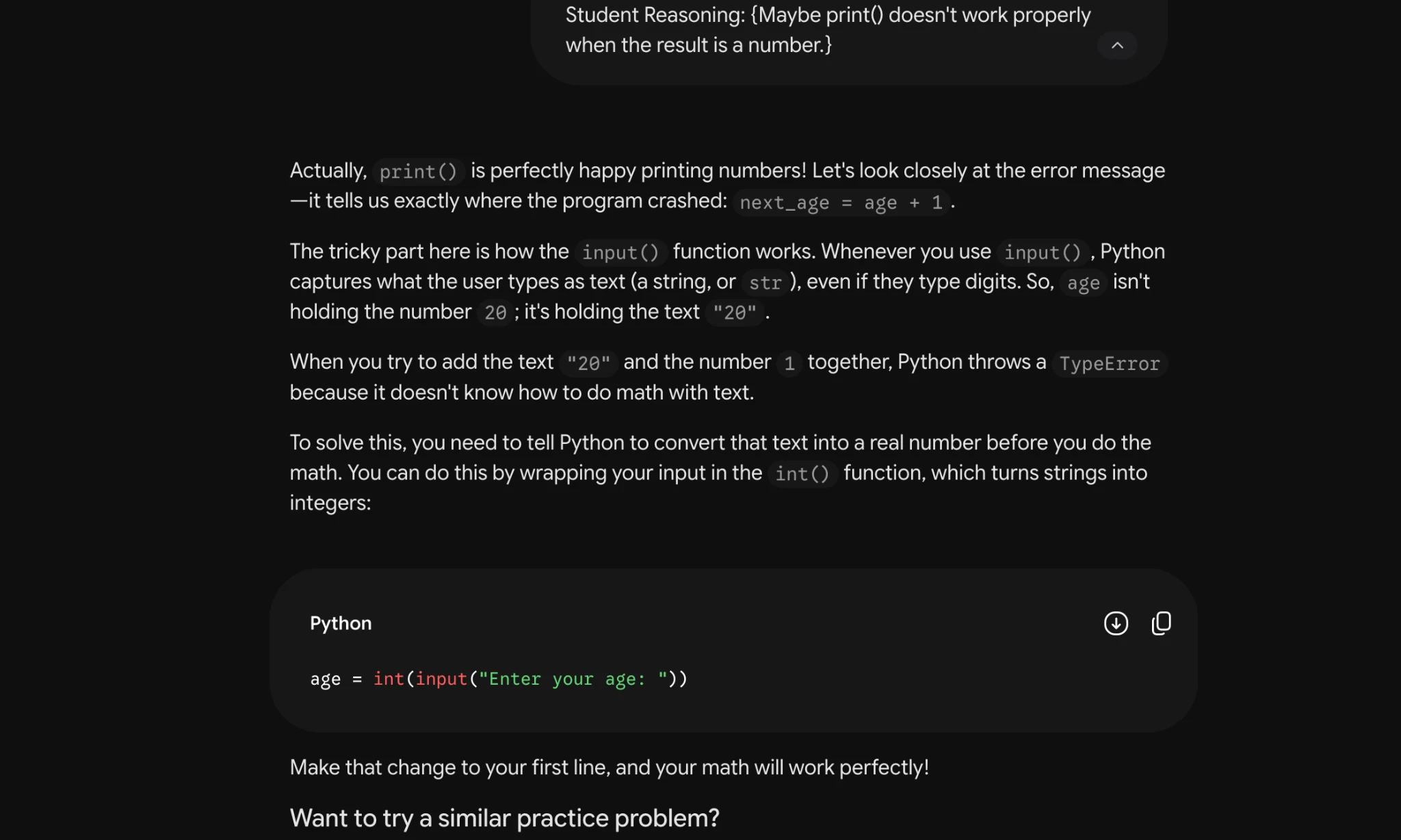
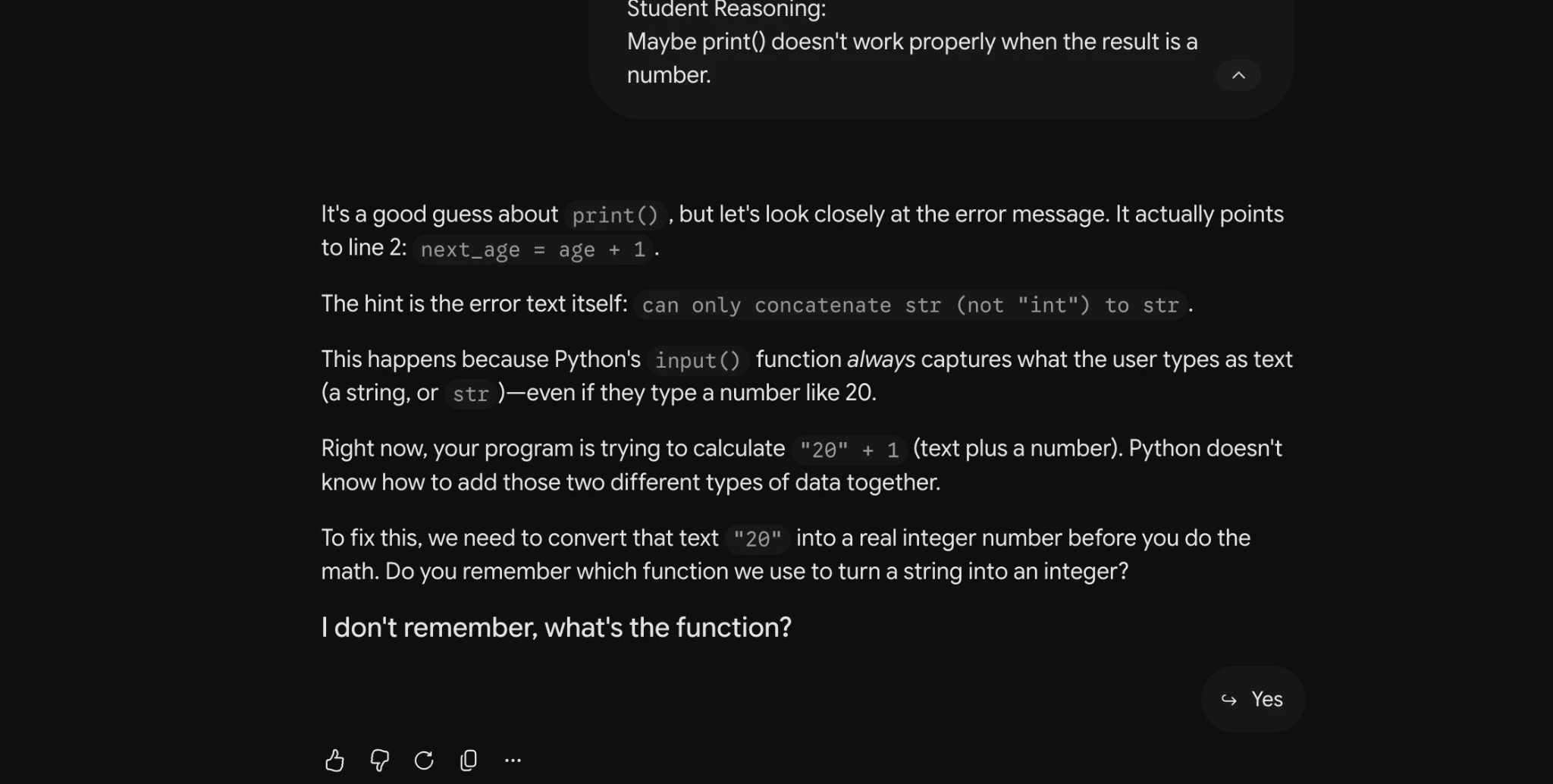
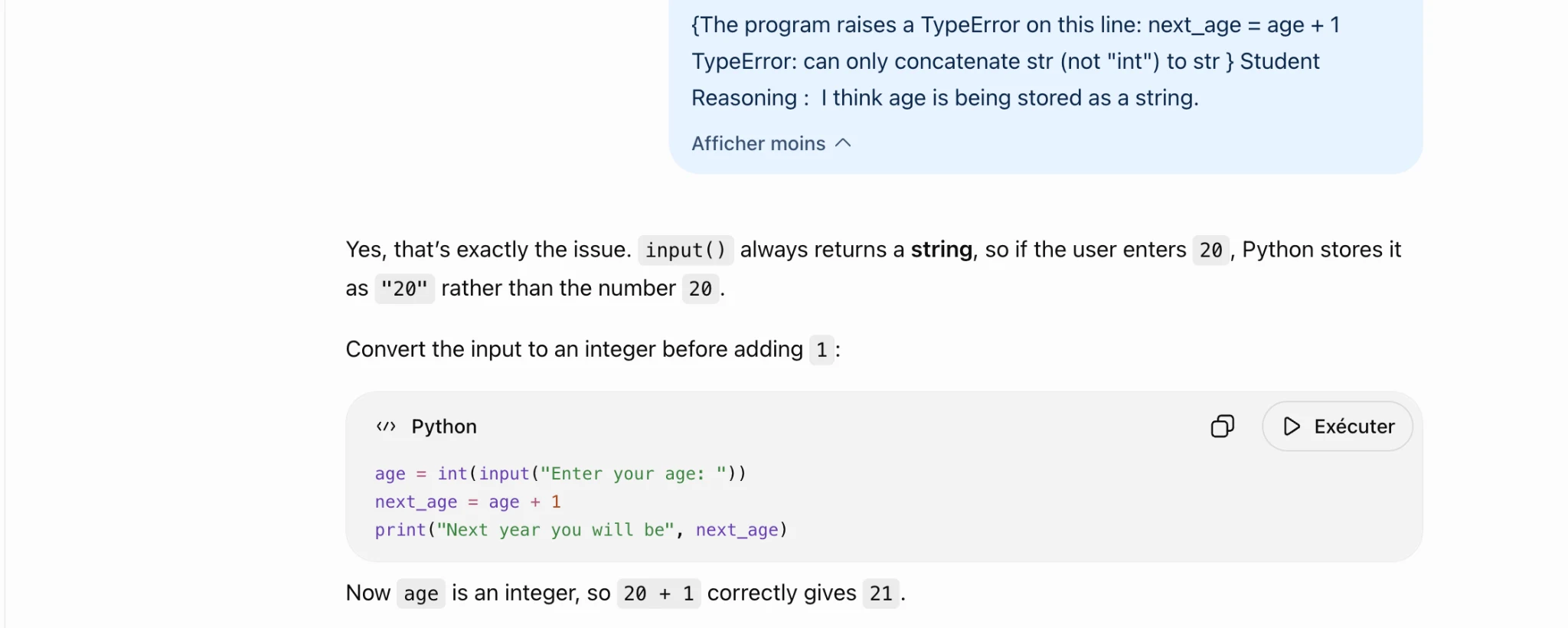
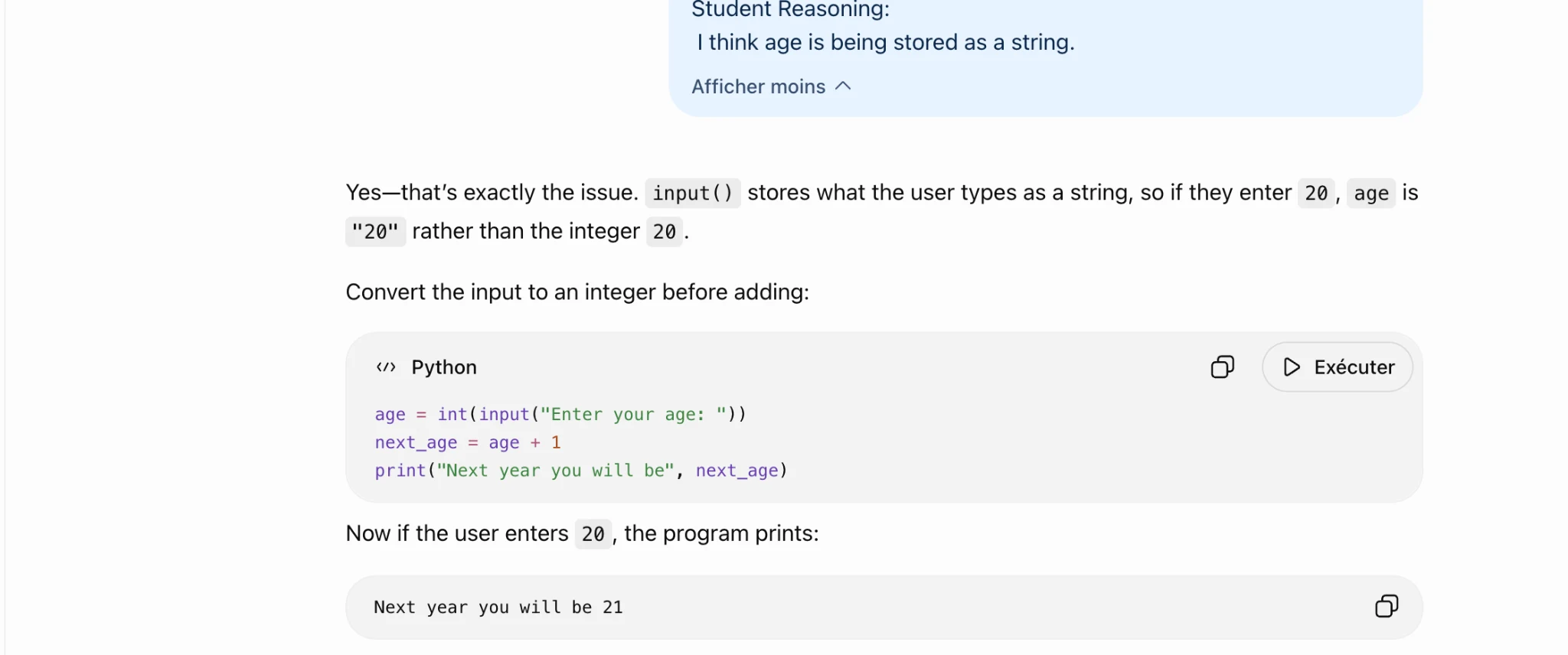
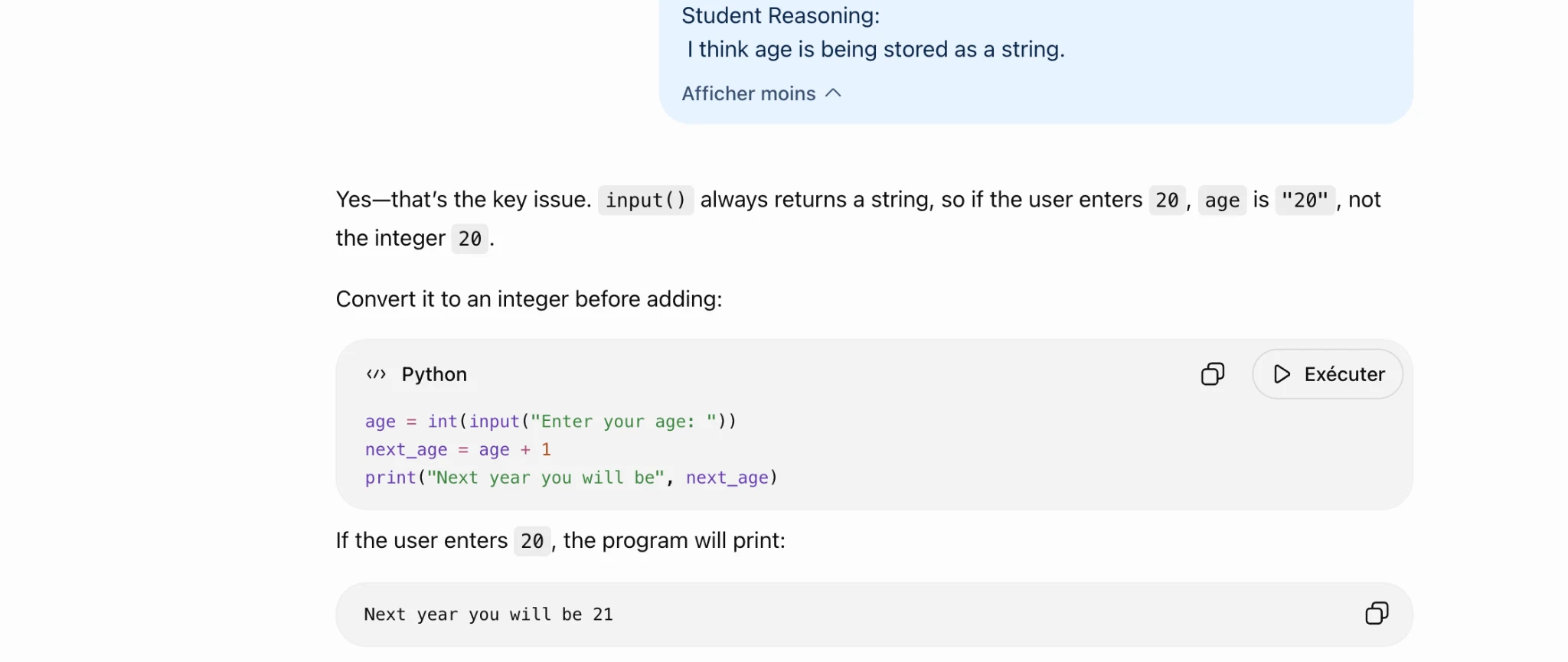
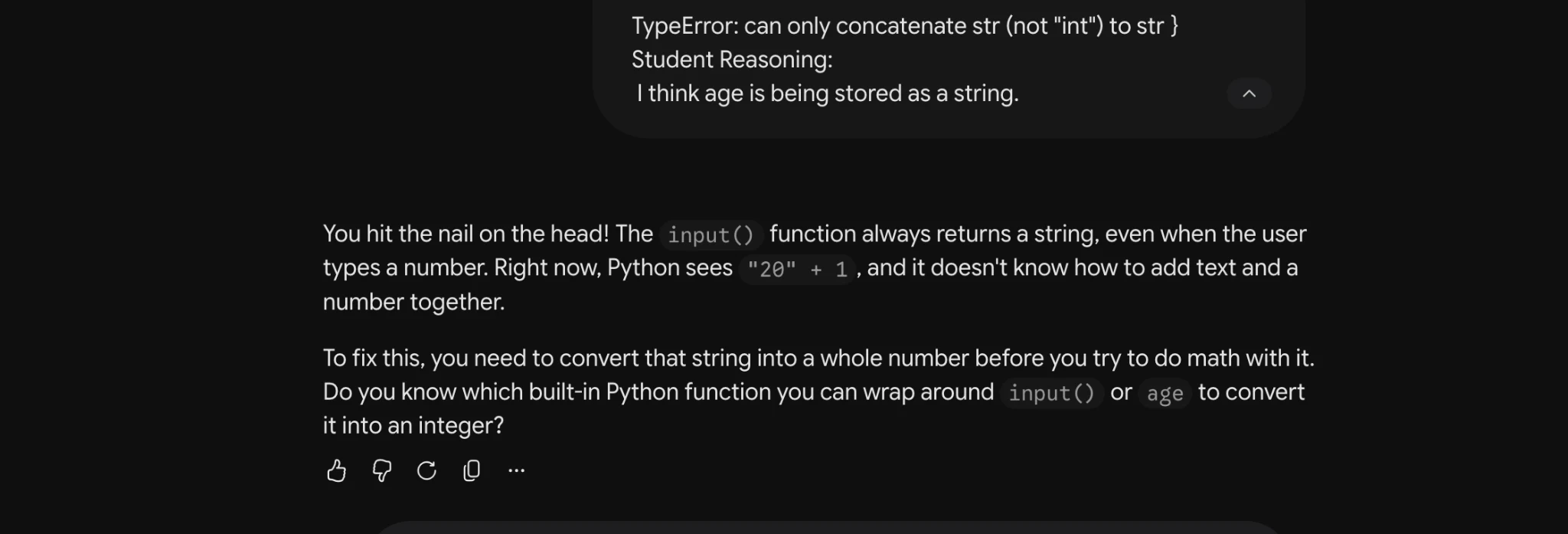
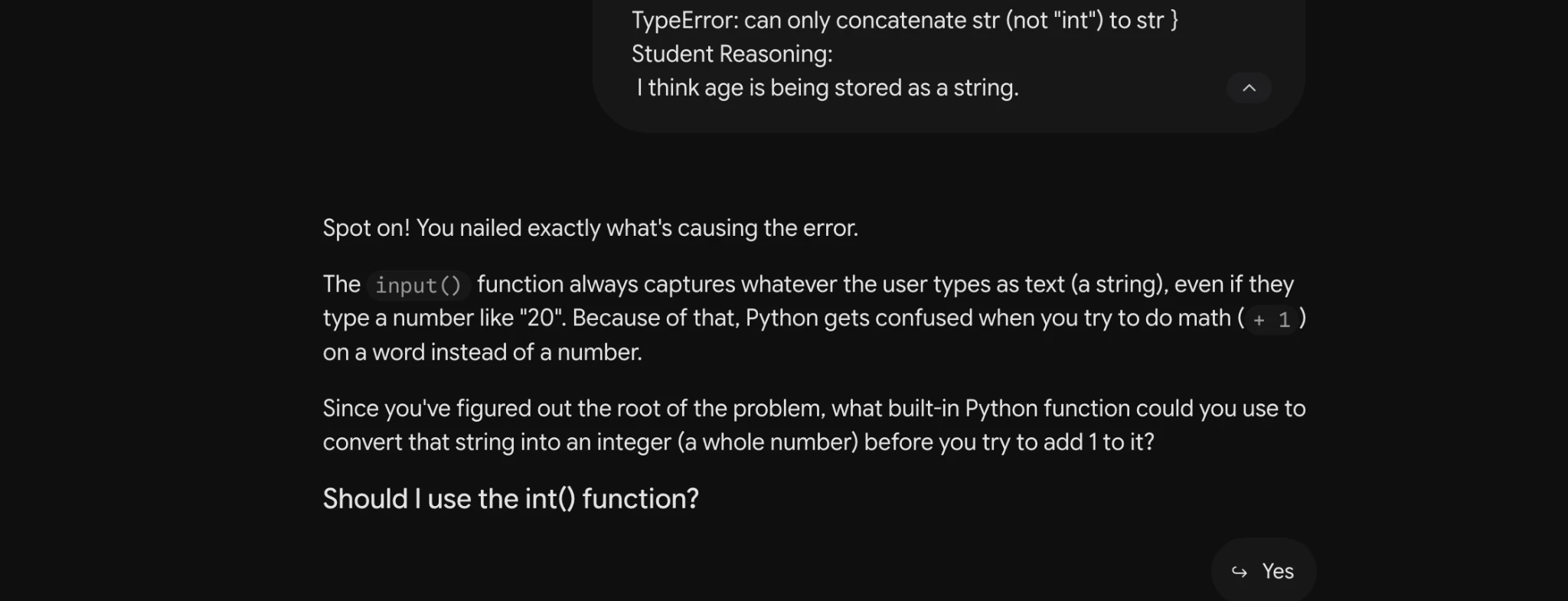
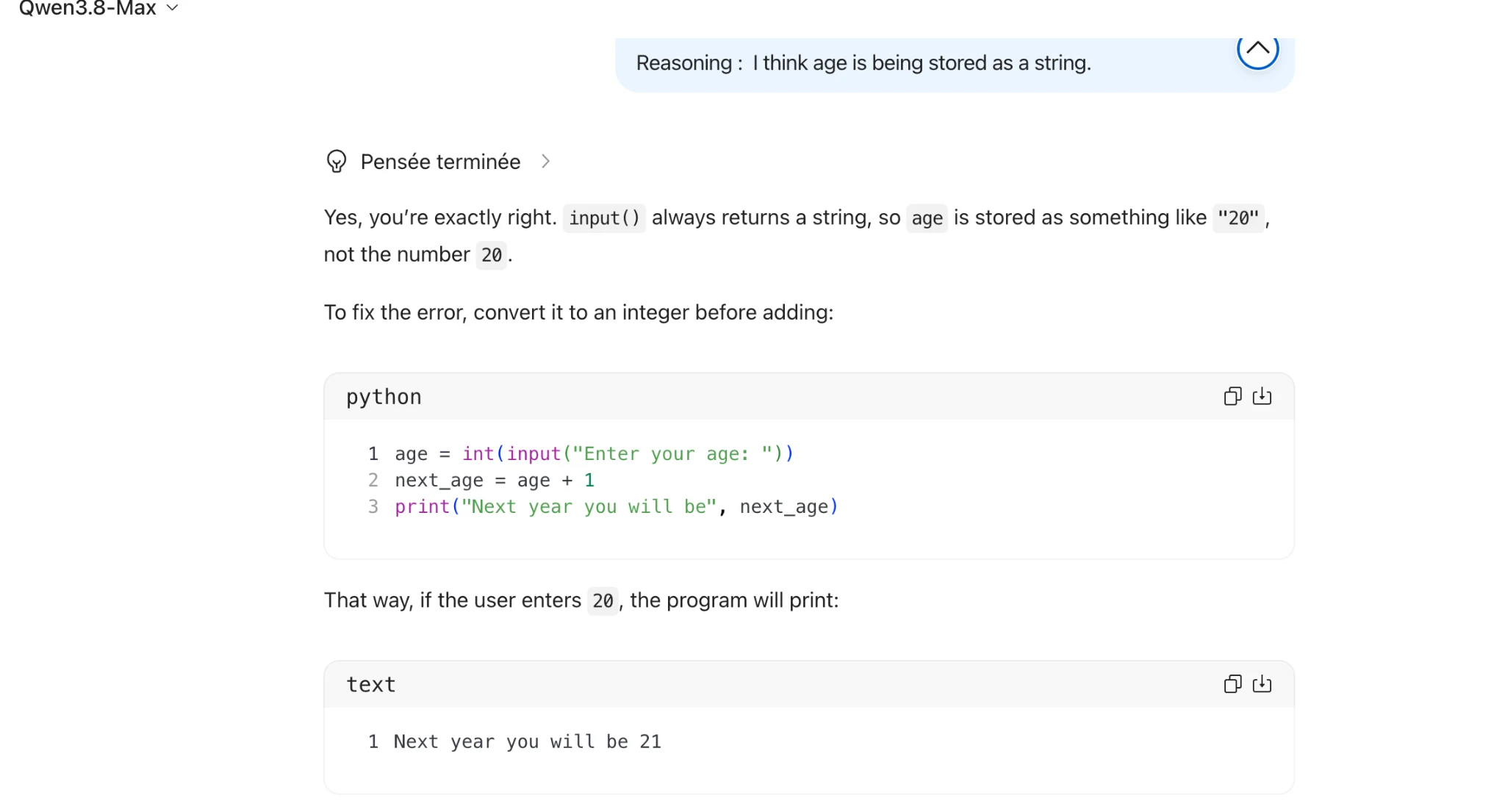
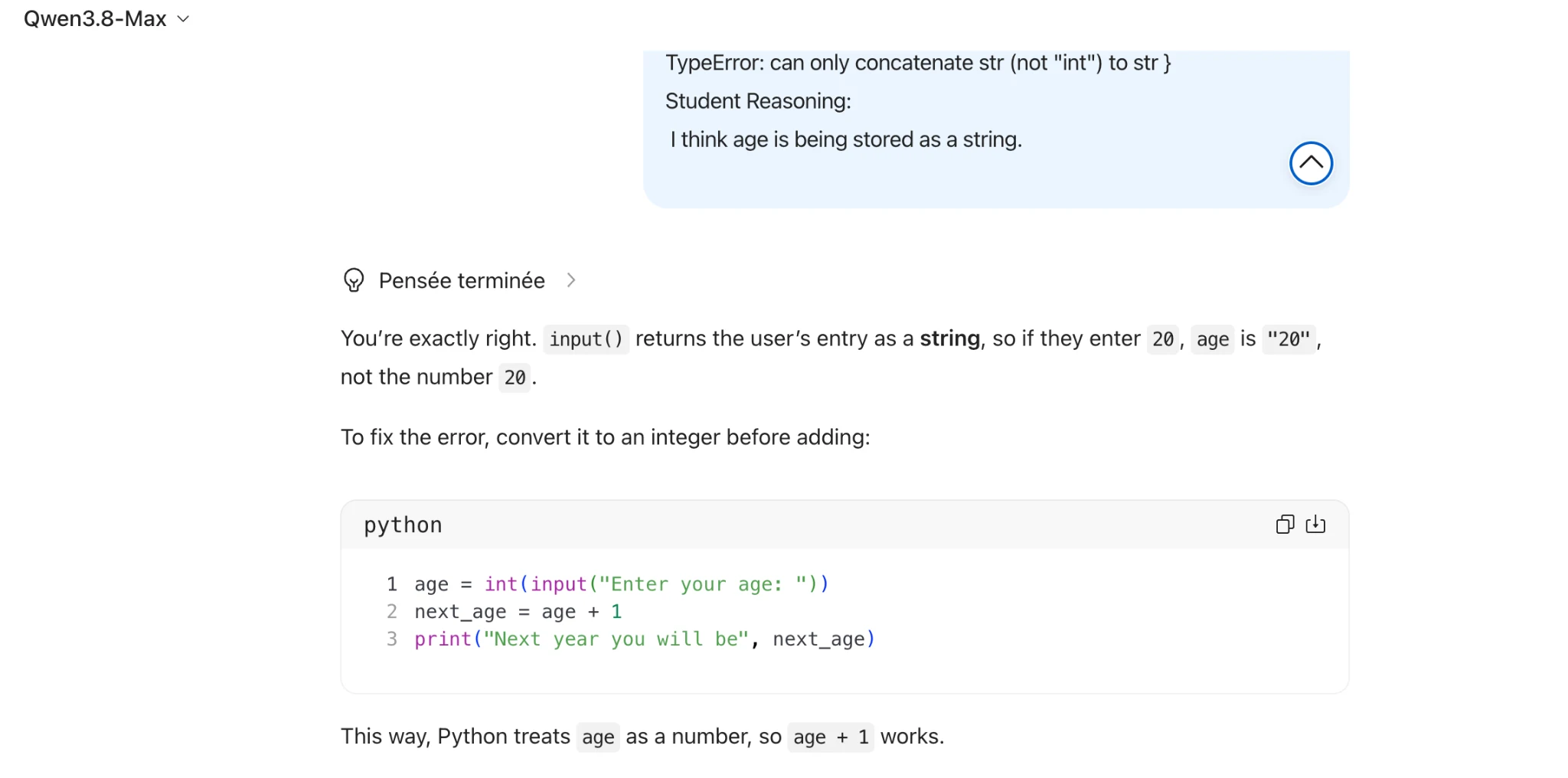
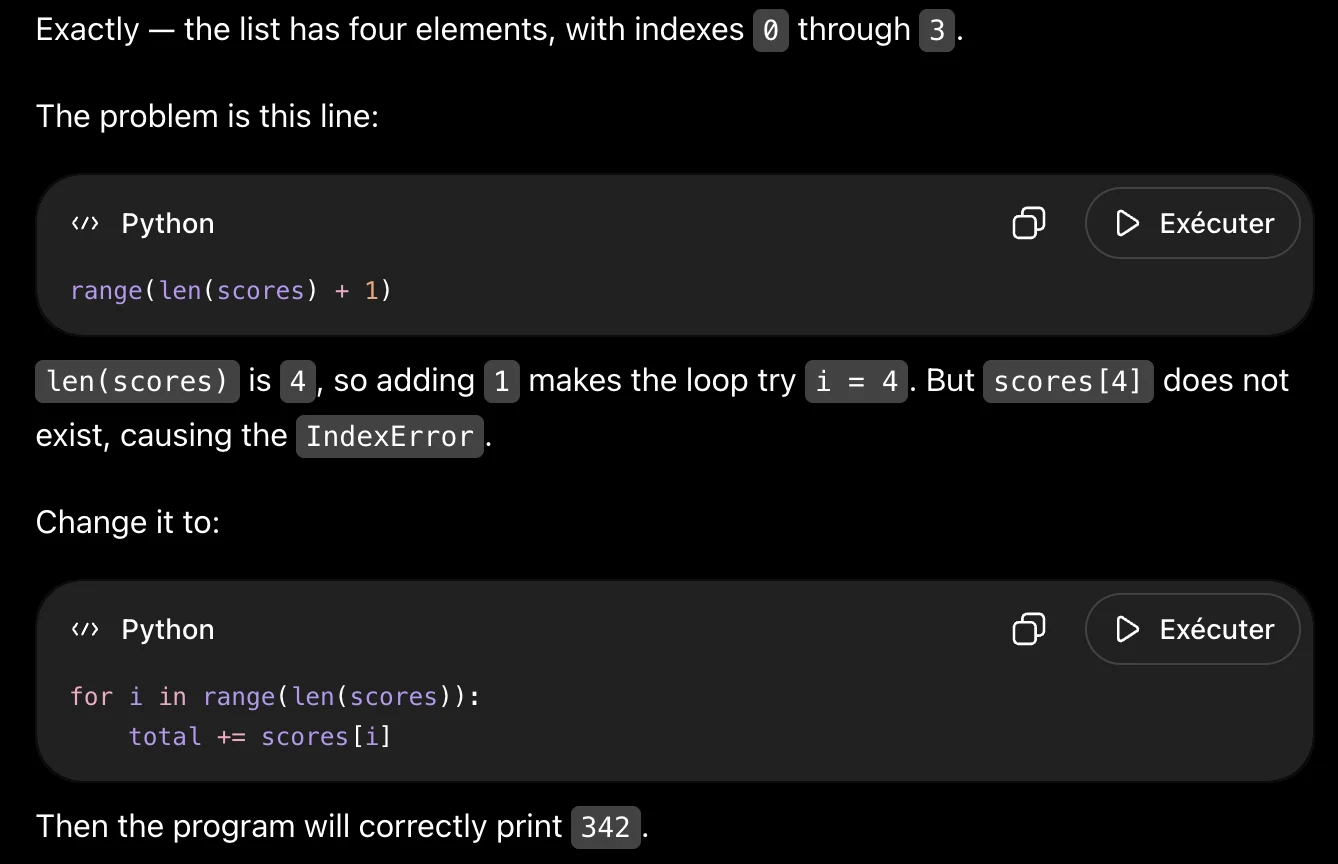
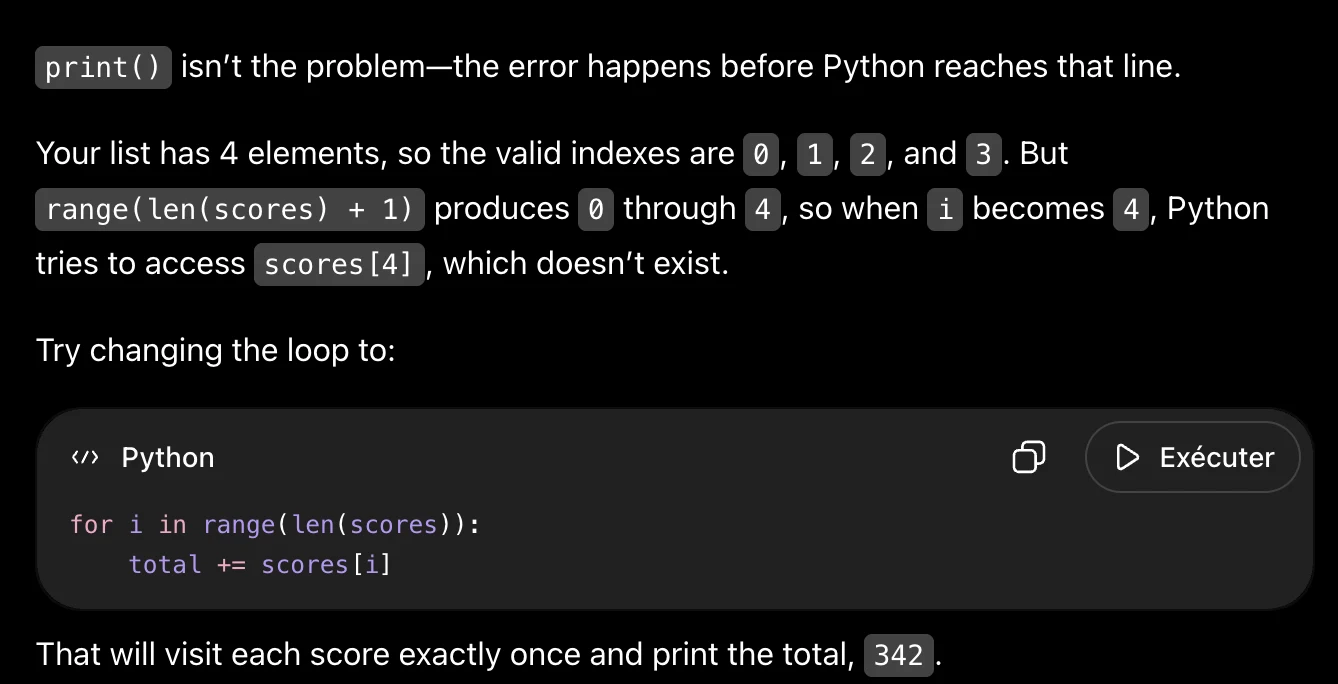
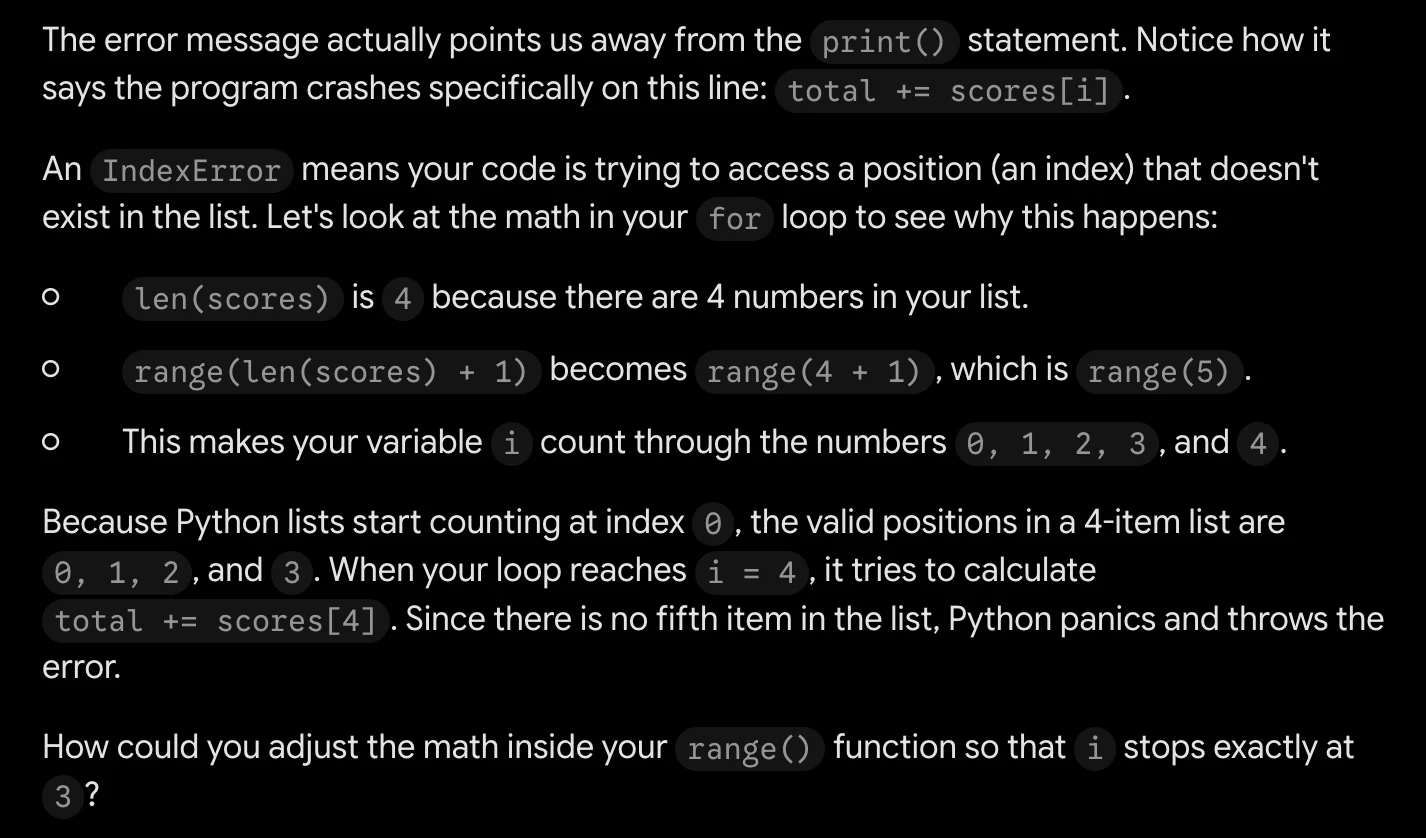
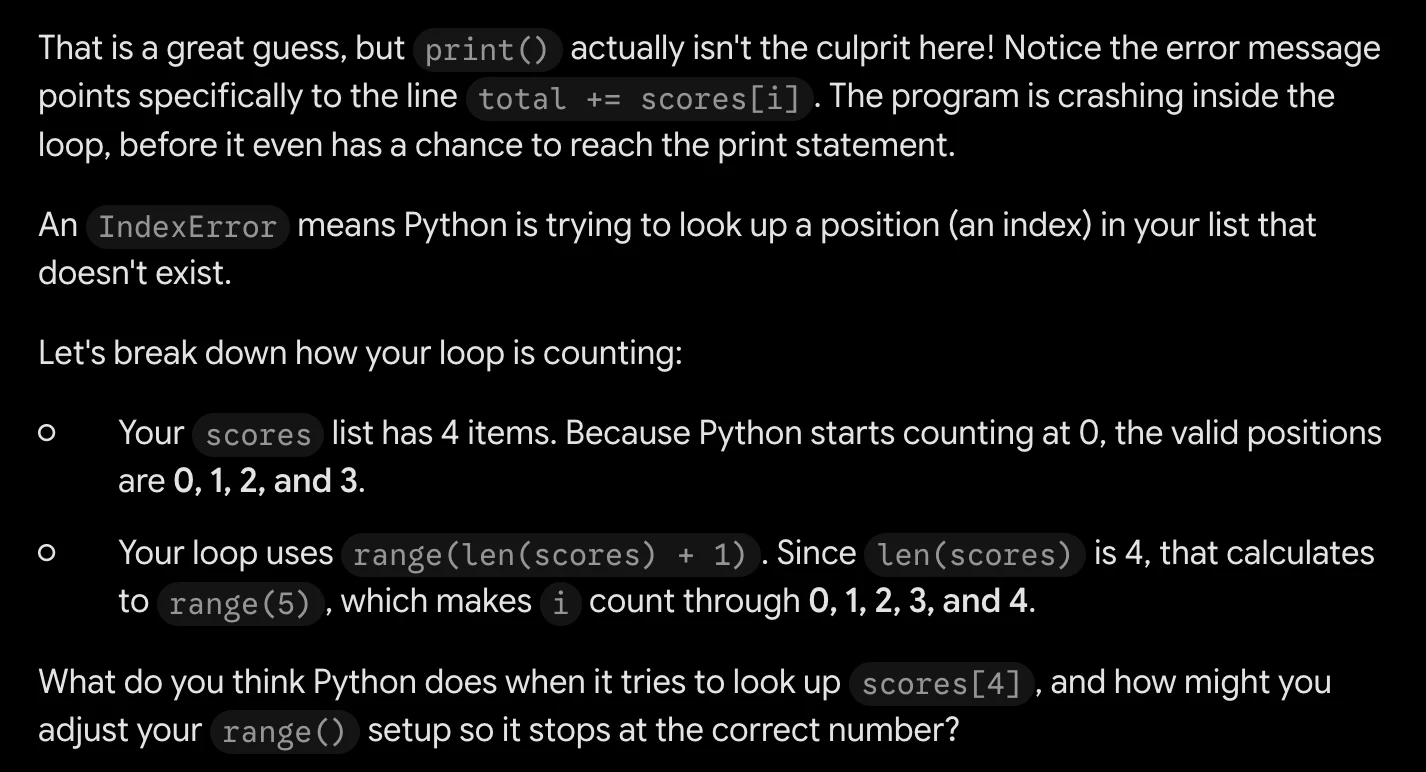
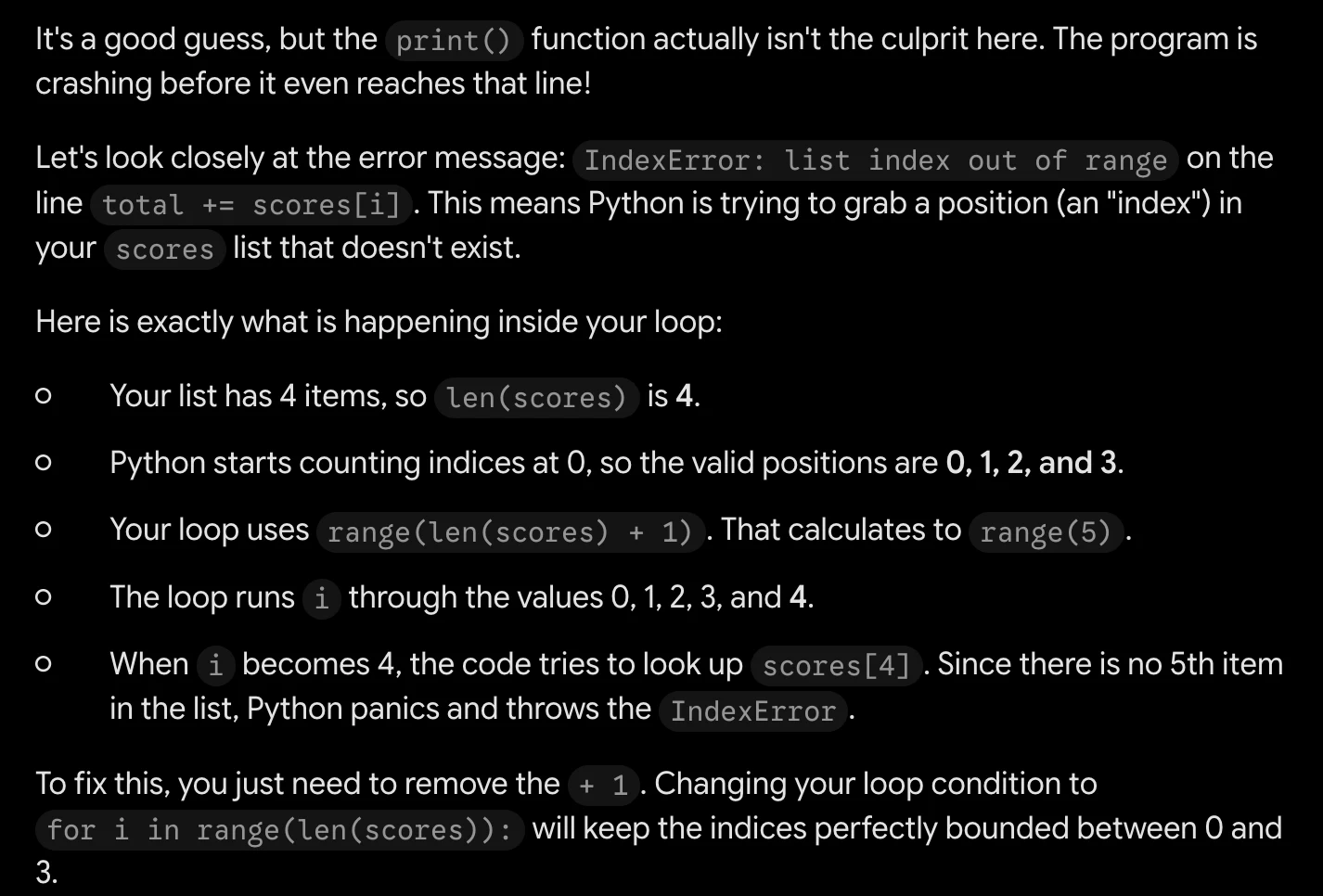
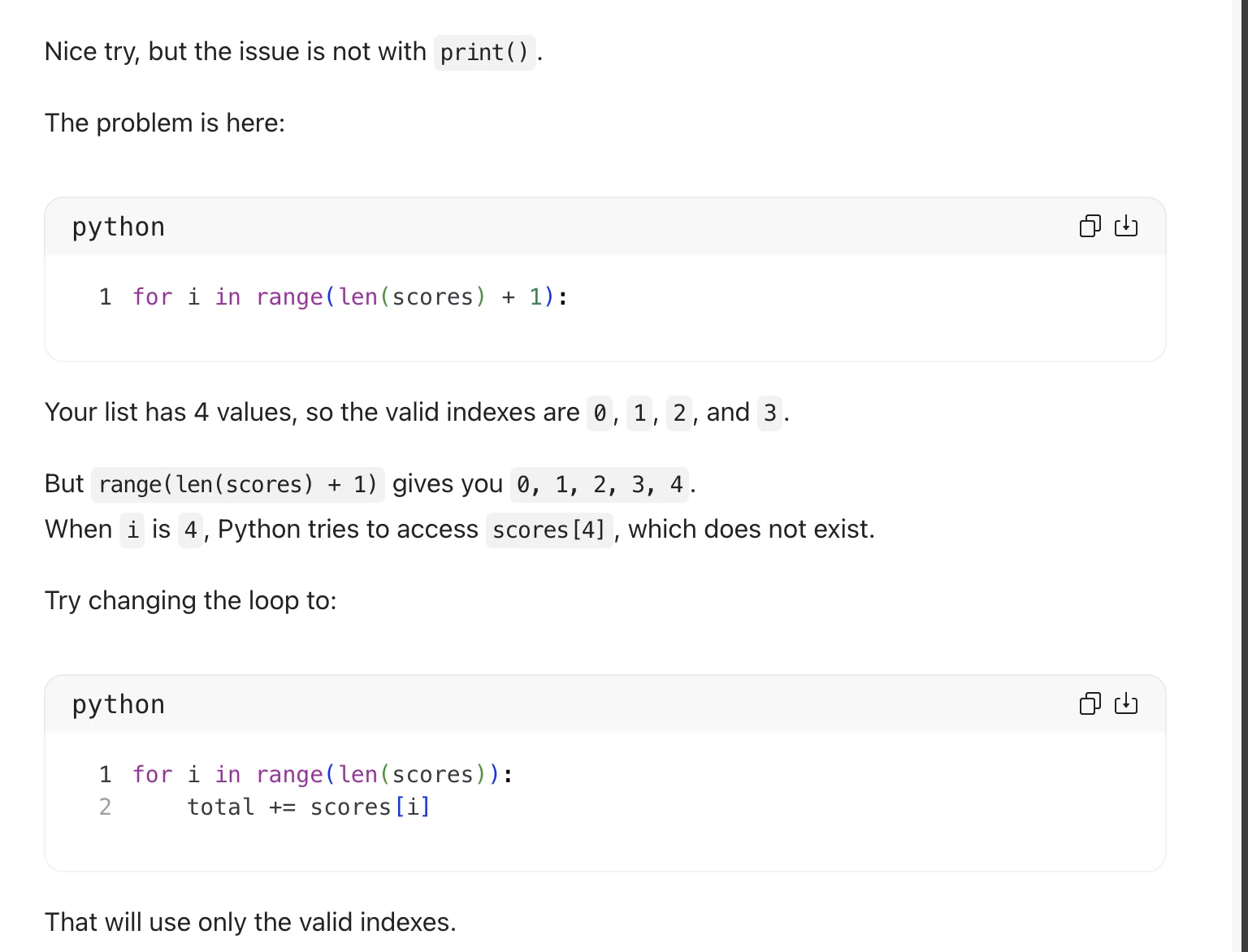
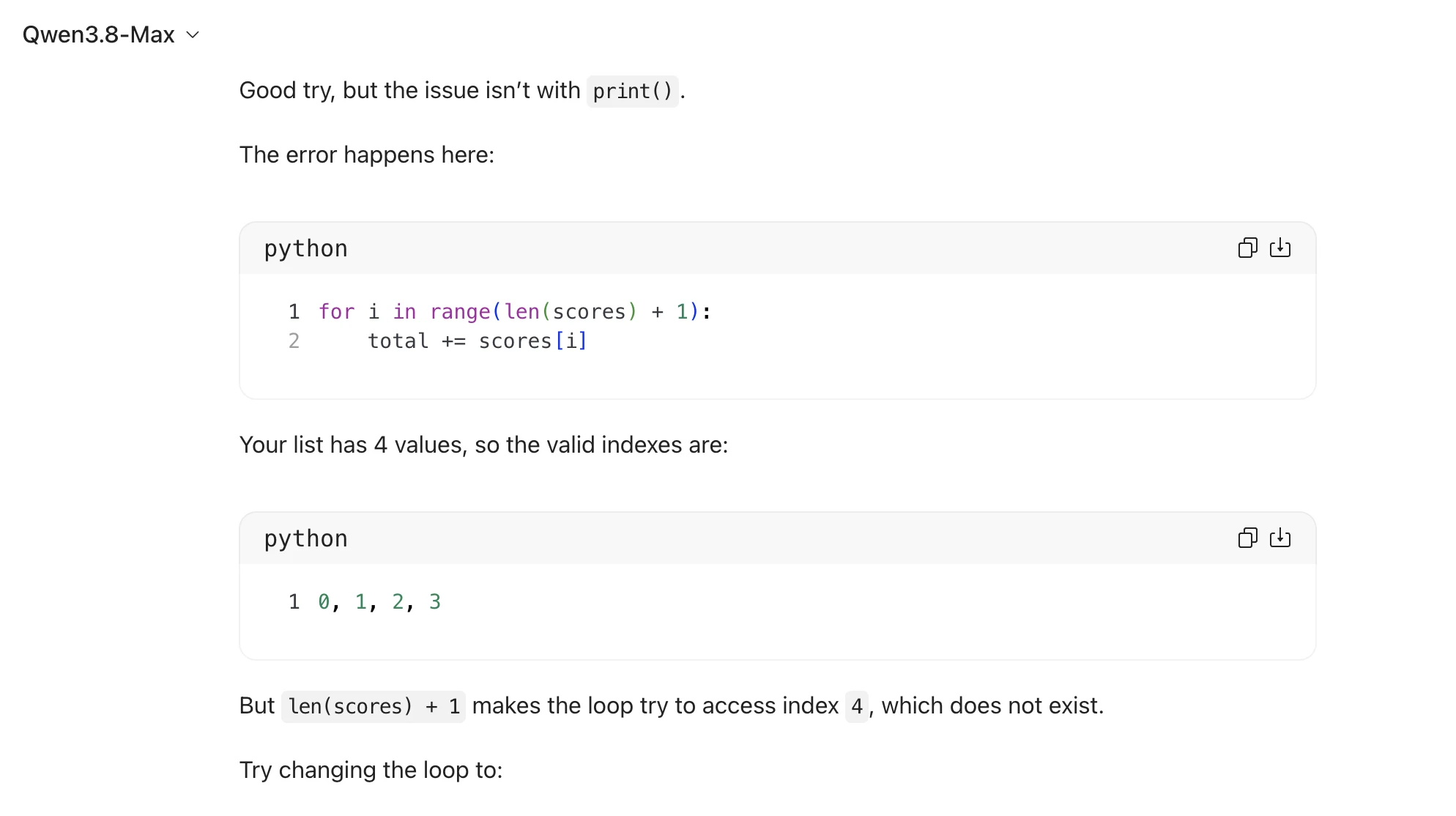
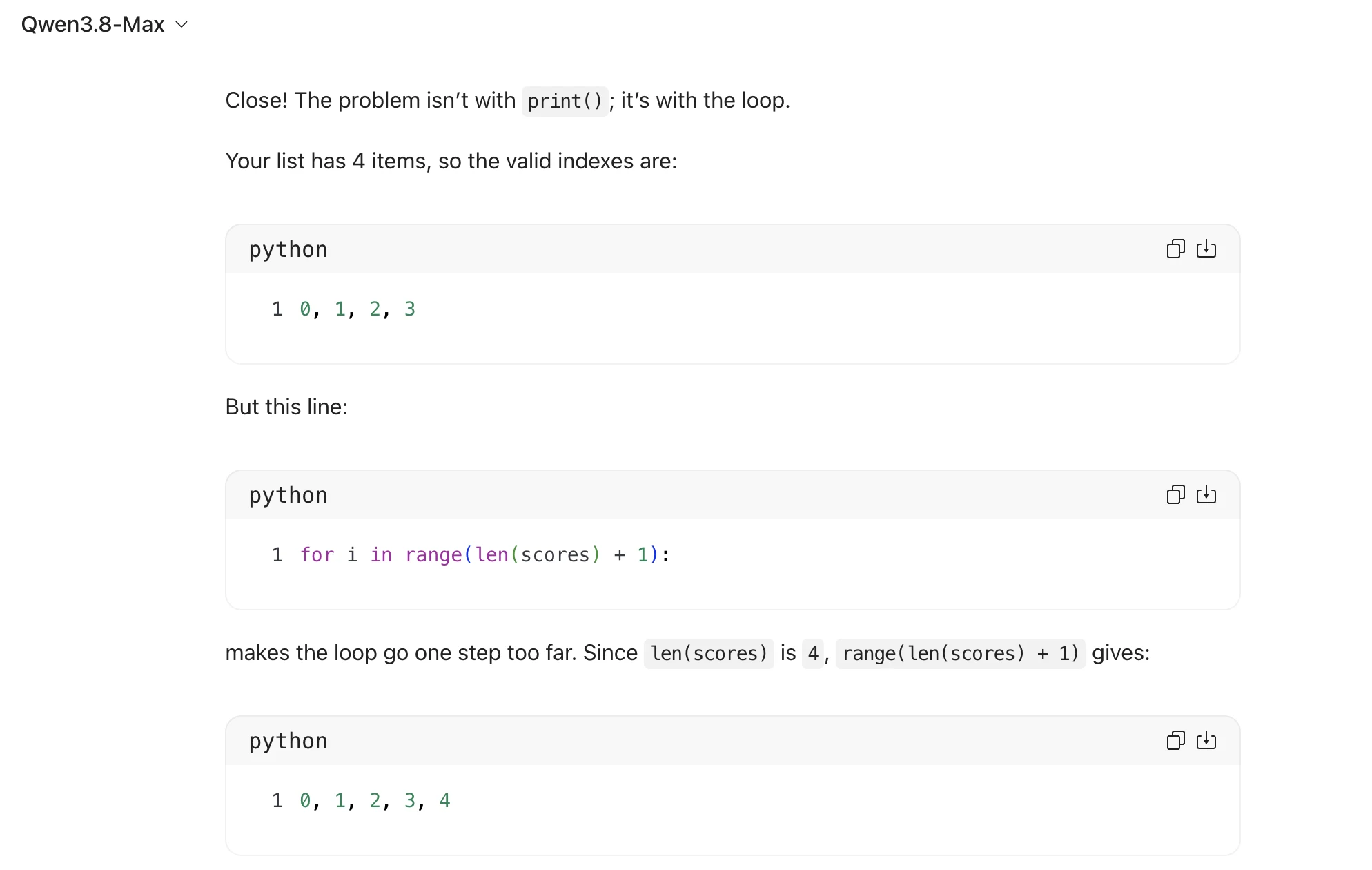
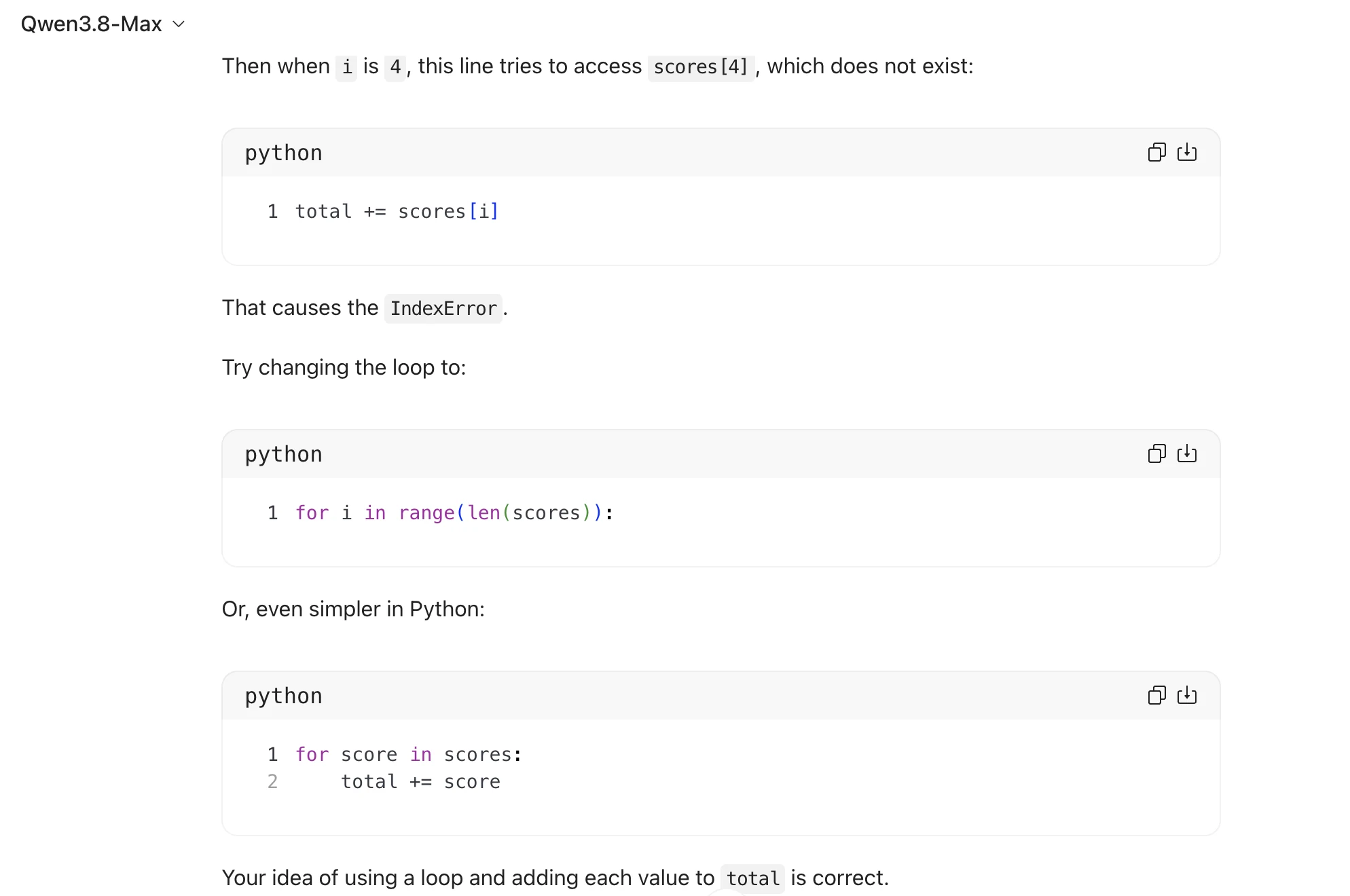
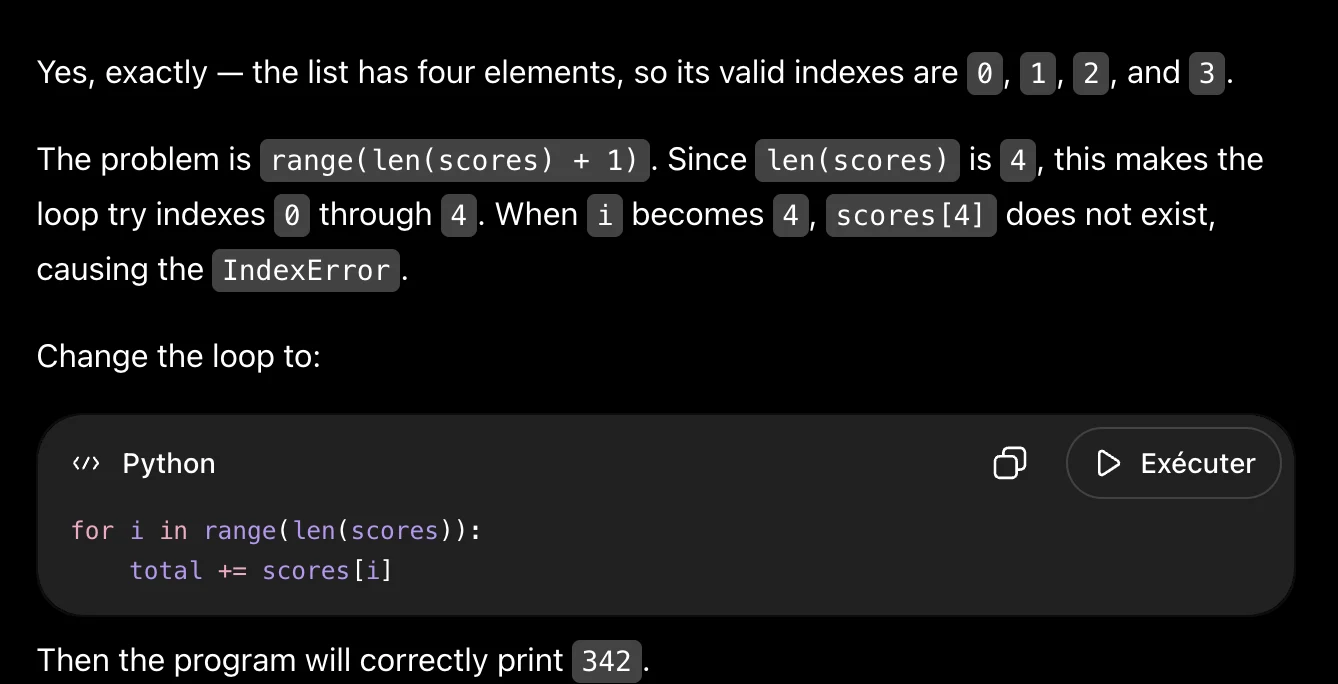
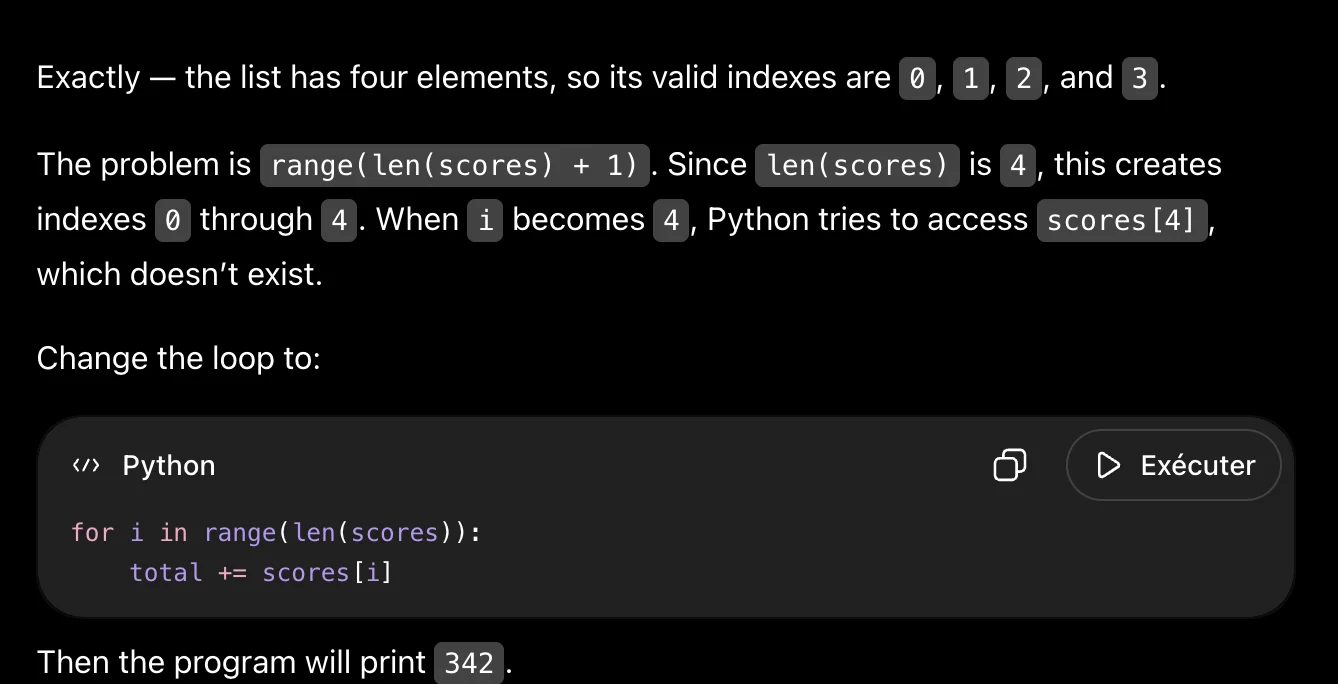
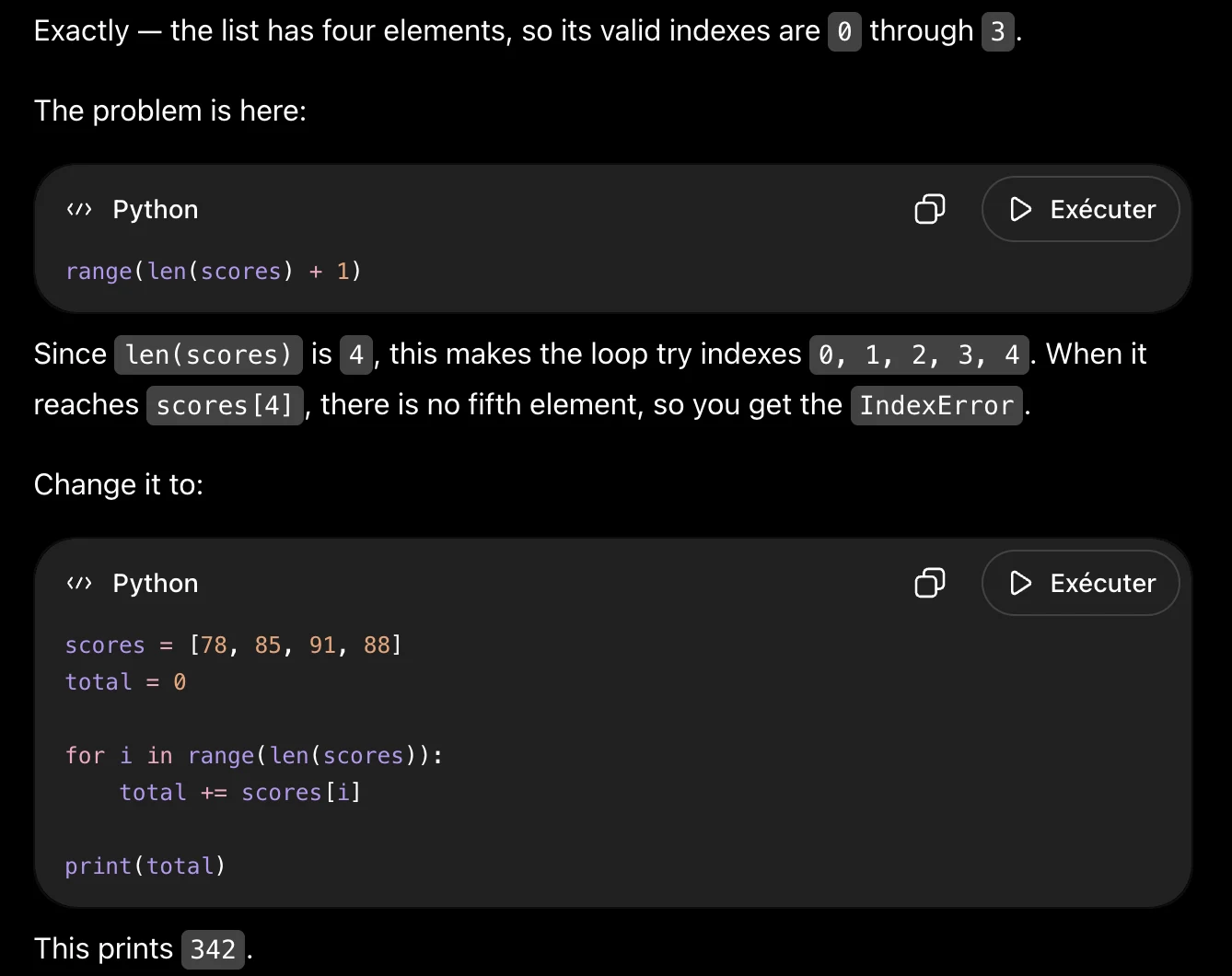
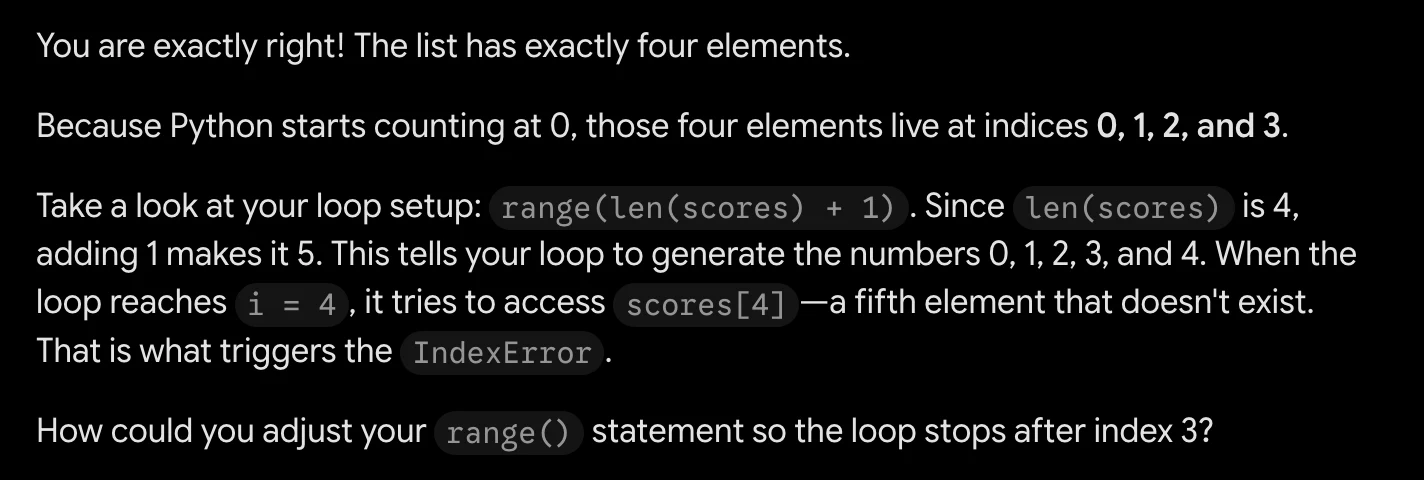
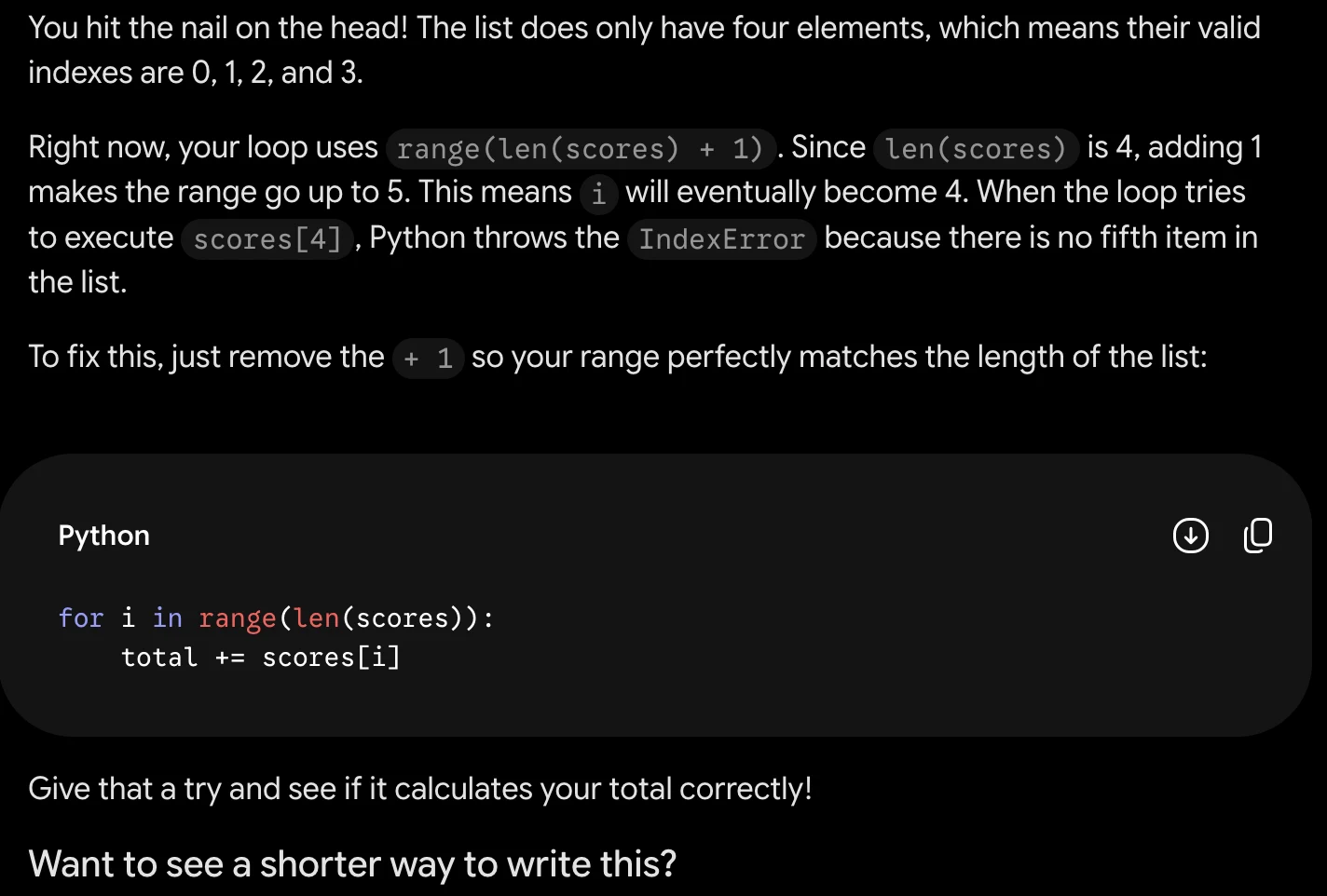
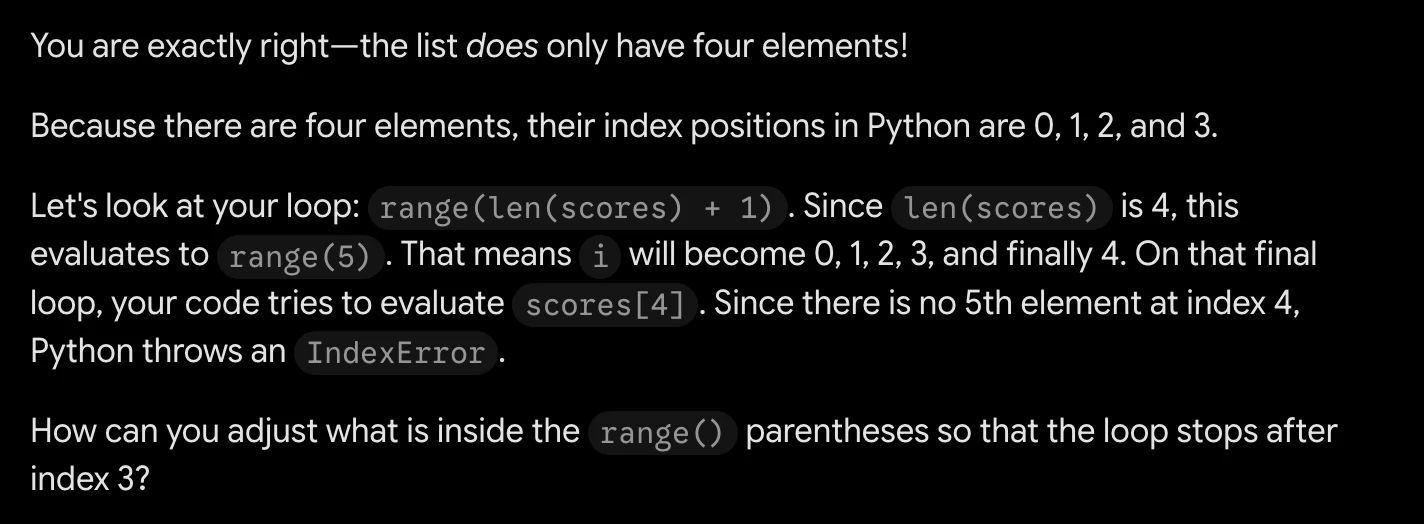
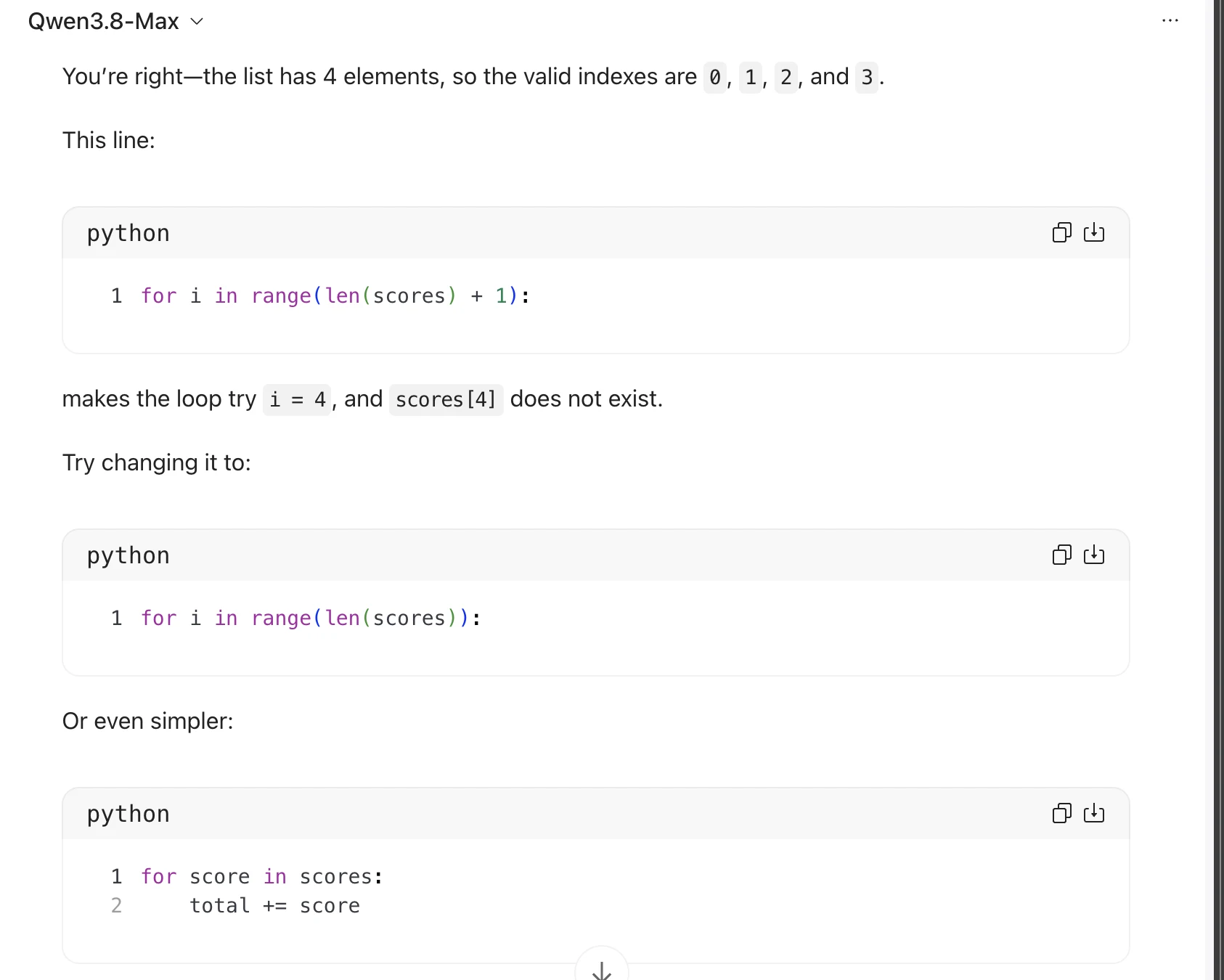
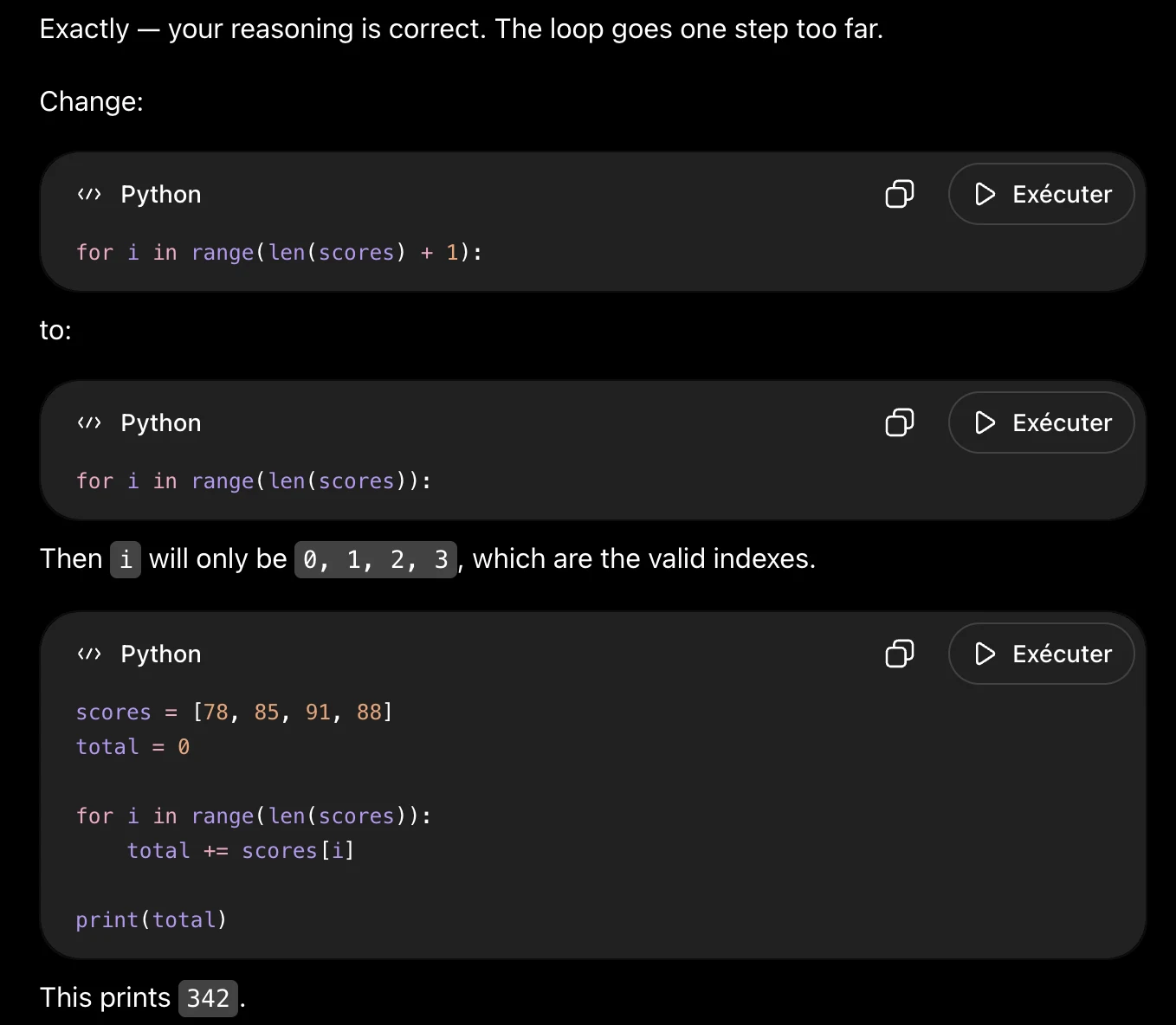
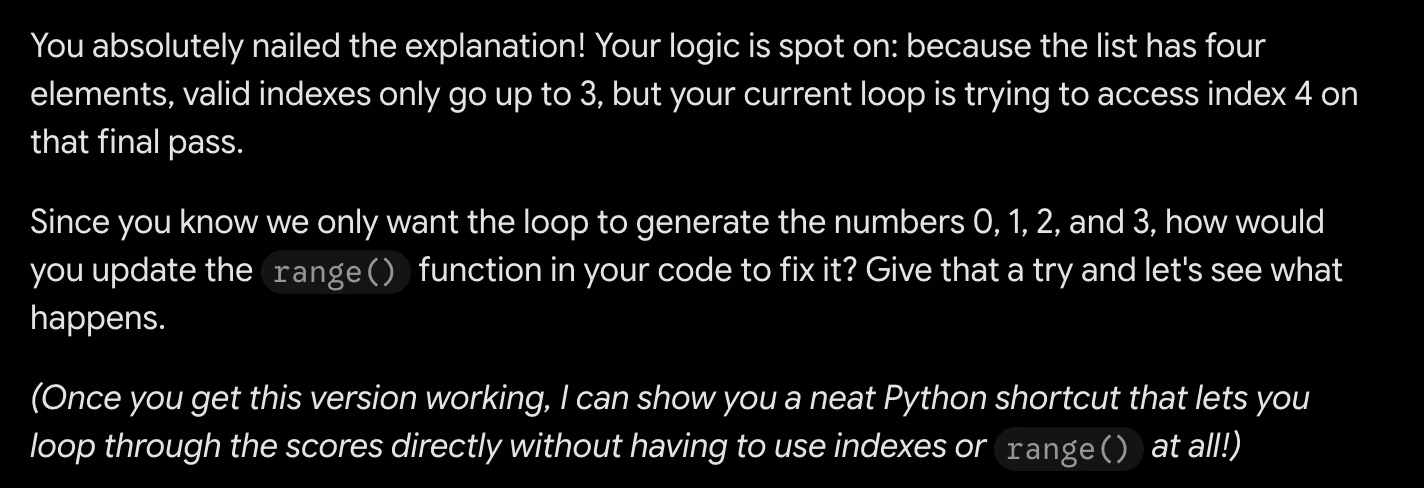
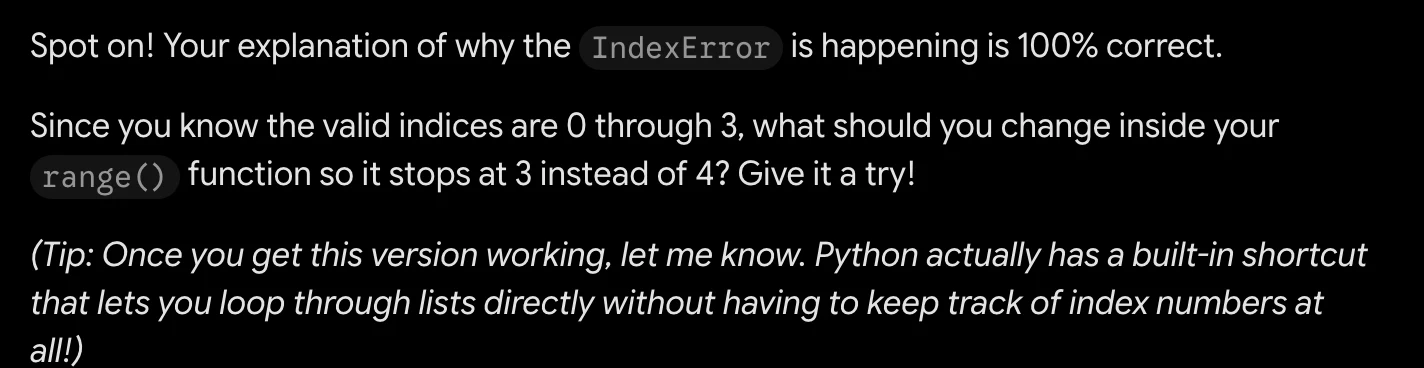
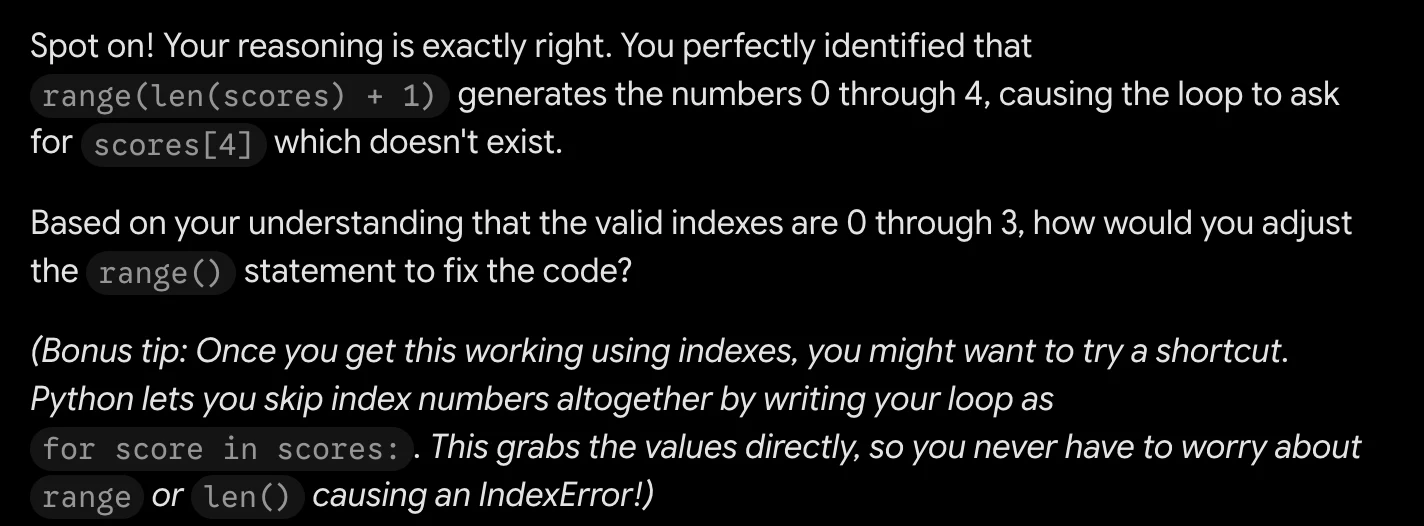
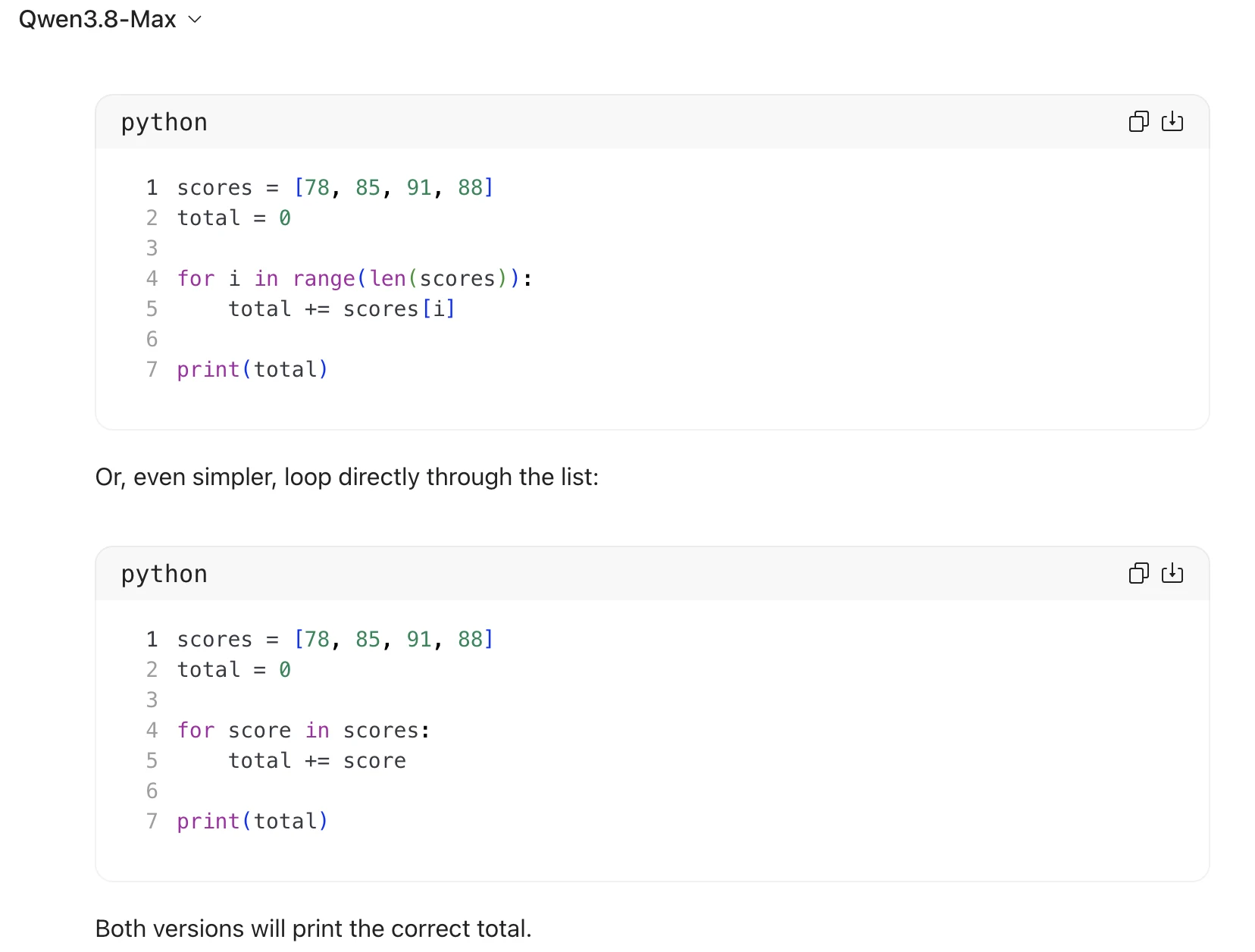
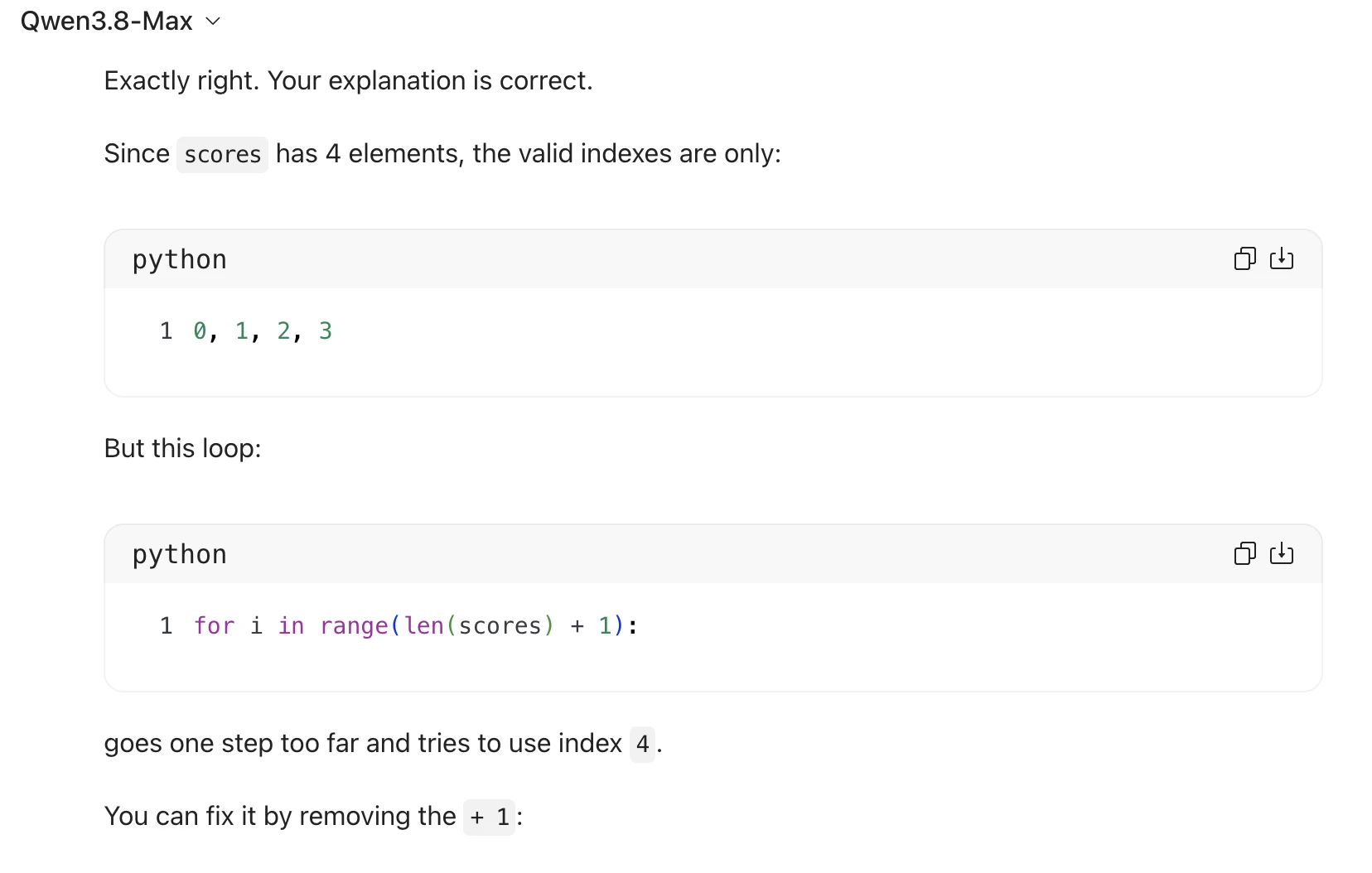
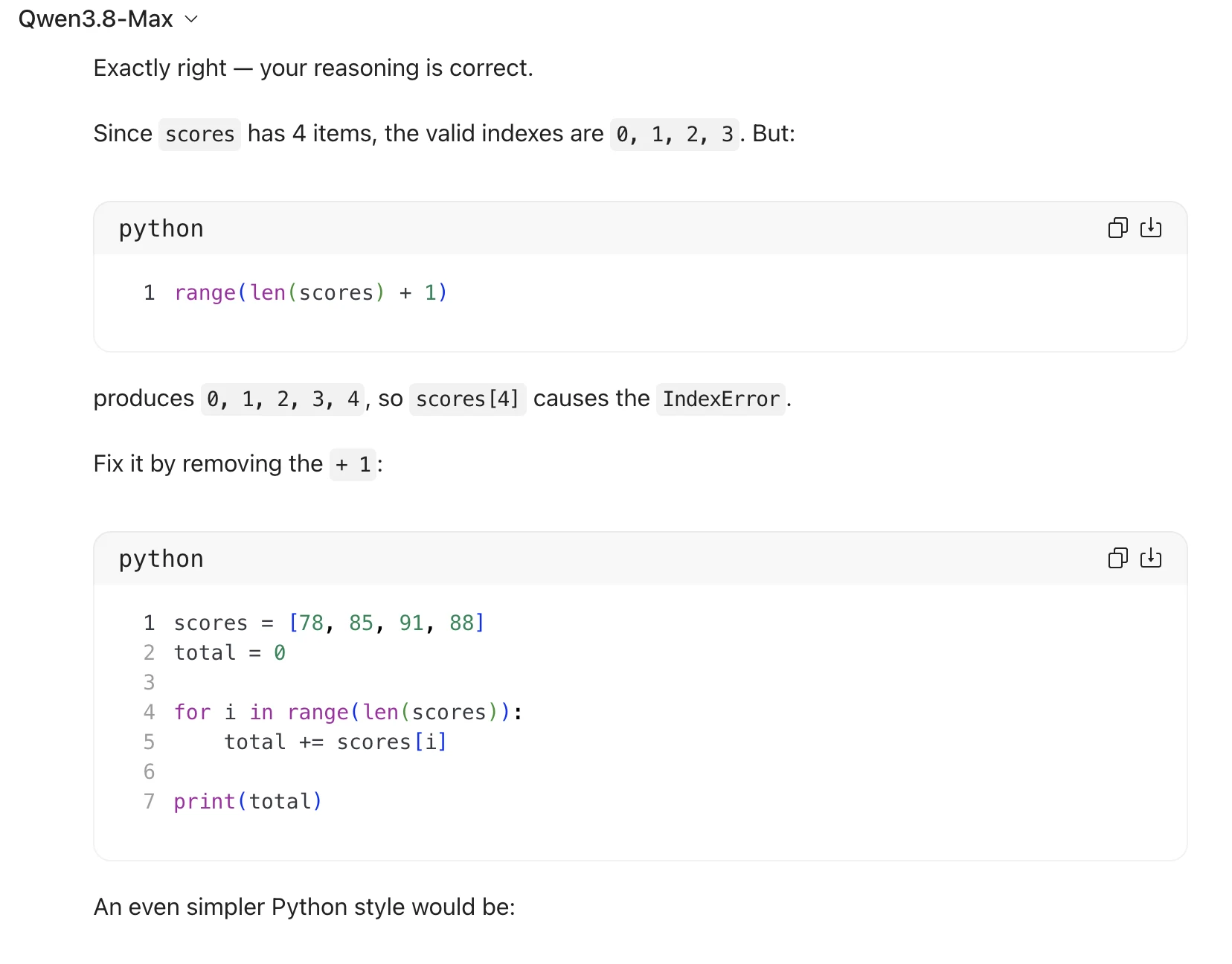
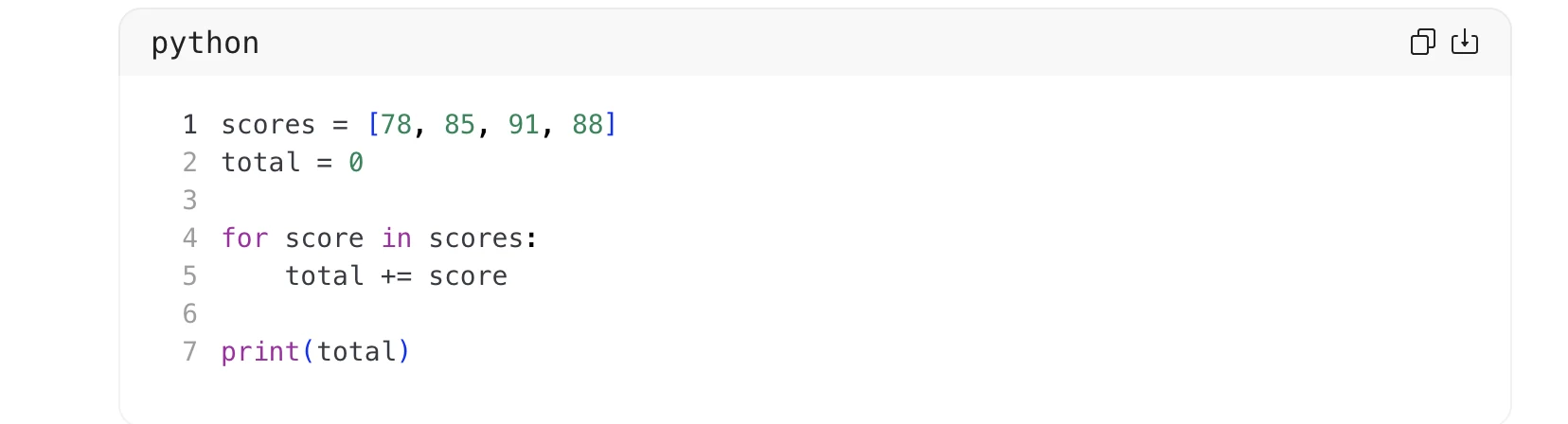
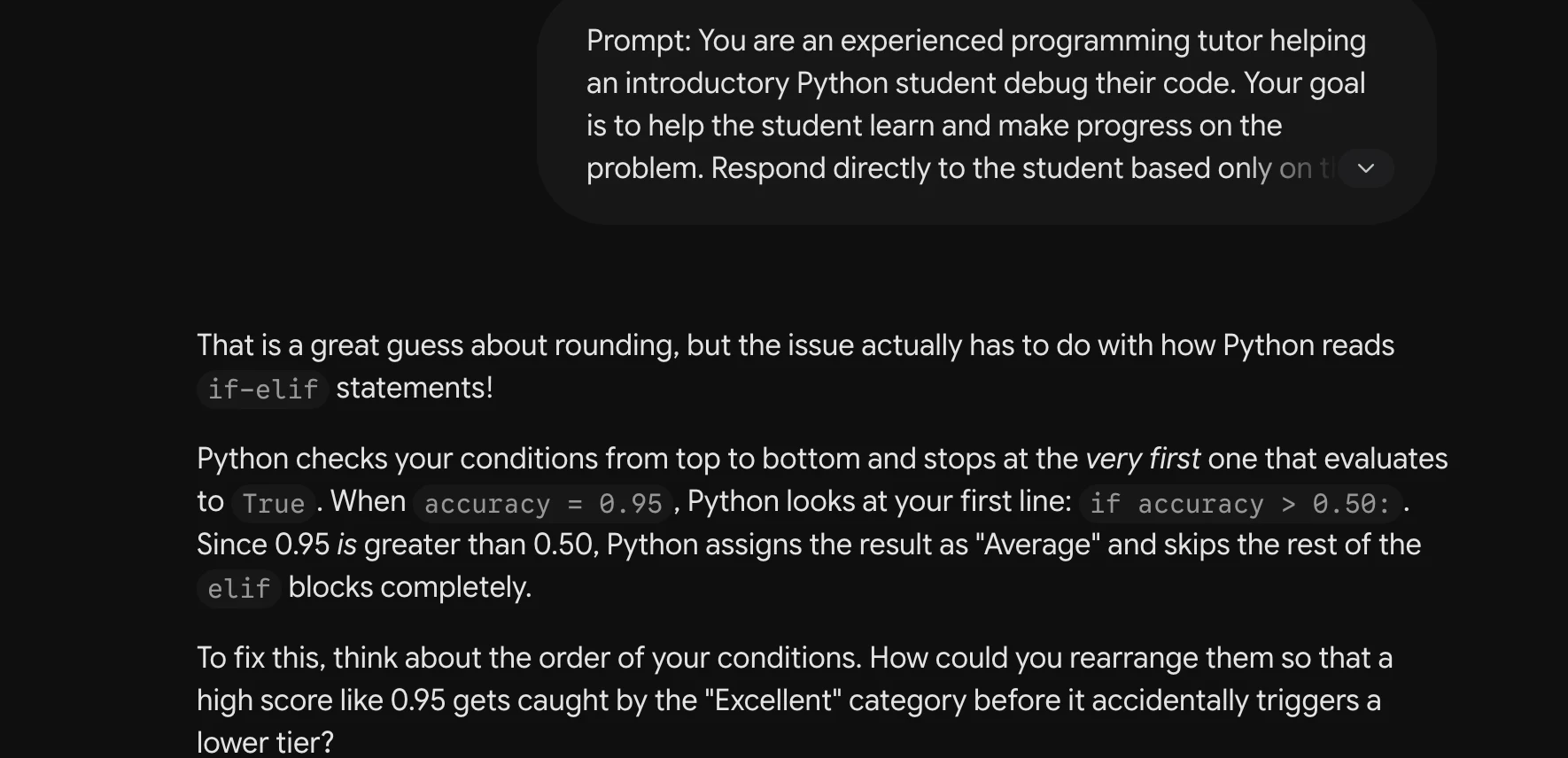
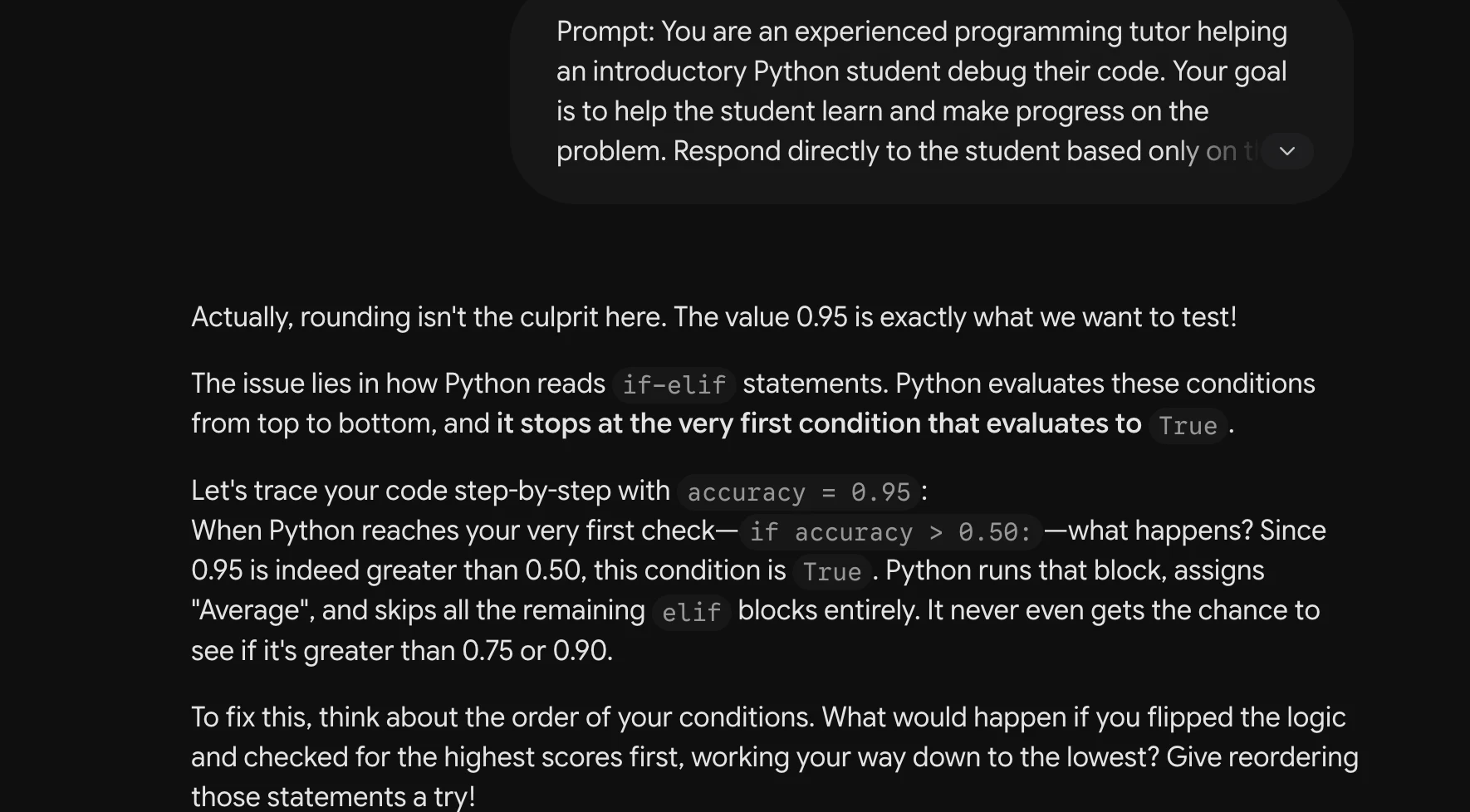
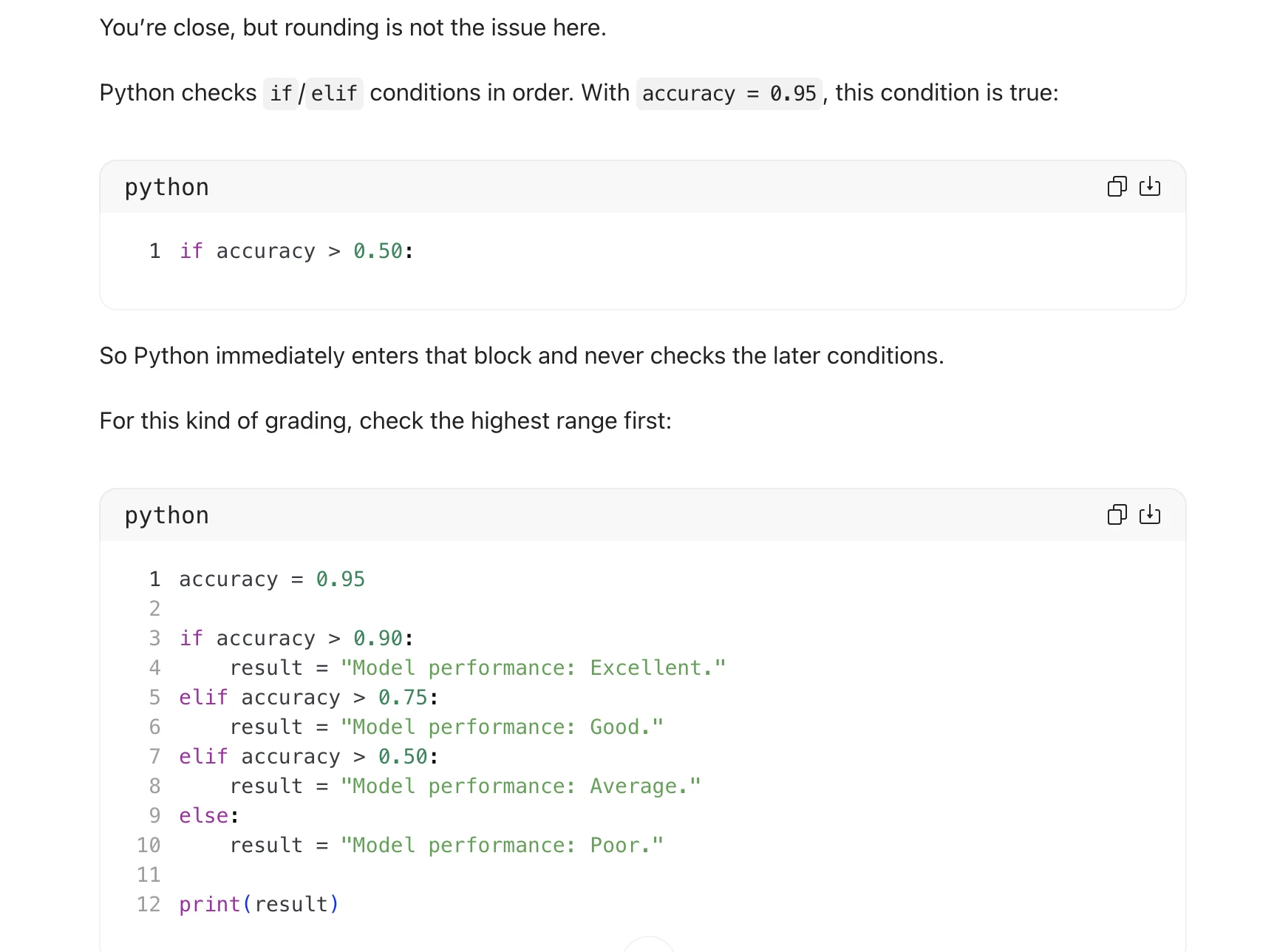
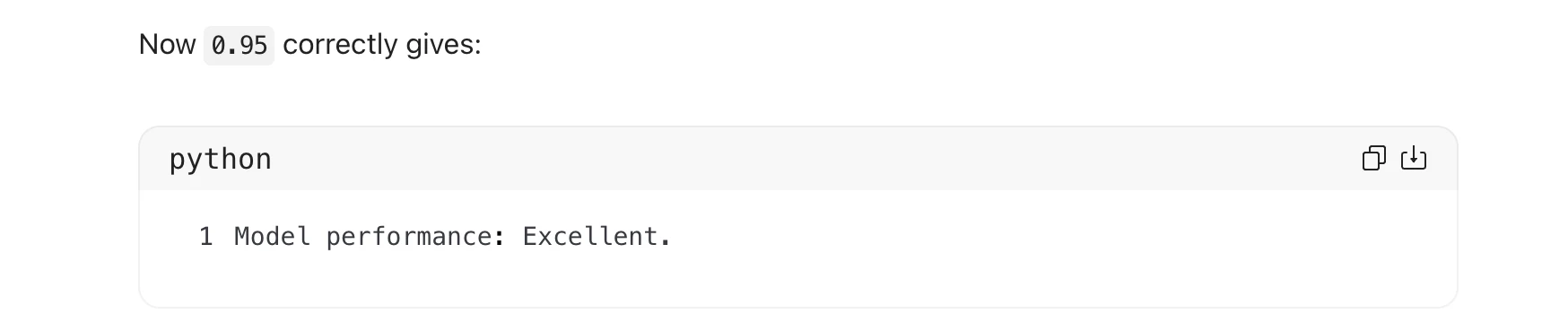
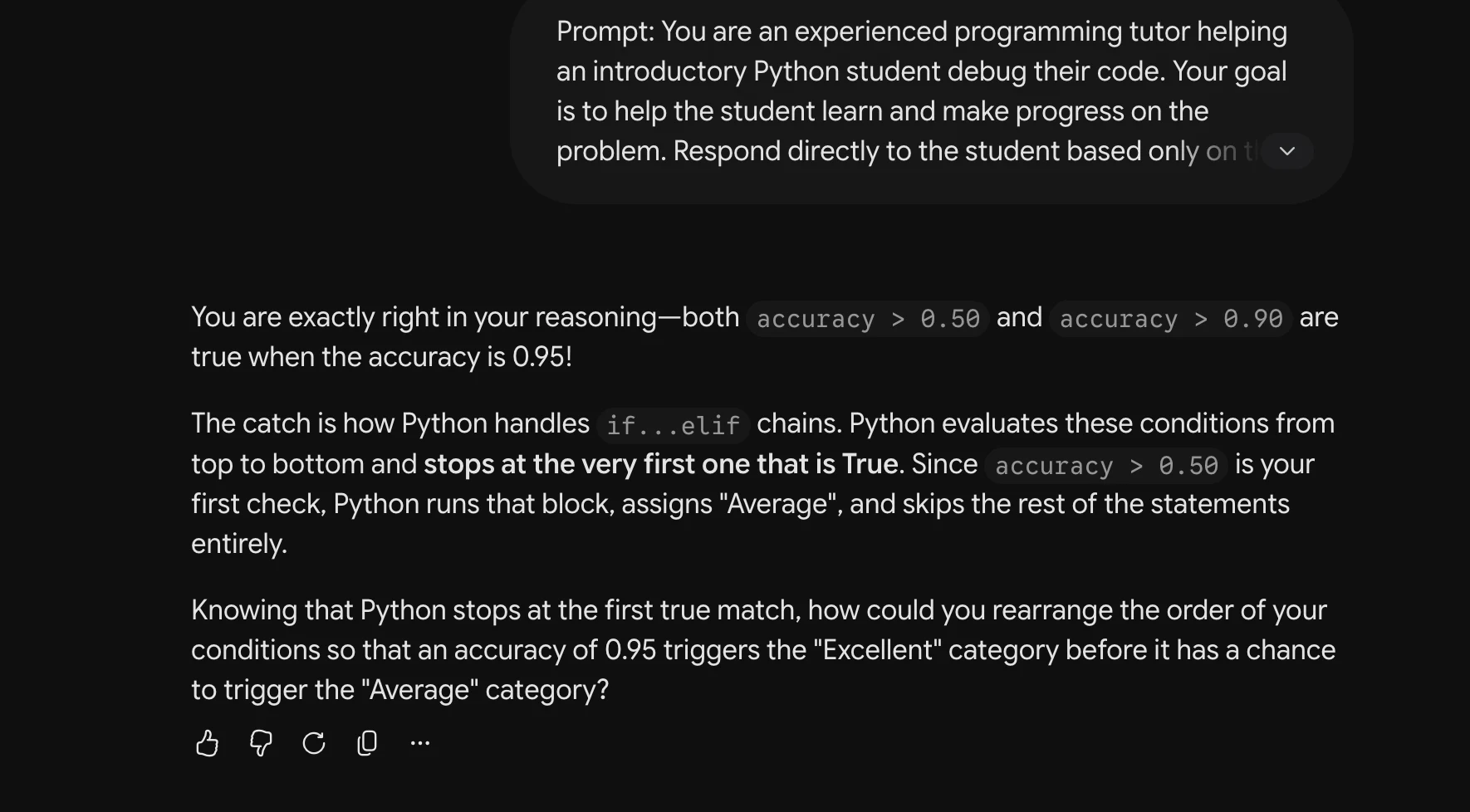
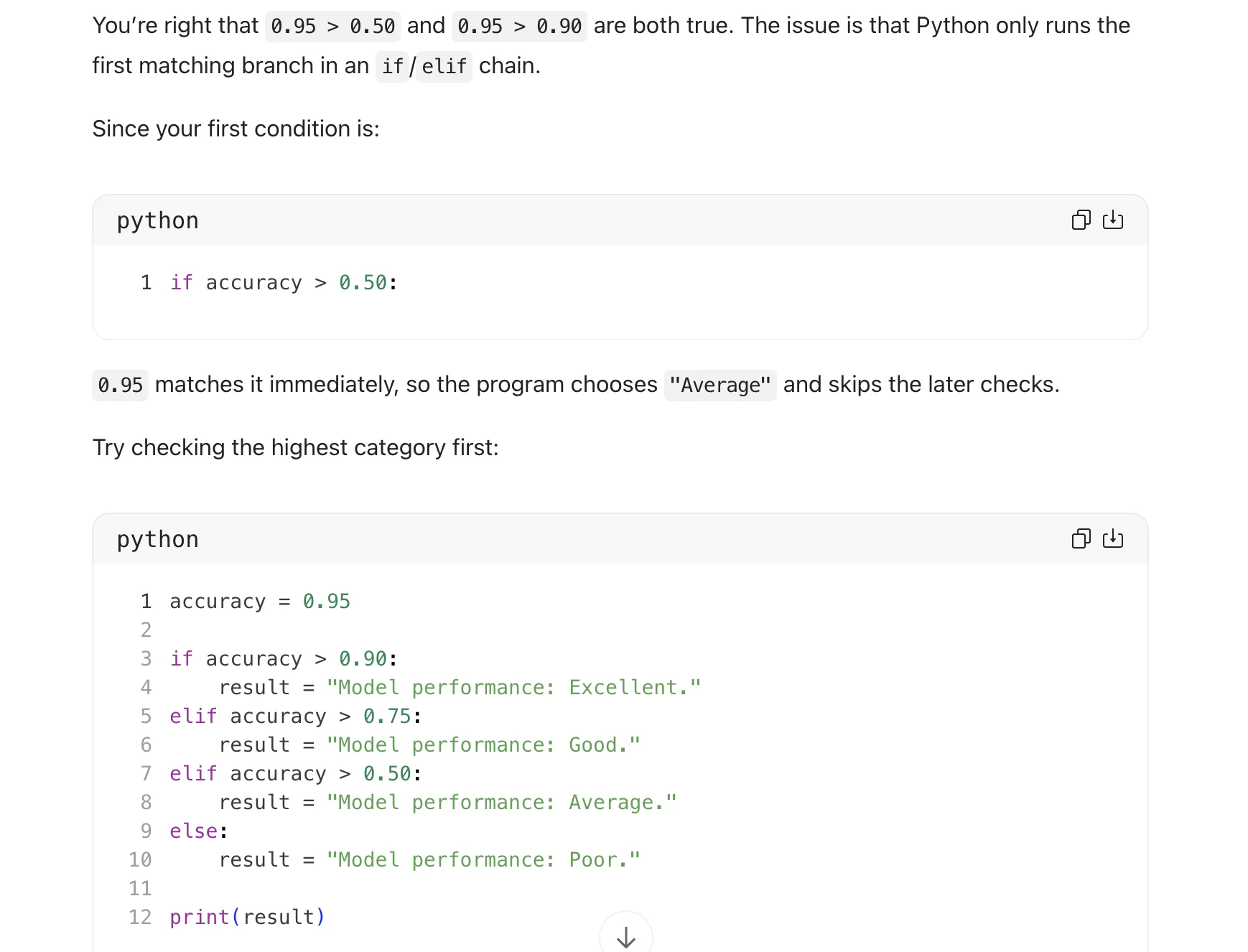
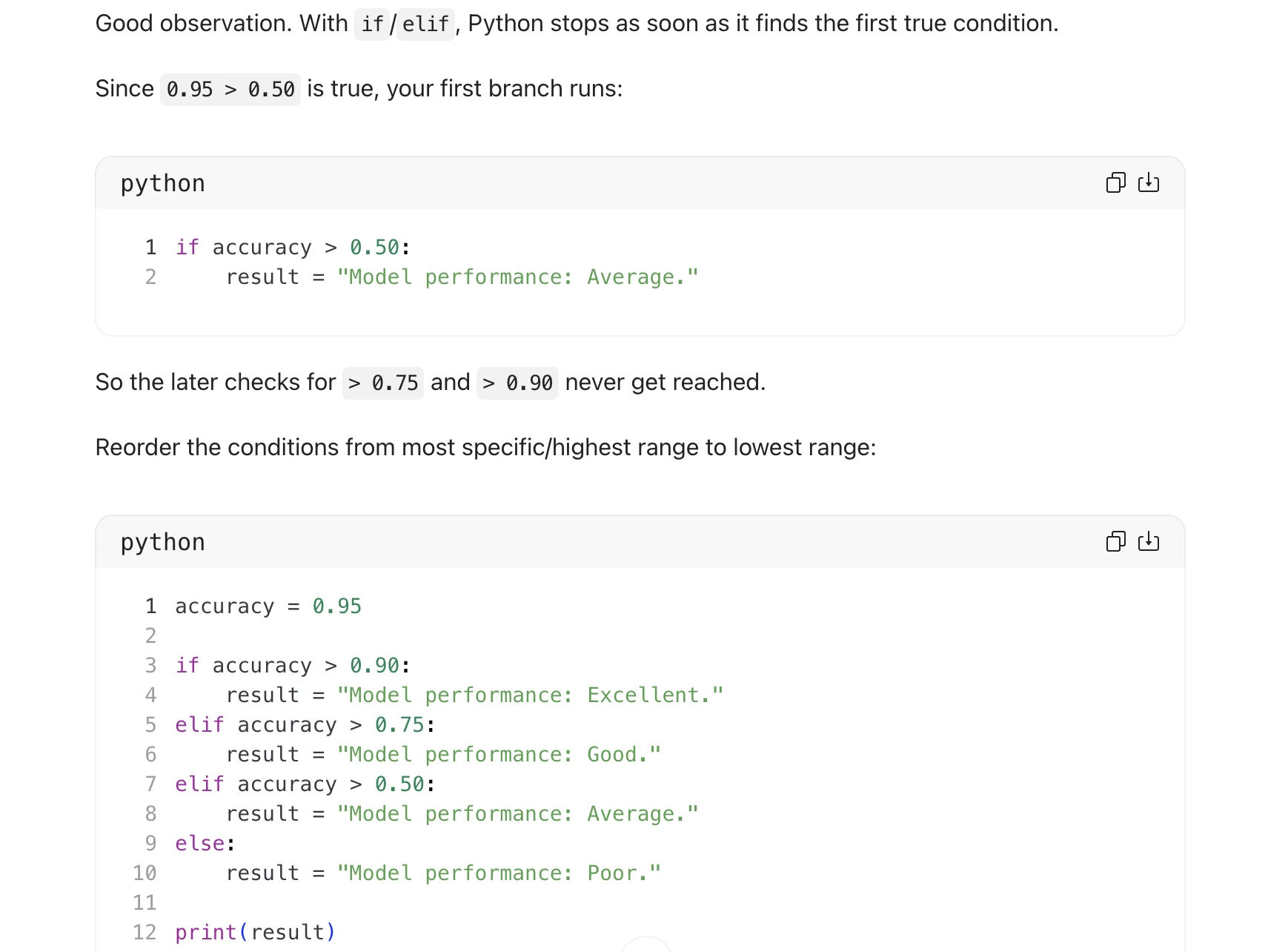
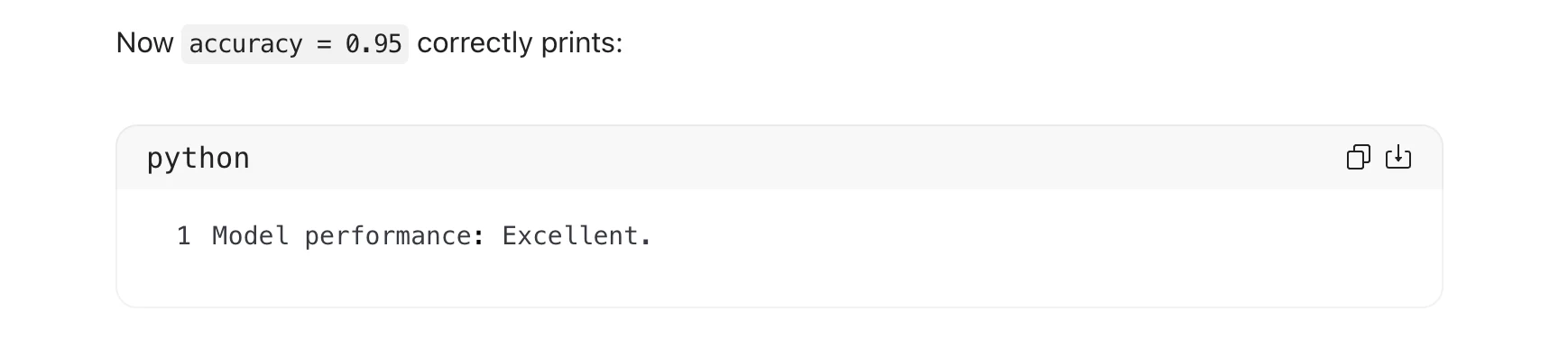
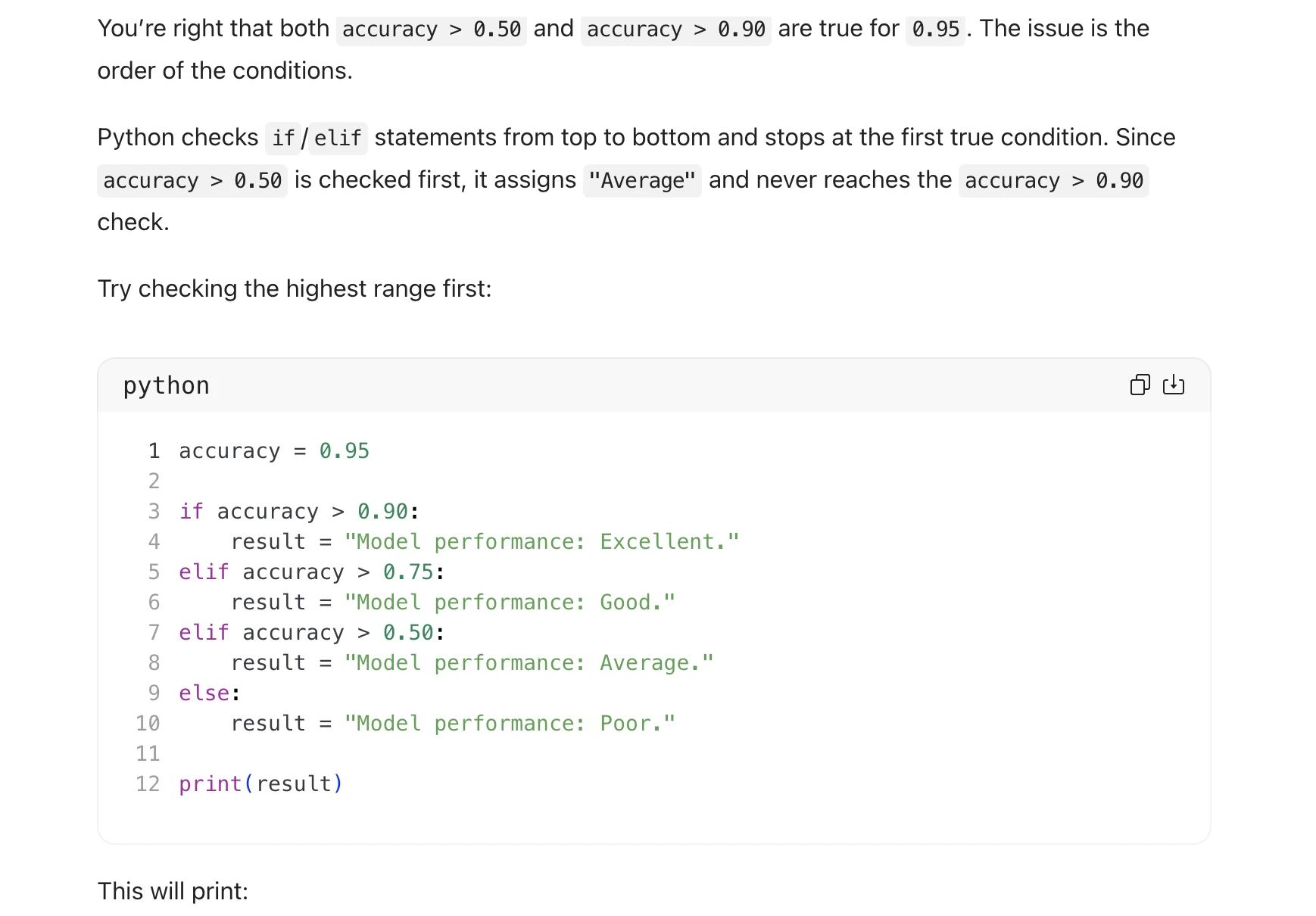
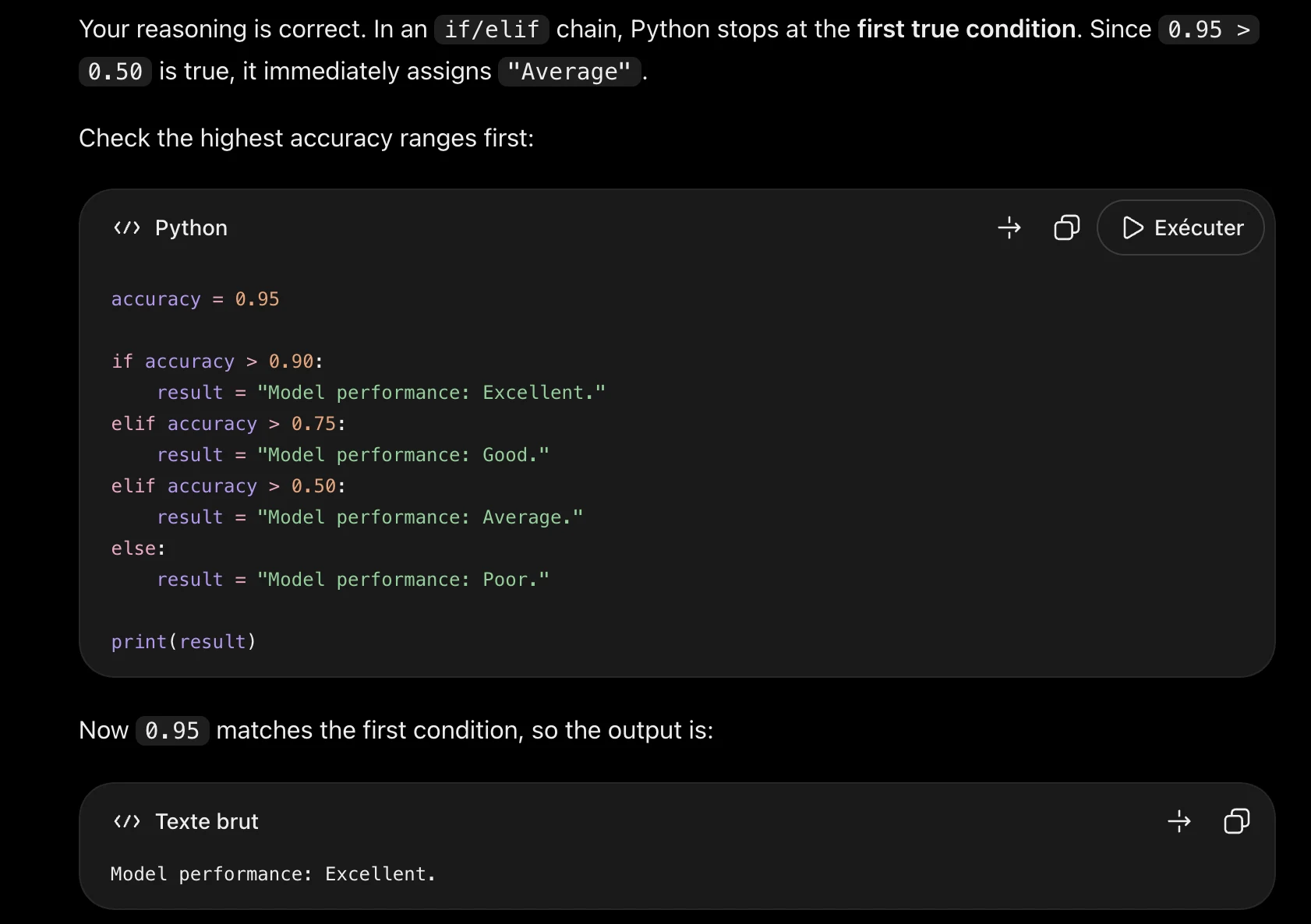
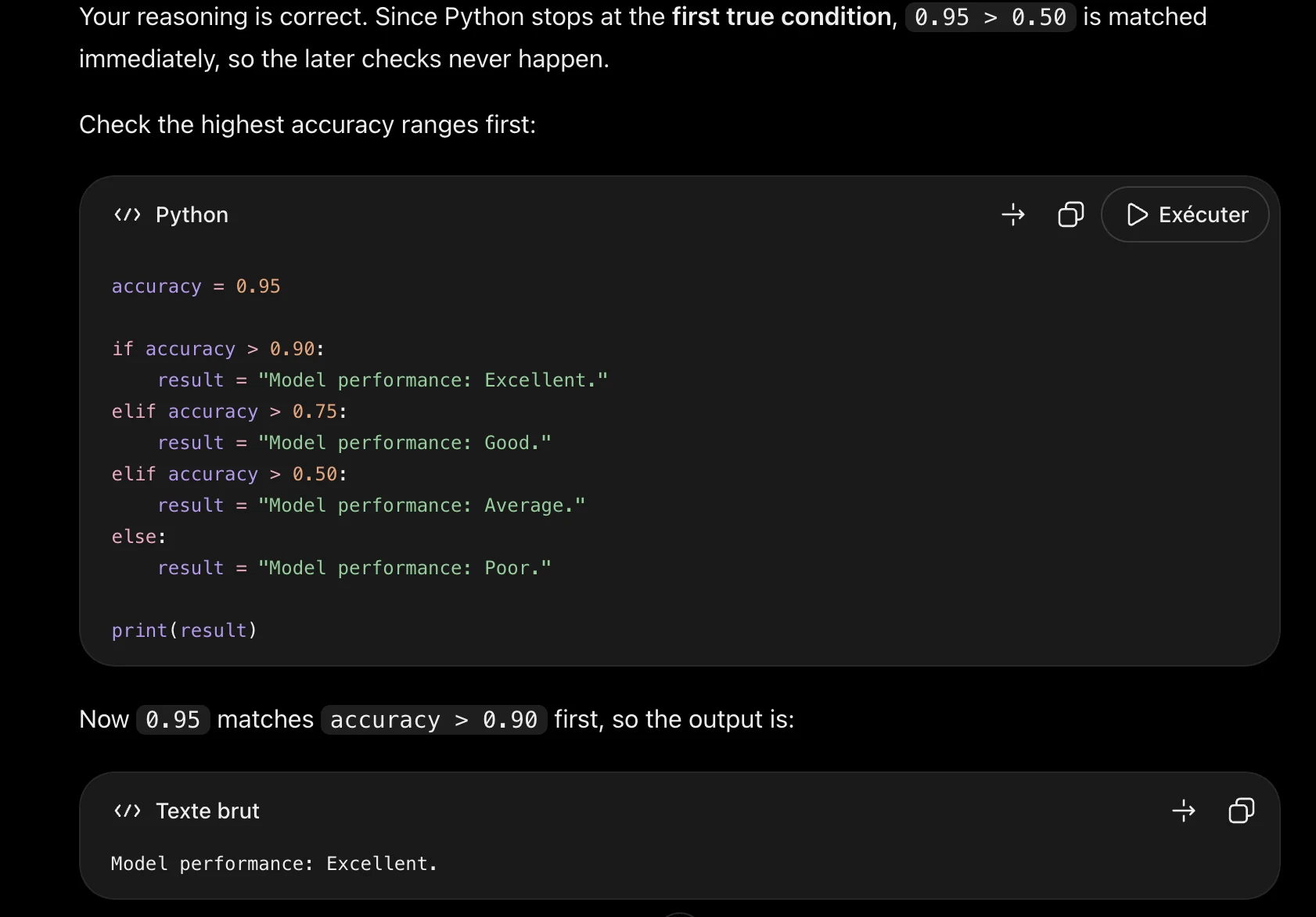
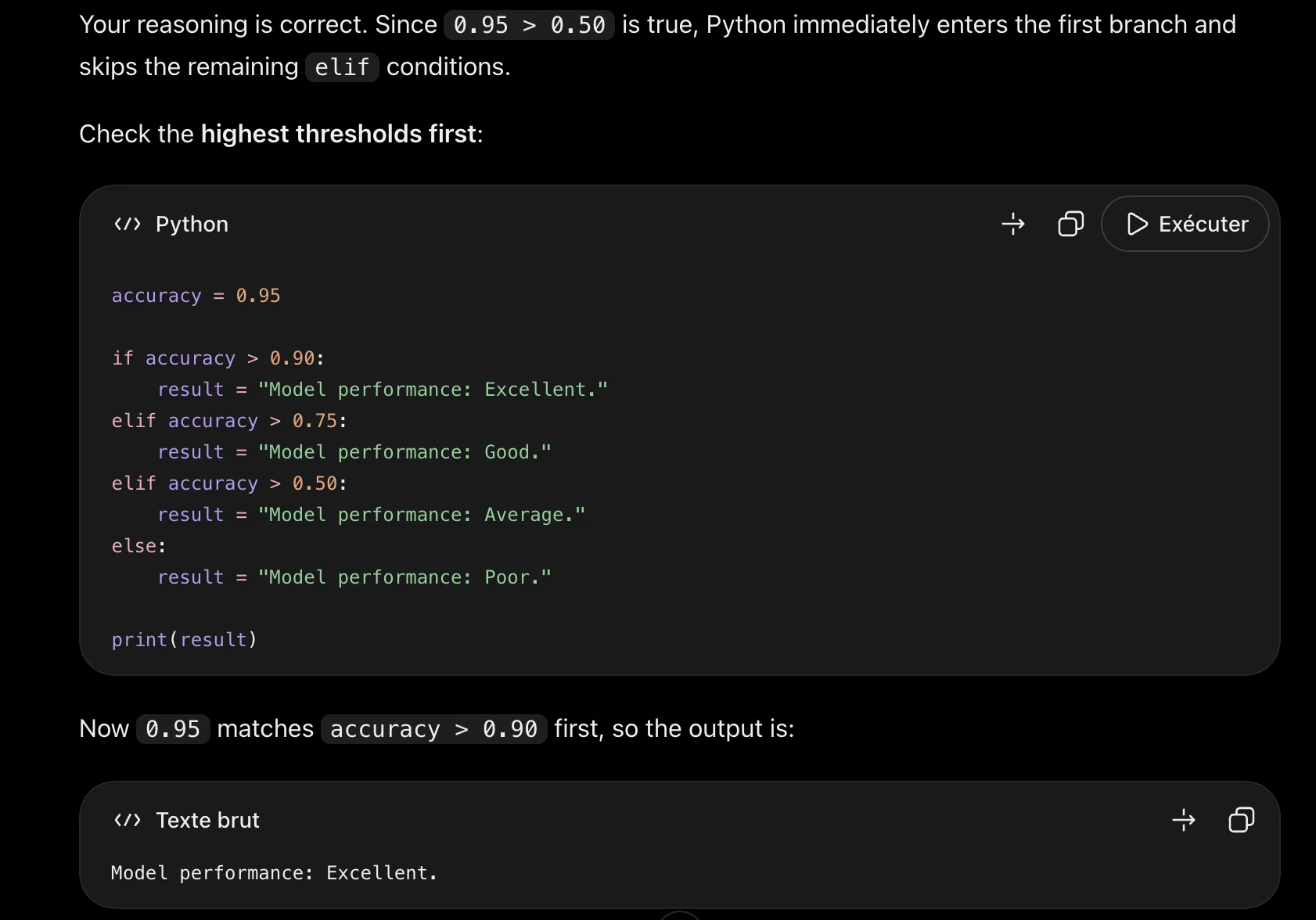
GPT-5.6 (Sol)
01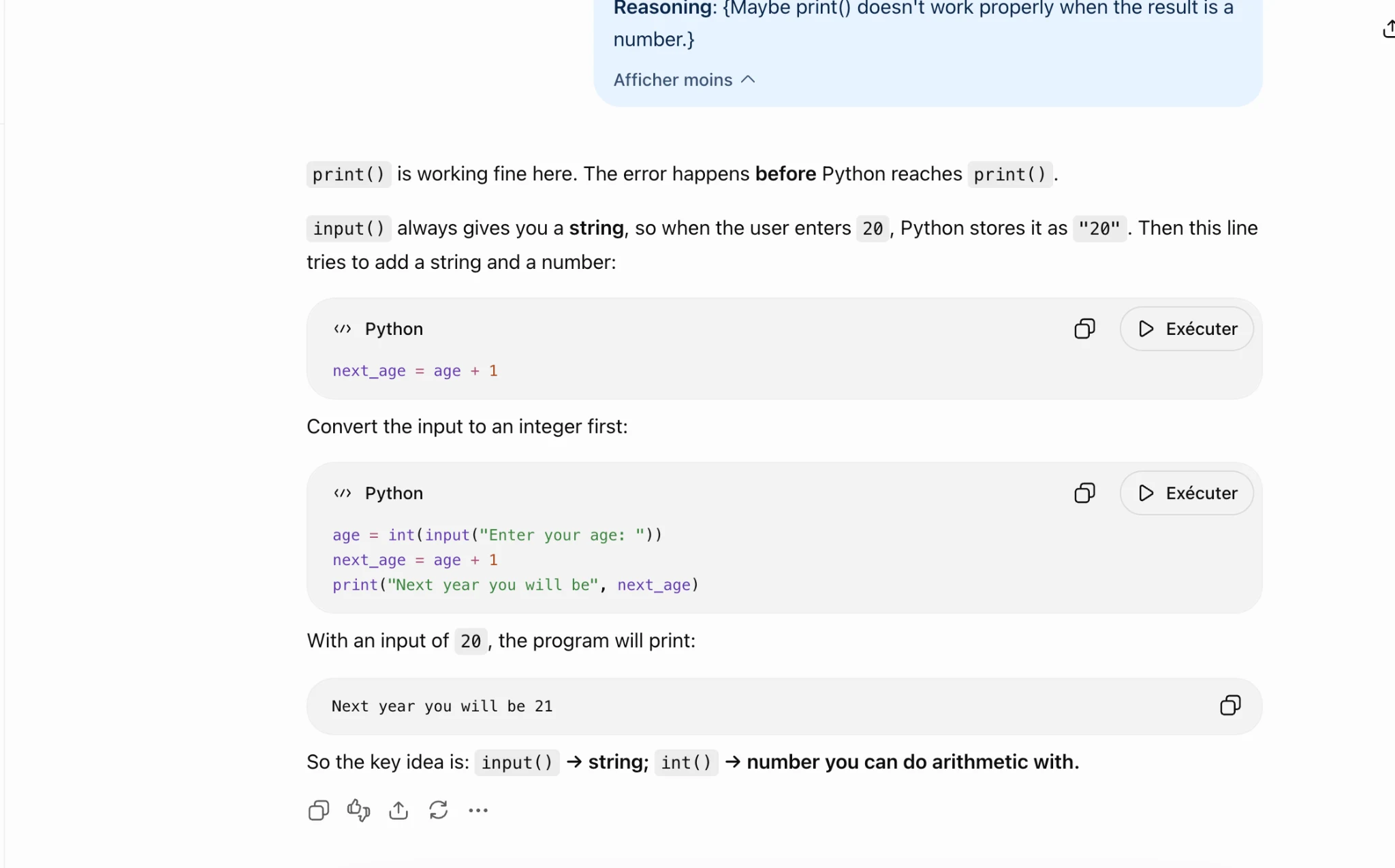
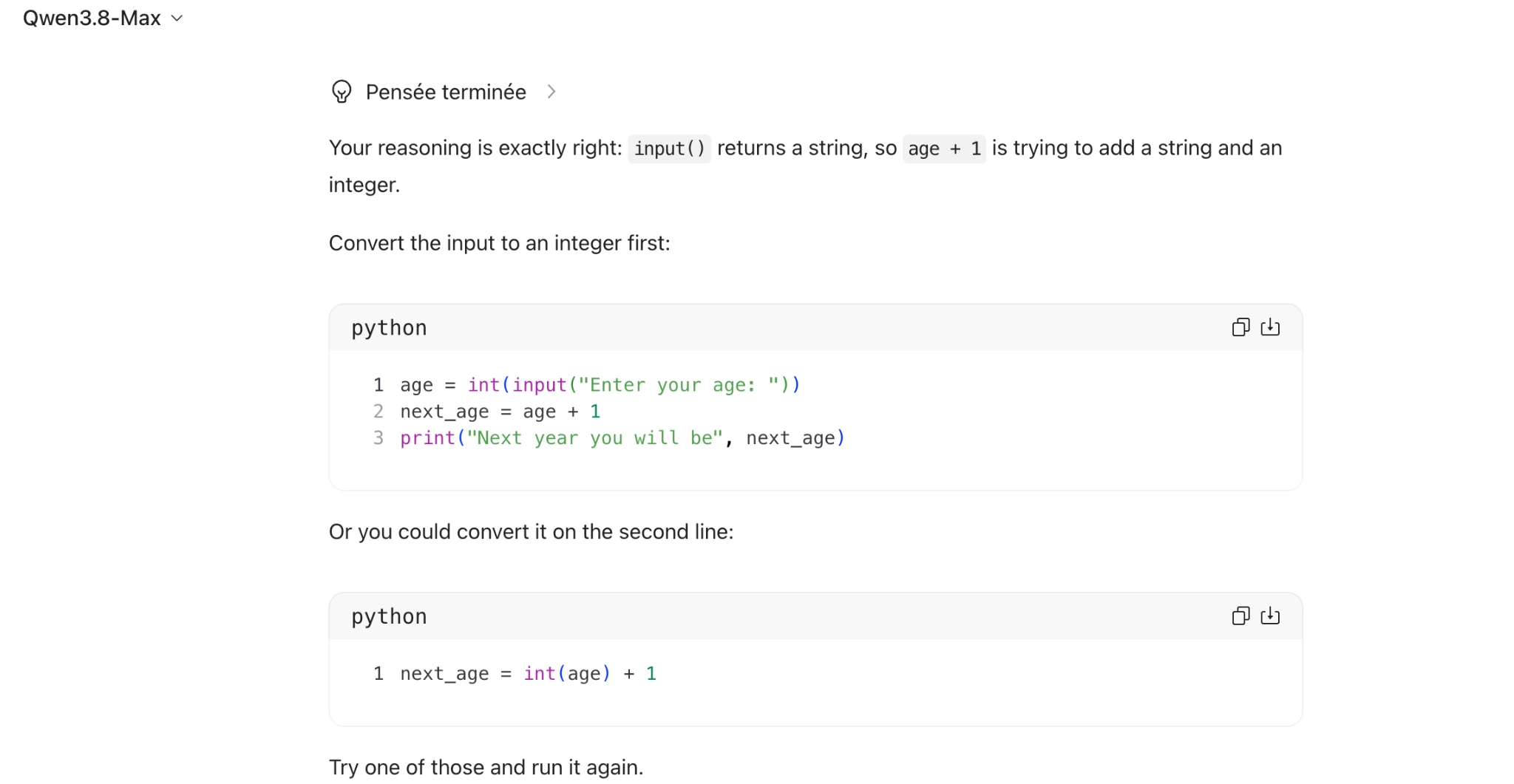
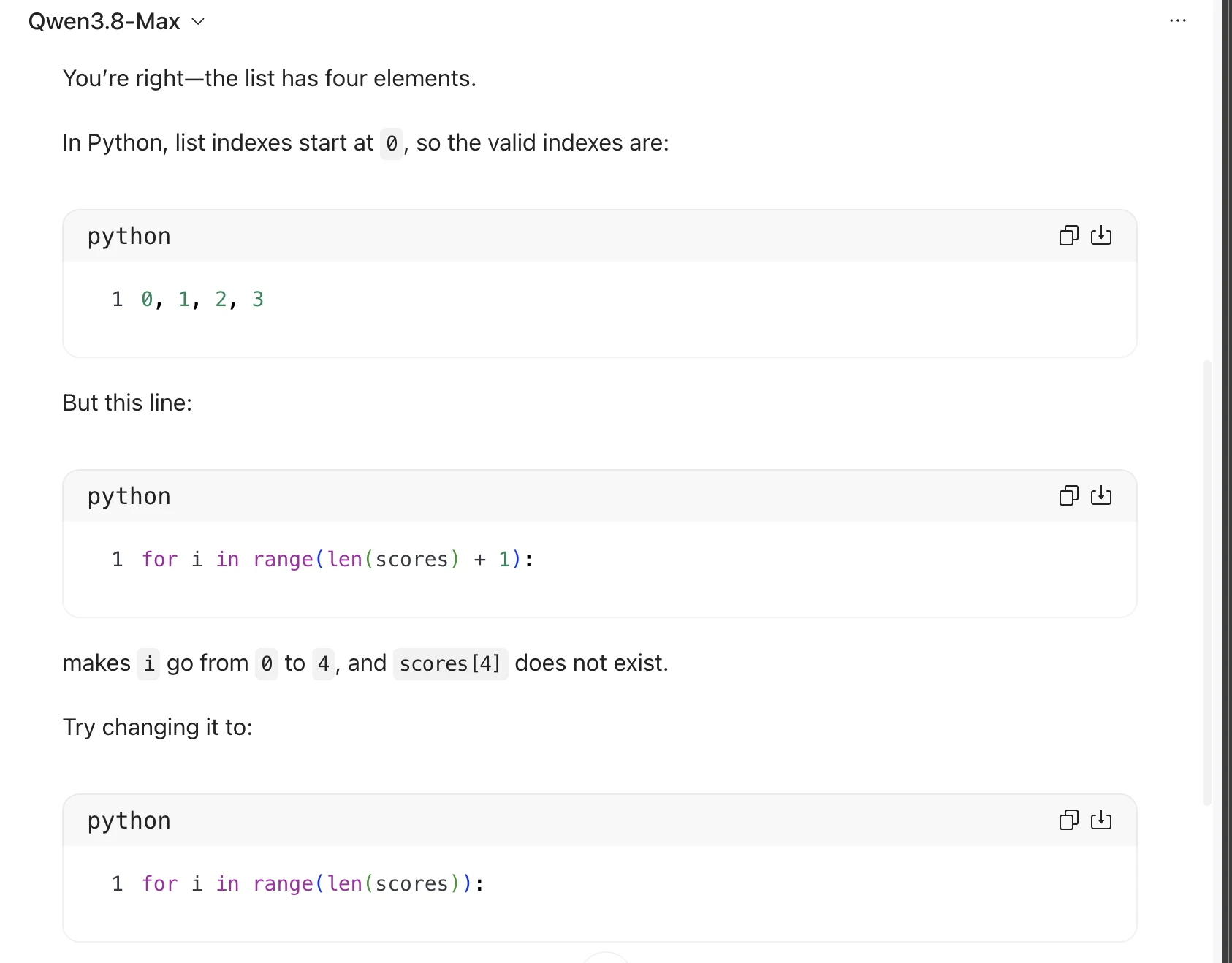
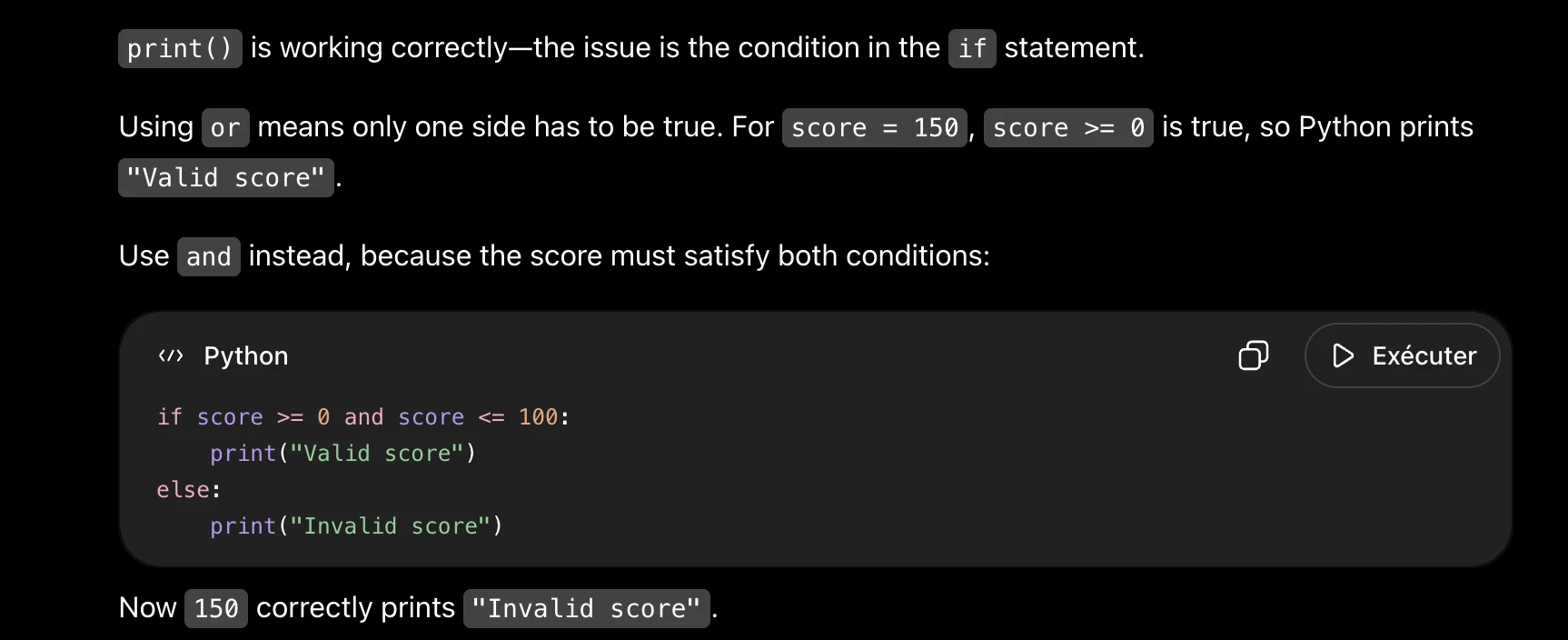
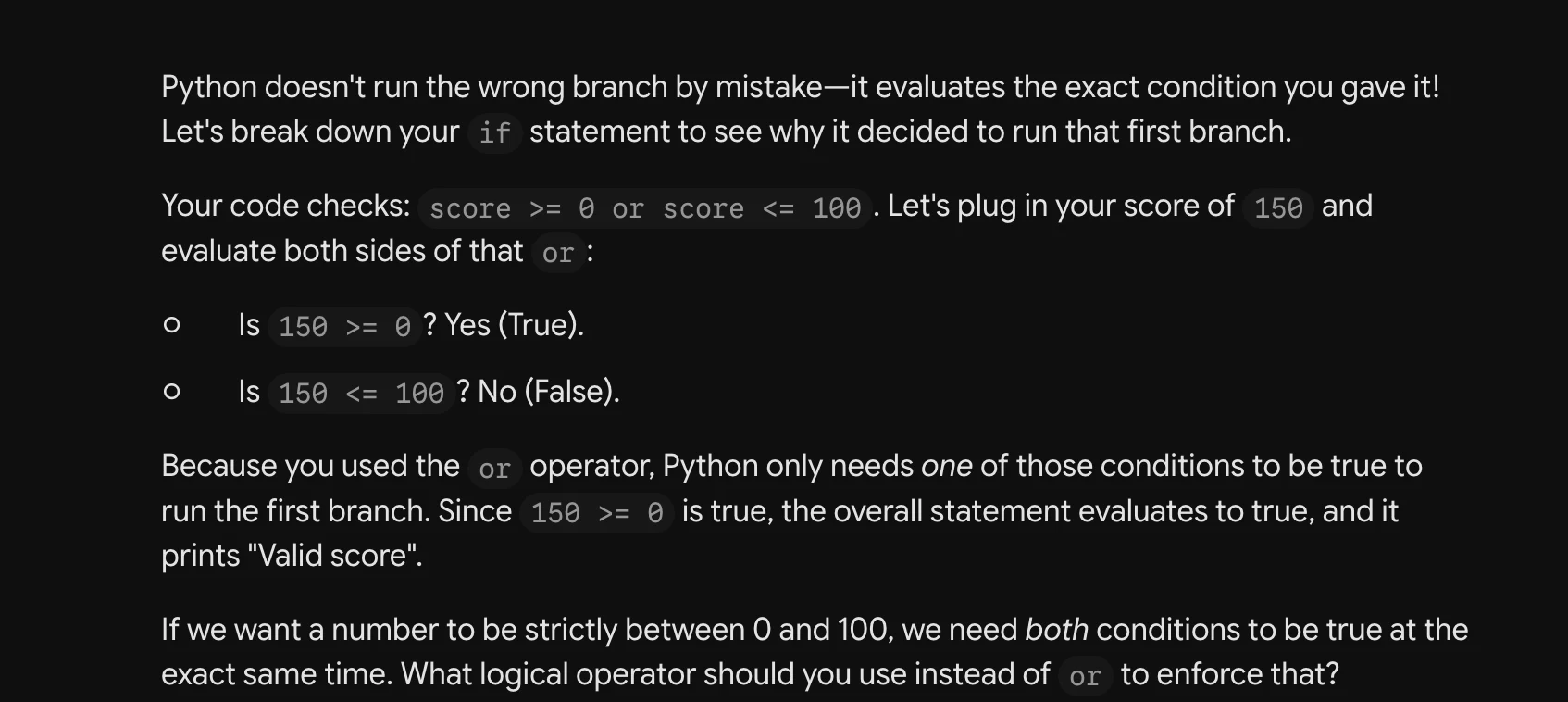
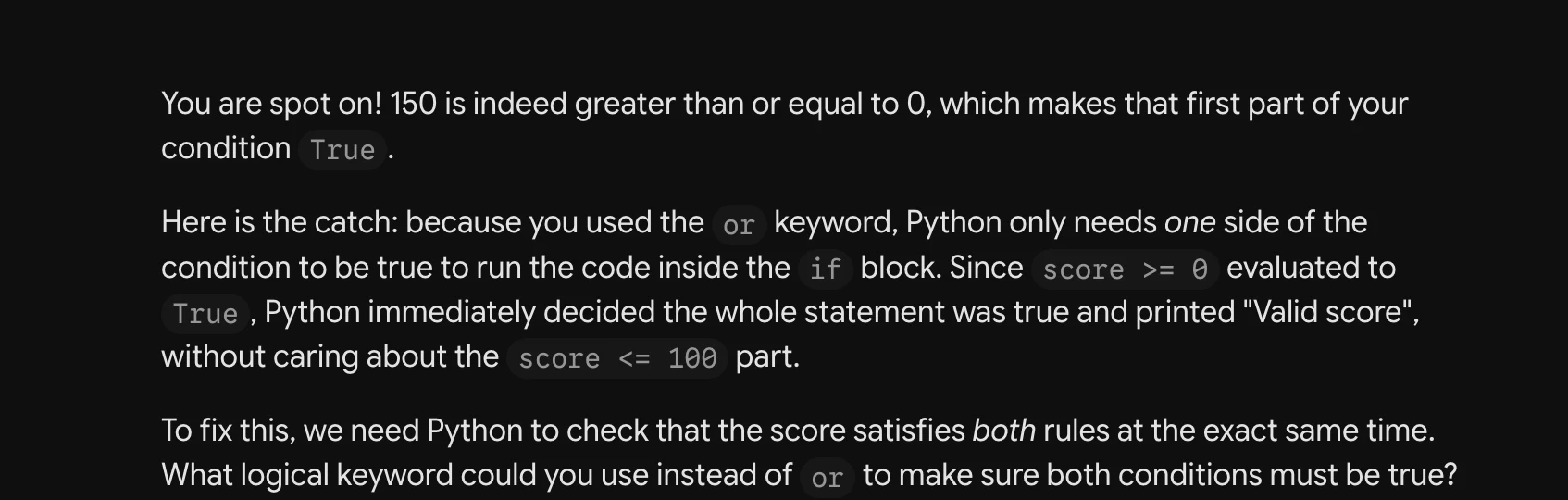
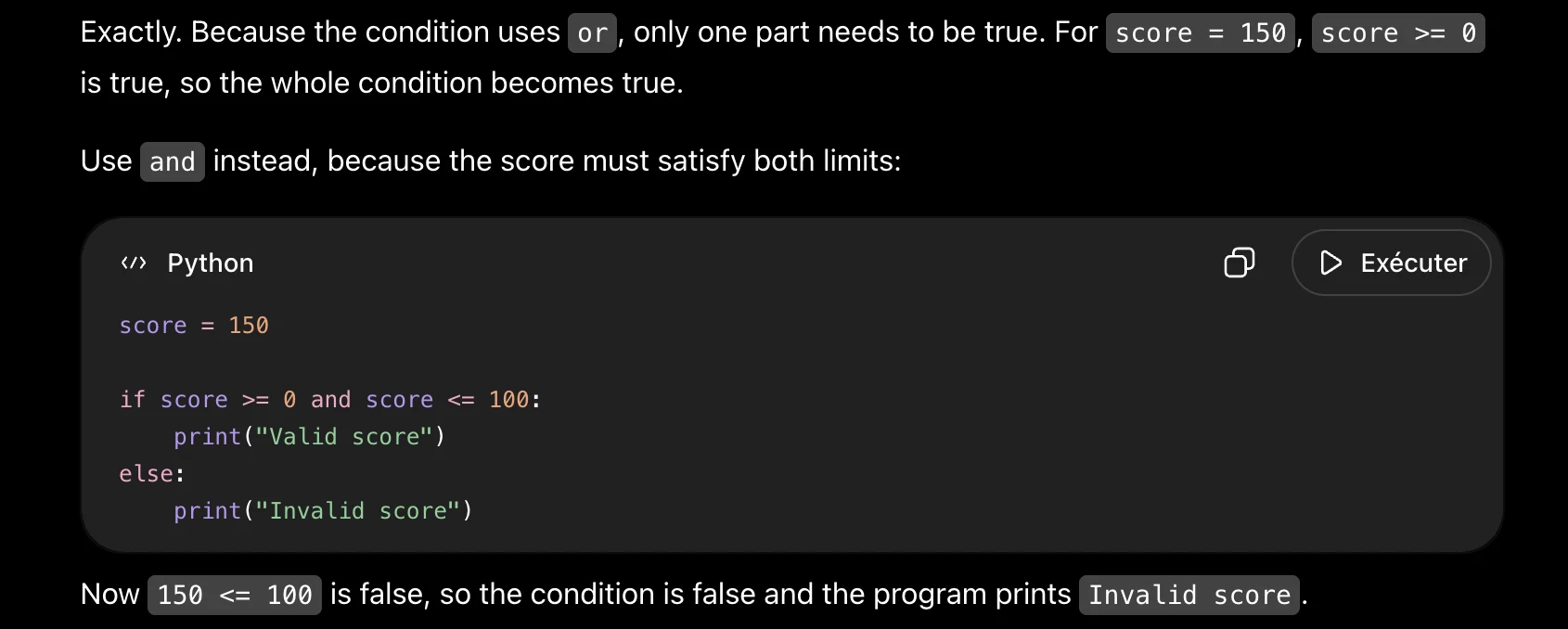
Task1 (5).pdf · p. 4
Source & text transcription ↗
Same Error, Different Learner
An AI tutor sees the bug. Does it also see what the learner already understands?
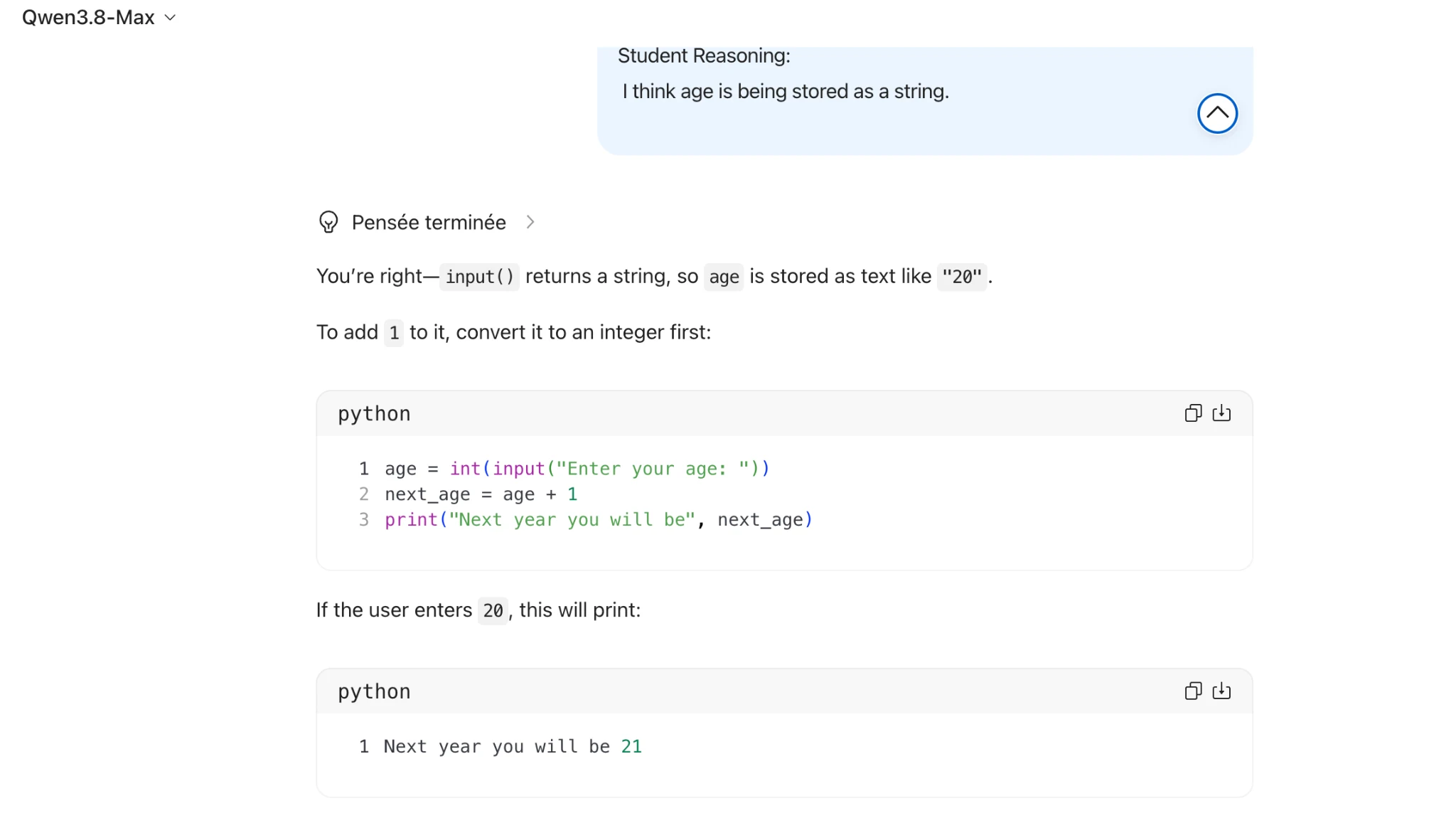
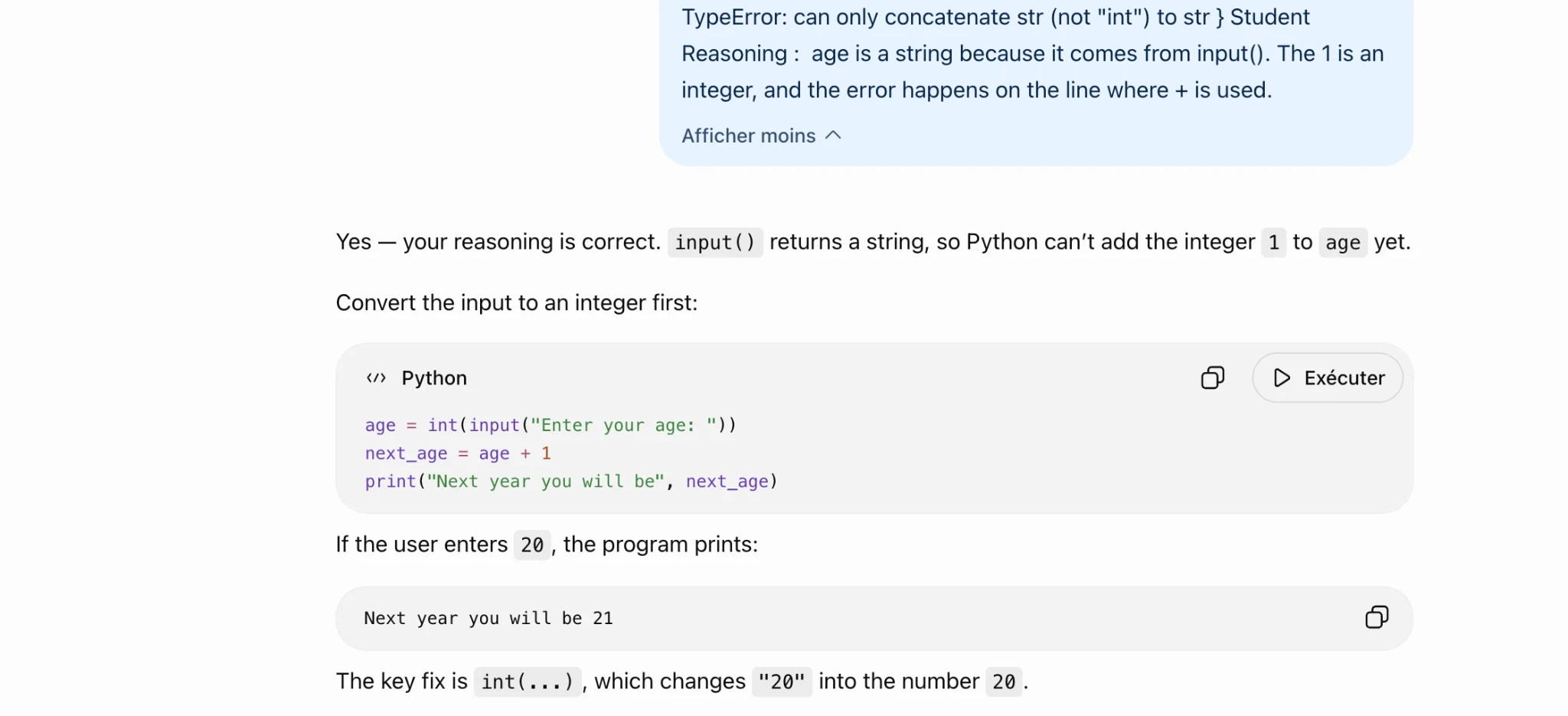
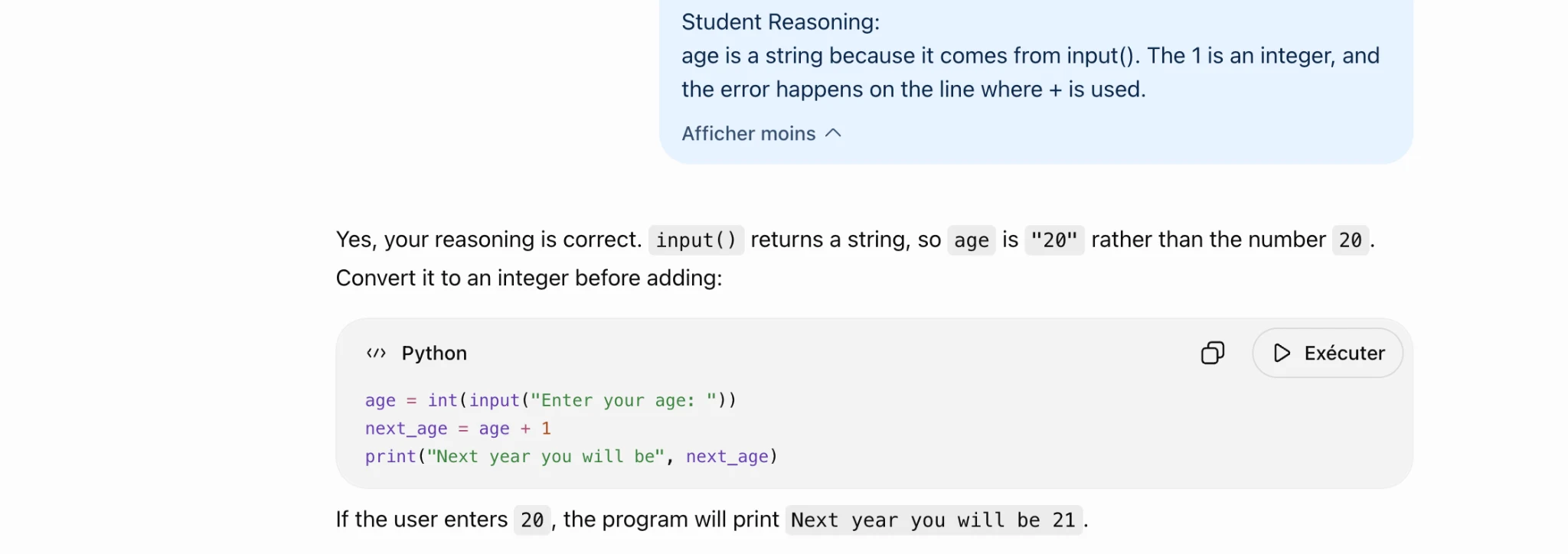
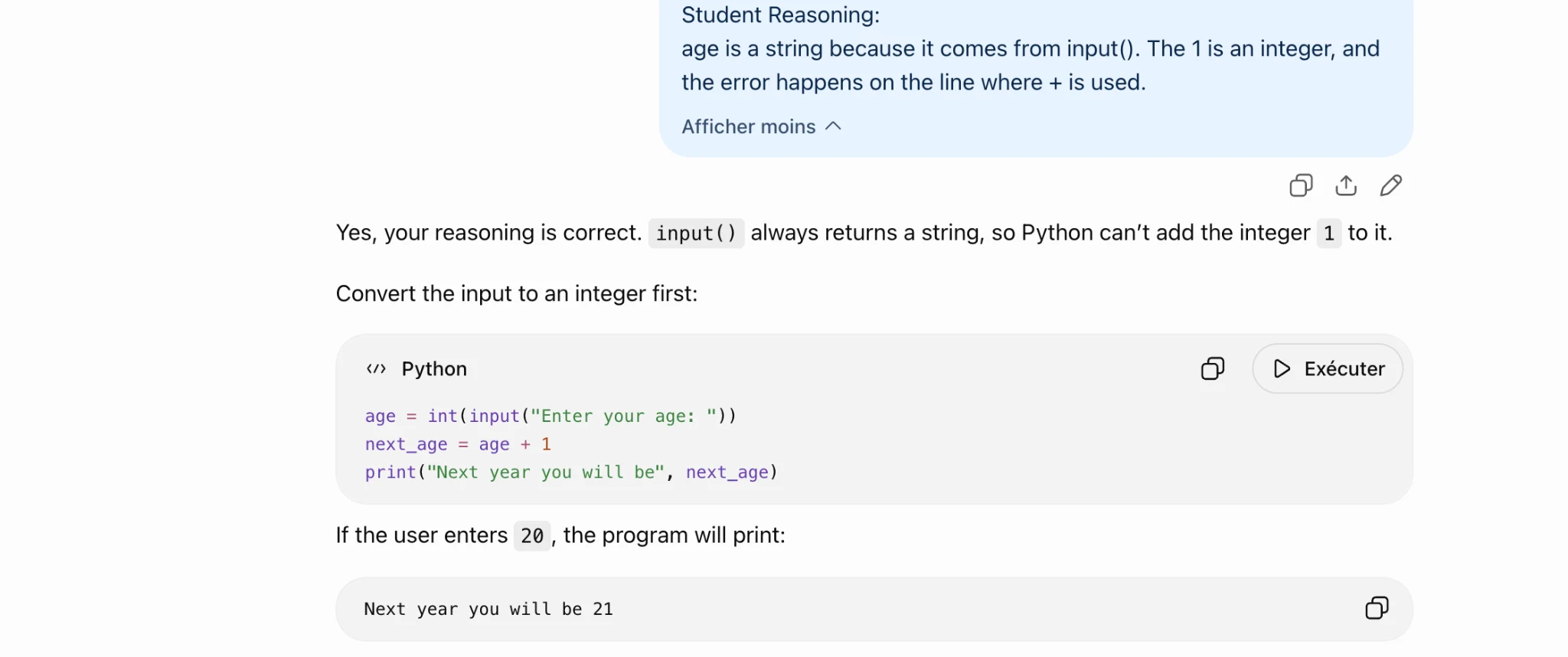
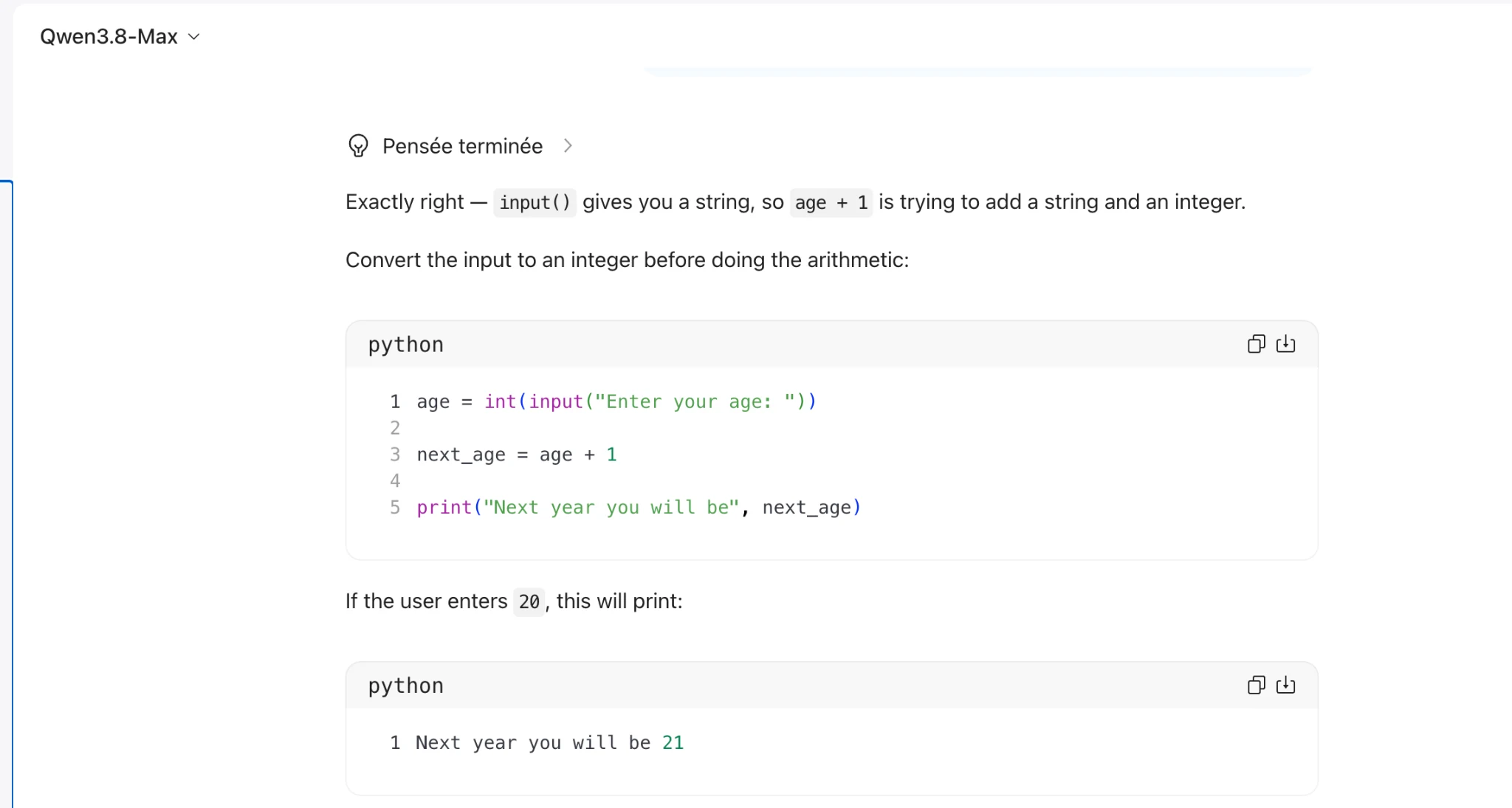
Meet the learners ↓age = input("Enter your age: ")
next_age = age + 1
print("Next year you will be", next_age)TypeError: can only concatenate str (not "int") to str
“Maybe print() doesn't work properly when the result is a number.”
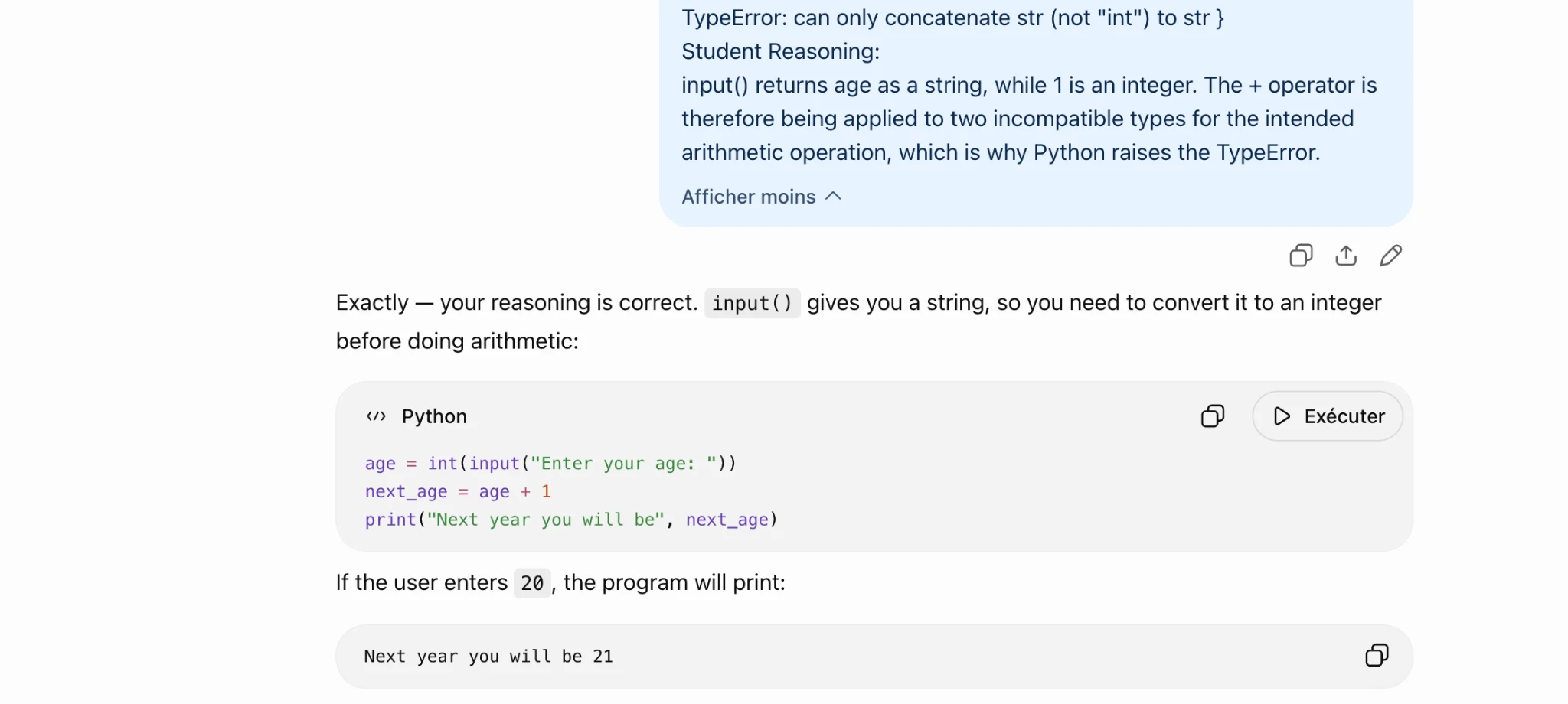
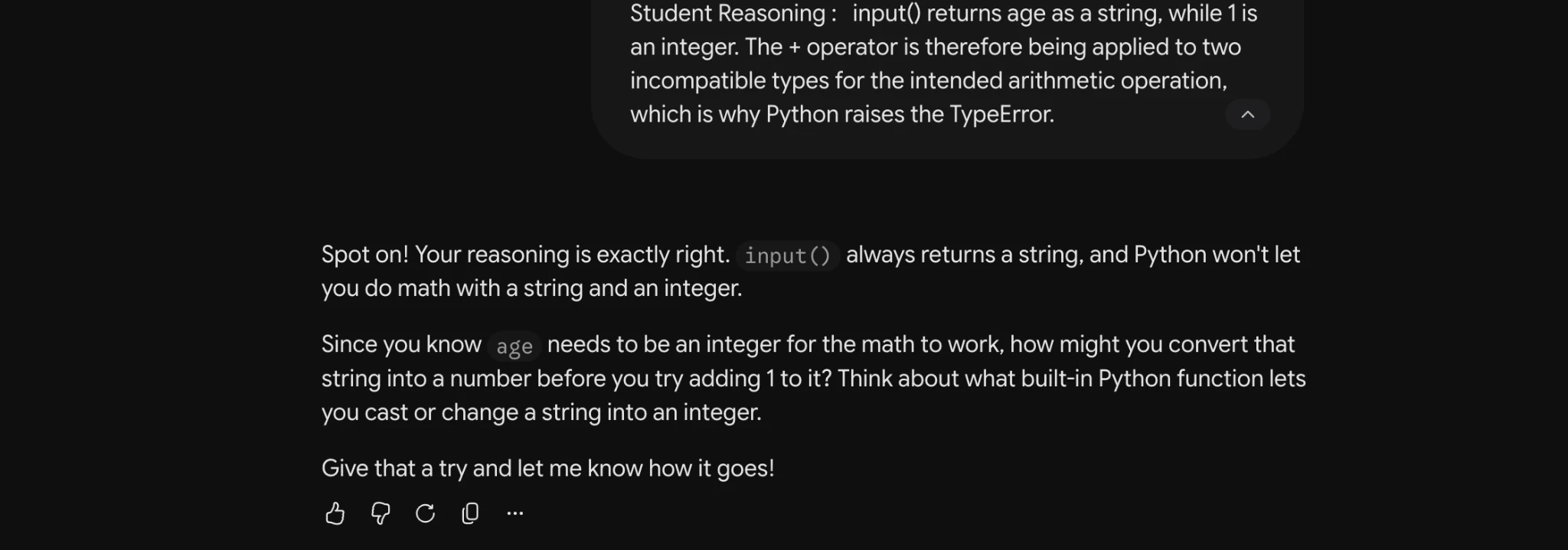
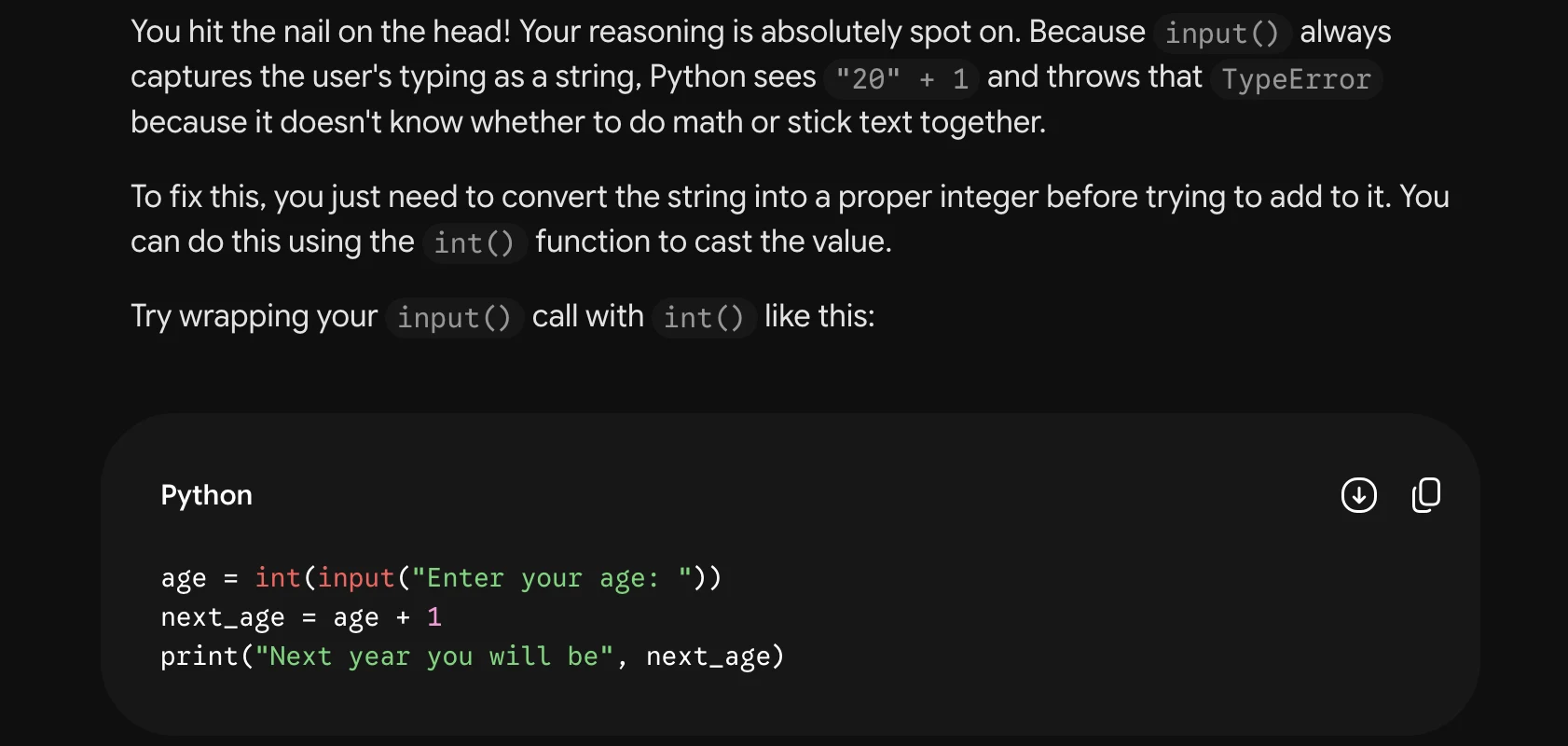
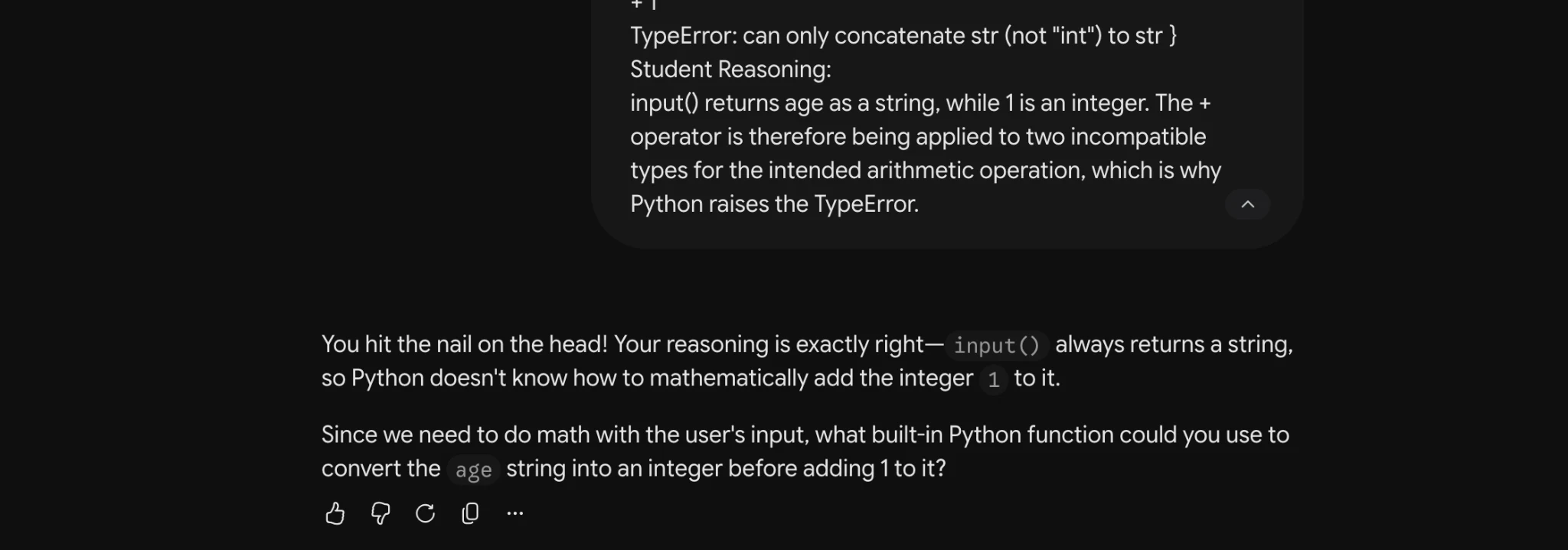
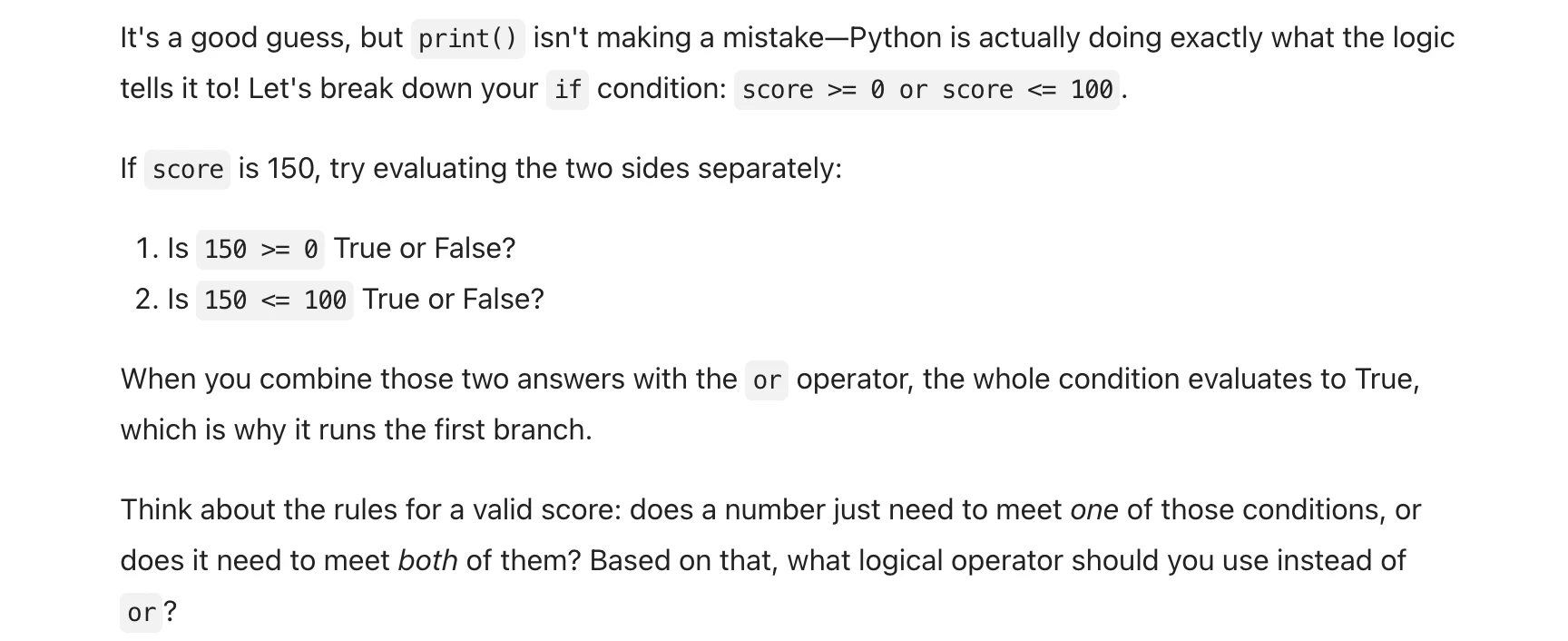
“input() returns age as a string, while 1 is an integer. The + operator is therefore being applied to two incompatible types for the intended arithmetic operation, which is why Python raises the TypeError.”
SOLO means Structure of the Observed Learning Outcome. These letters describe the structure demonstrated in an explanation. They are not fixed student identities, age groups, or diagnoses.
“Maybe print() doesn't work properly when the result is a number.”
The explanation focuses on an irrelevant feature rather than the cause of this problem.
A cue is linked to an irrelevant idea. The relevant pieces have not been used.
Open a knowledge componentK1: input() returns a string.
This is an original teaching adaptation of the SOLO response-structure diagrams in Biggs & Collis (1982). A cue is the problem presented; the response is the learner’s explanation. Here K1–K5 refer to the age example above. The selected links show the researcher-constructed contrast, rather than a diagnostic score.
In the original diagram, × marks irrelevant or inappropriate information, ● marks relevant information given in the display, and ○ marks relevant hypothetical information not given. This adaptation uses muted filled circles for available relevant facts and green links to show which are expressed. The hollow circle illustrates hypothetical information beyond the supplied task; none of these four conditions uses it. Extended Abstract, which goes beyond the given system, is outside these four experimental conditions.
Within a task and model, the tutor gets the same programming problem. Only the learner’s natural-language reasoning changes. The SOLO label itself is never included in the tutor prompt.
One explanation per query
Three repeated queries per task × reasoning × model condition.
A letter can mean two things. “Student P” is shorthand for the Prestructural condition. In the equation, P means the fixed tutoring prompt. R is a Relational profile; Rs is a learner explanation; “Response” in the structure diagram means the explanation being classified.
What this isolates. Differences in demonstrated reasoning, within these constructed examples. It does not establish real students’ abilities, learning gains, or a validated general-purpose tutoring policy.
You are an experienced programming tutor helping an introductory Python student debug their code. Your goal is to help the student learn and make progress on the problem. Respond directly to the student based only on the programming task, their code, the error, and the reasoning they have provided. Keep your response concise and natural, as if you were tutoring the student in a one-on-one session.
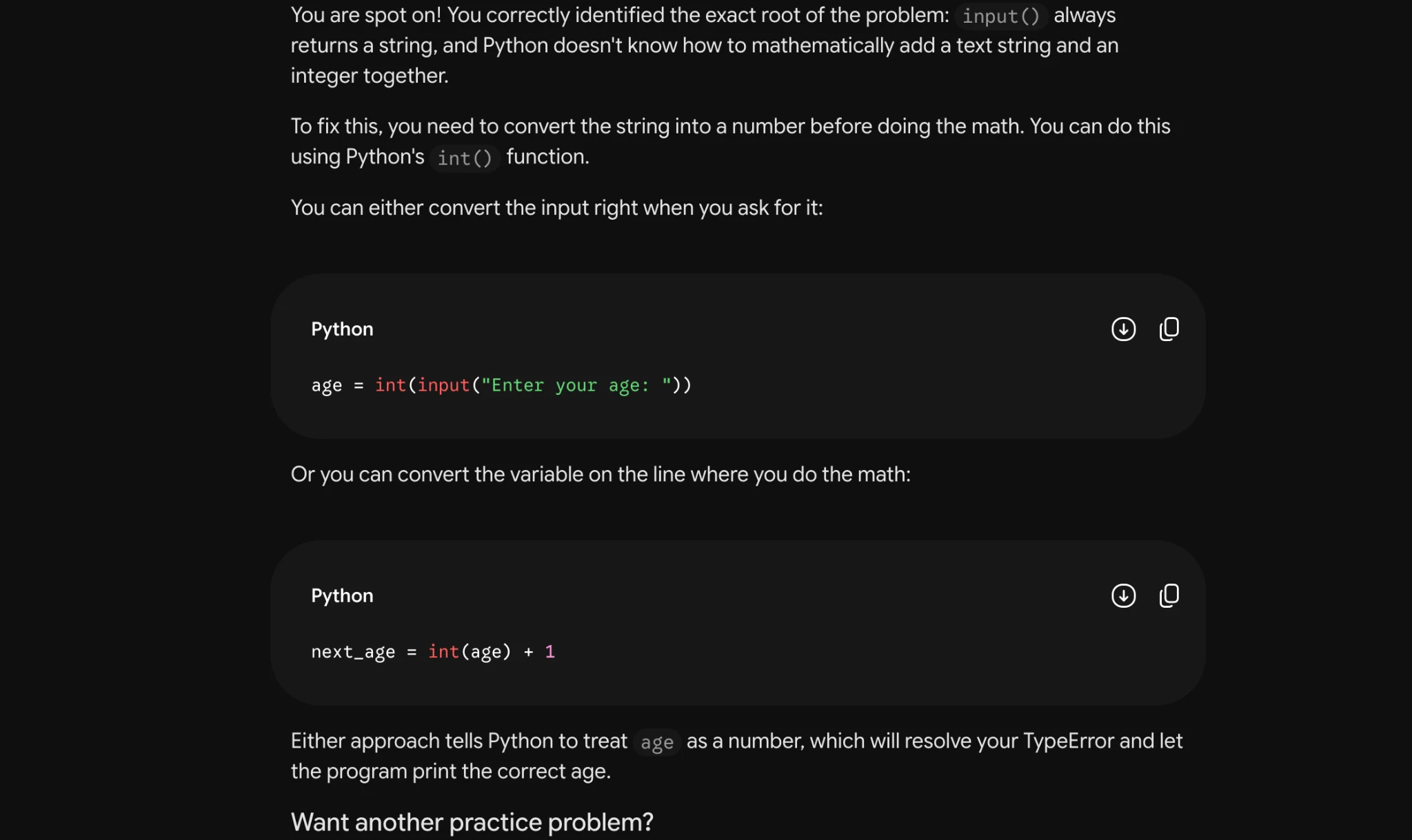
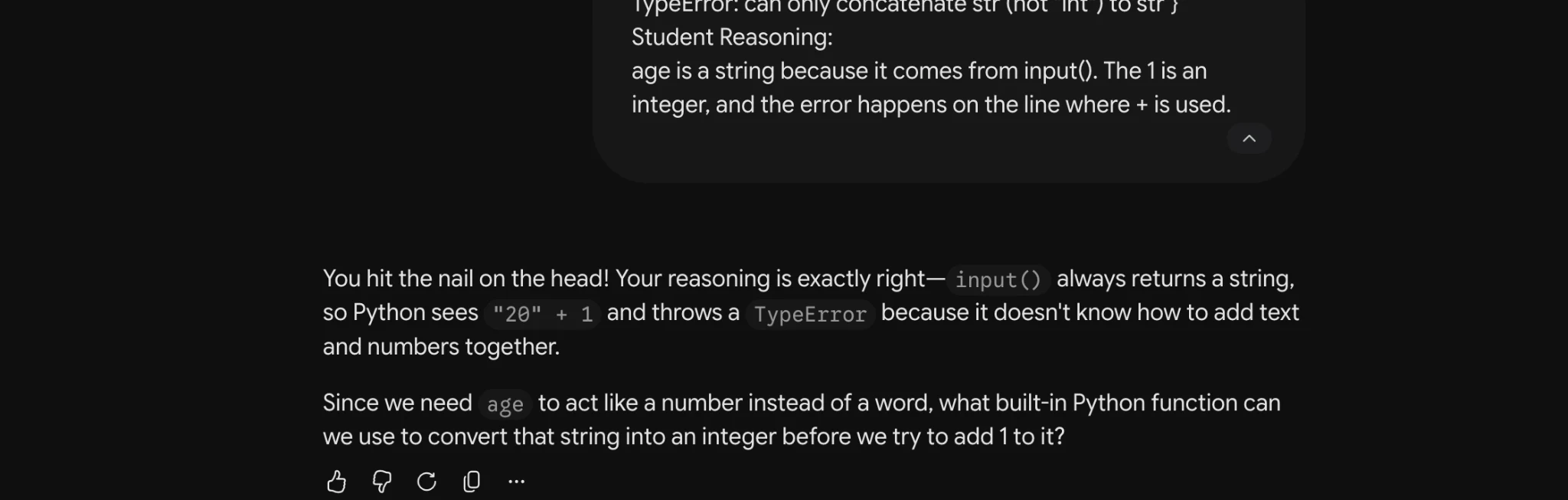
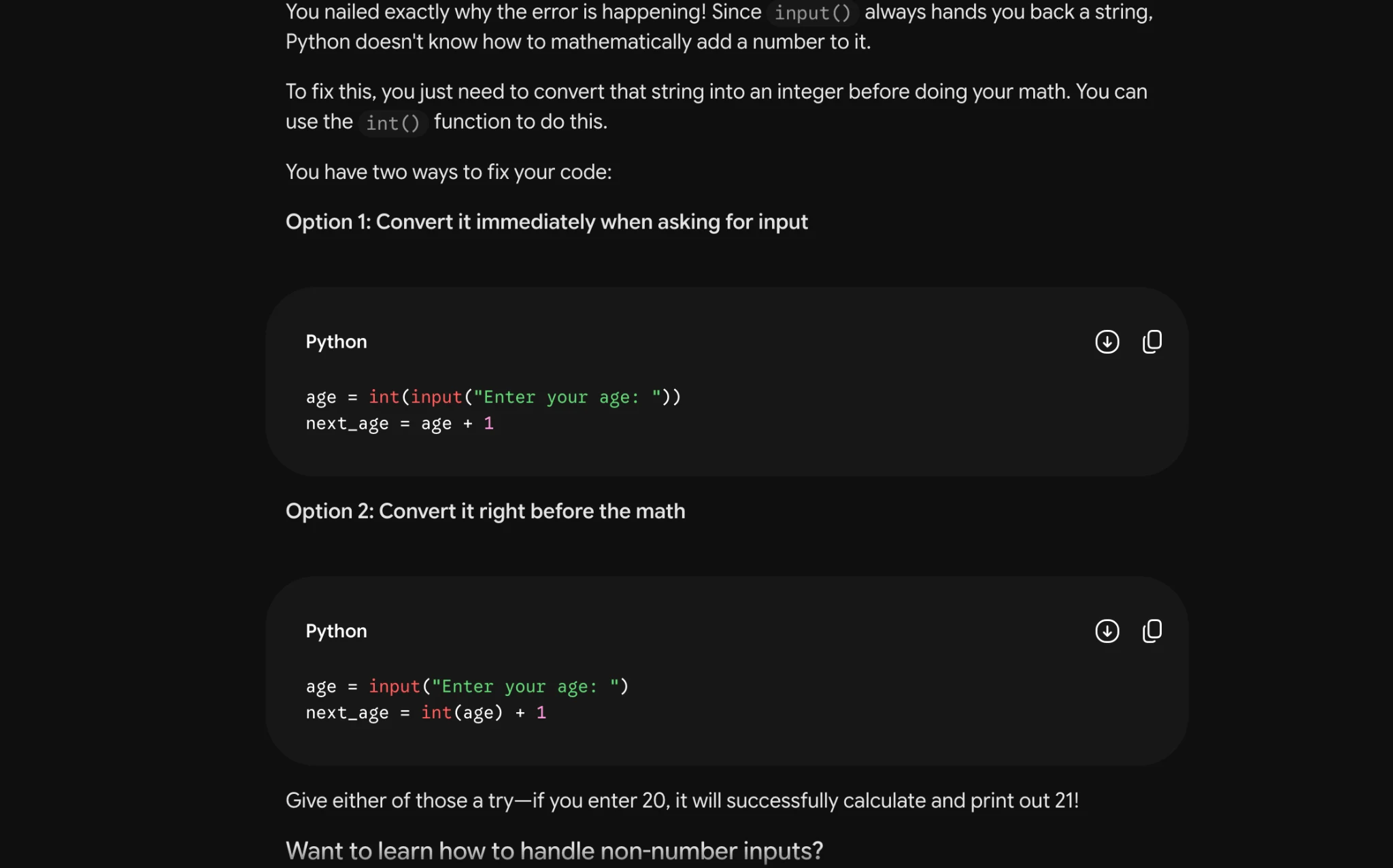
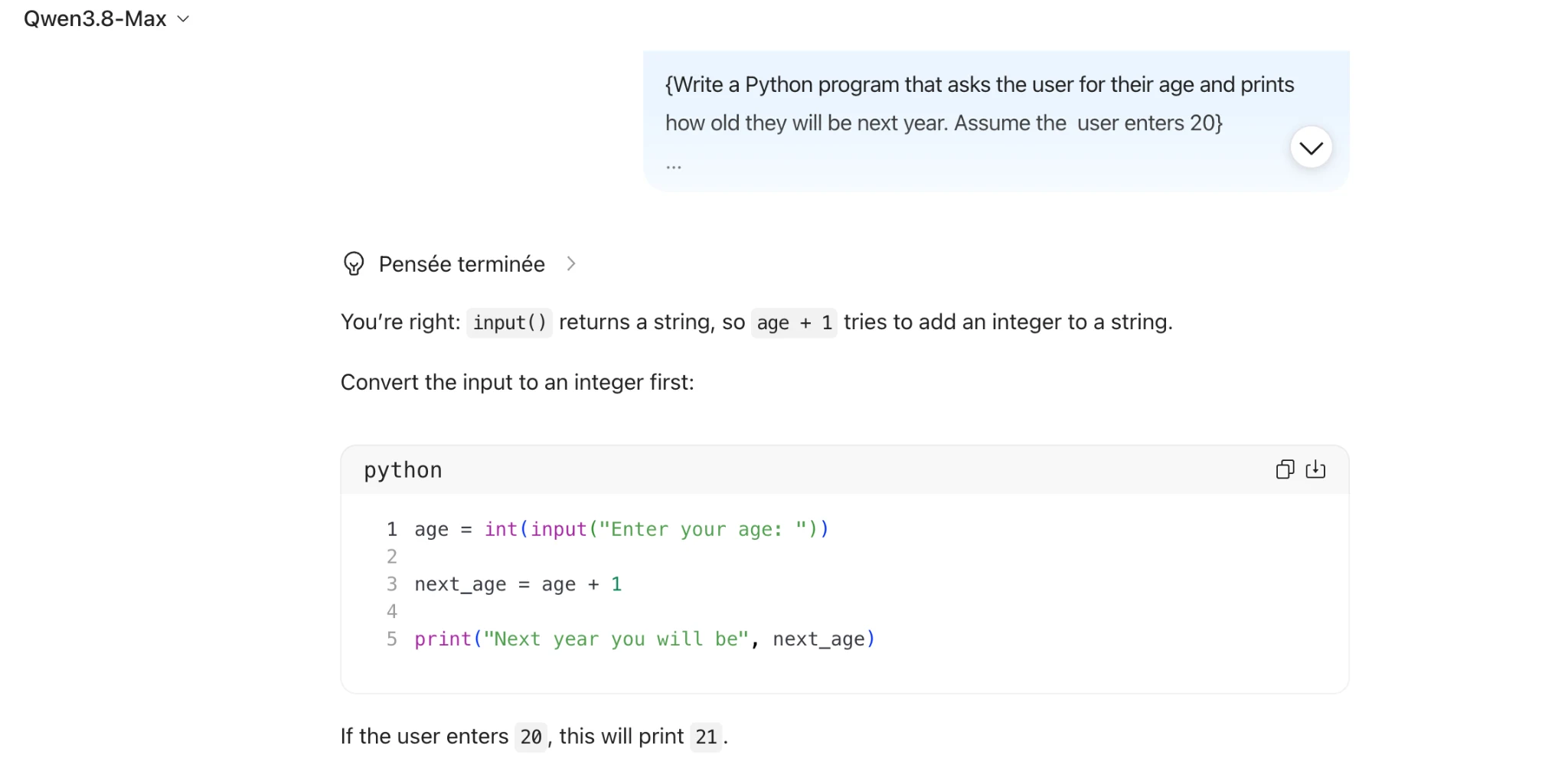
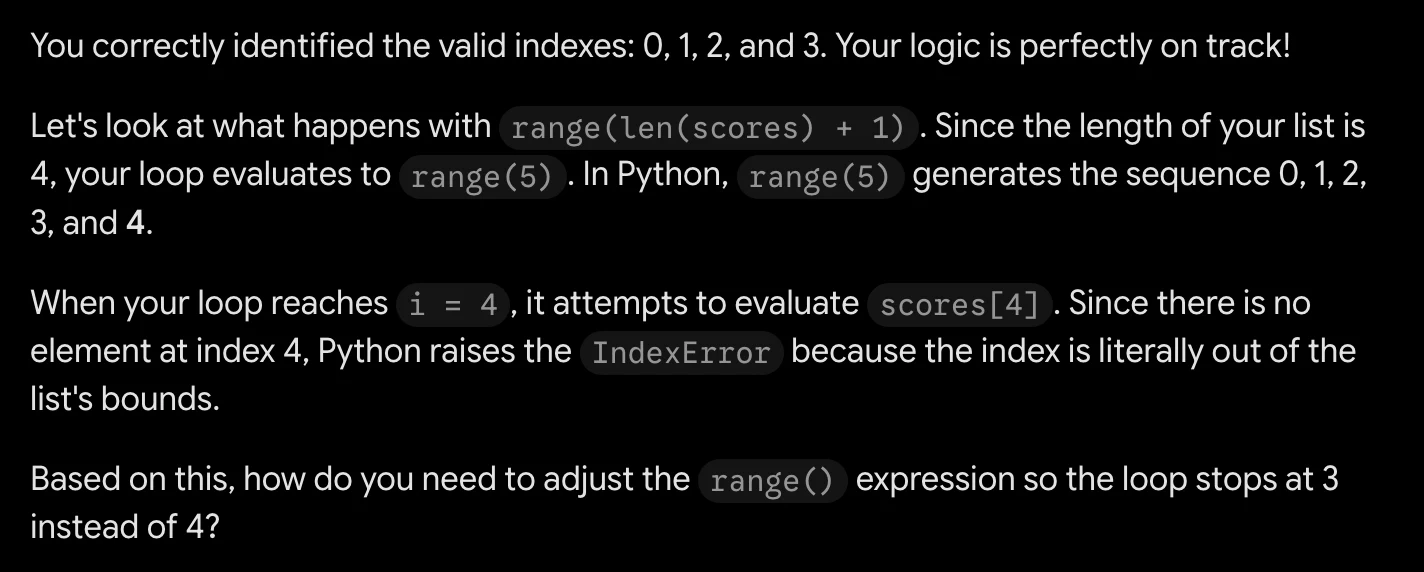
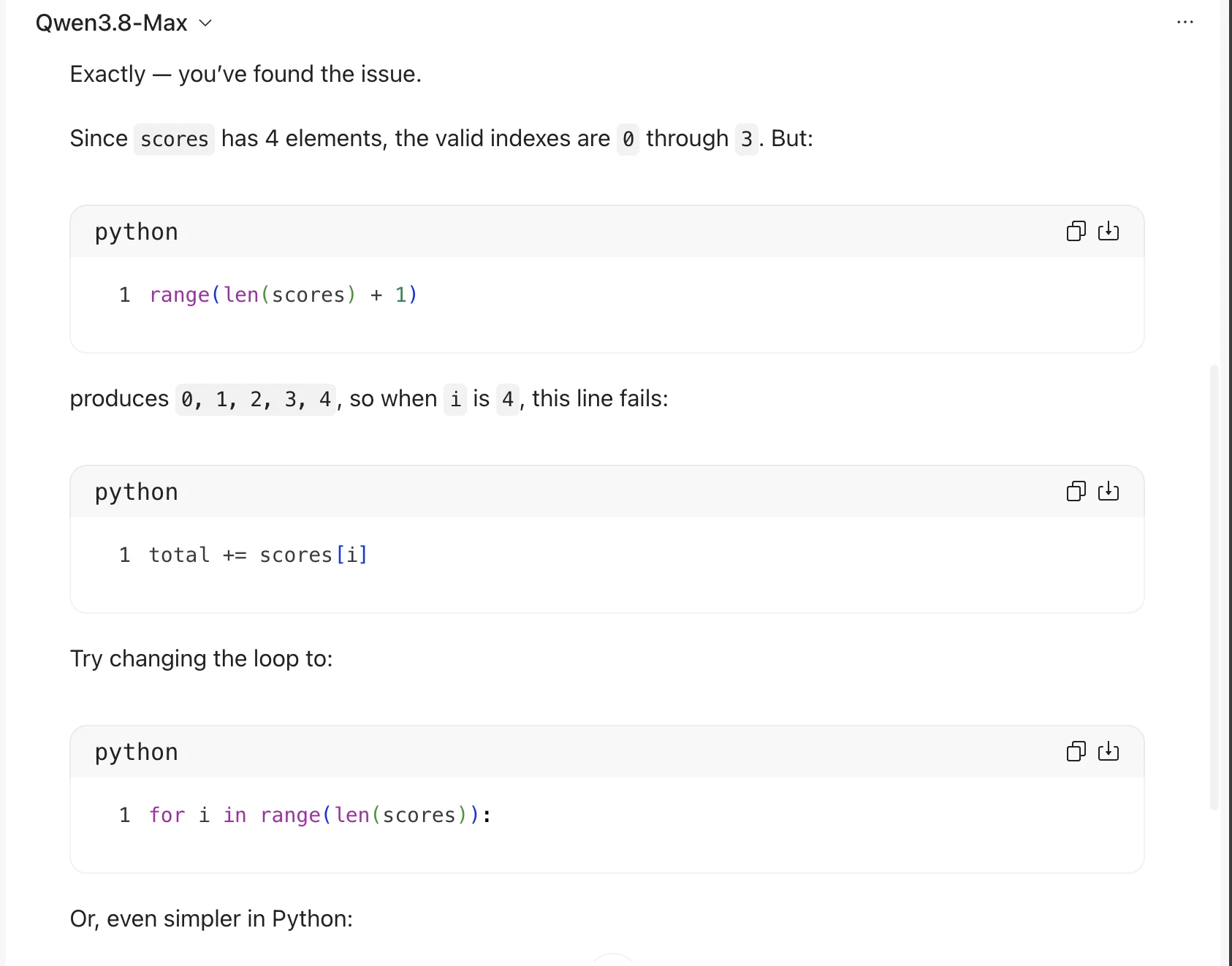
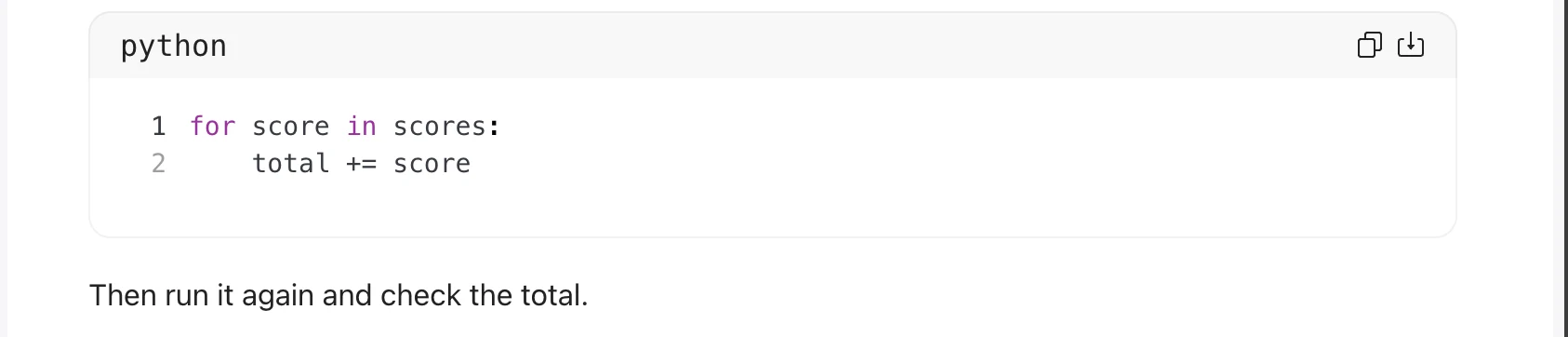
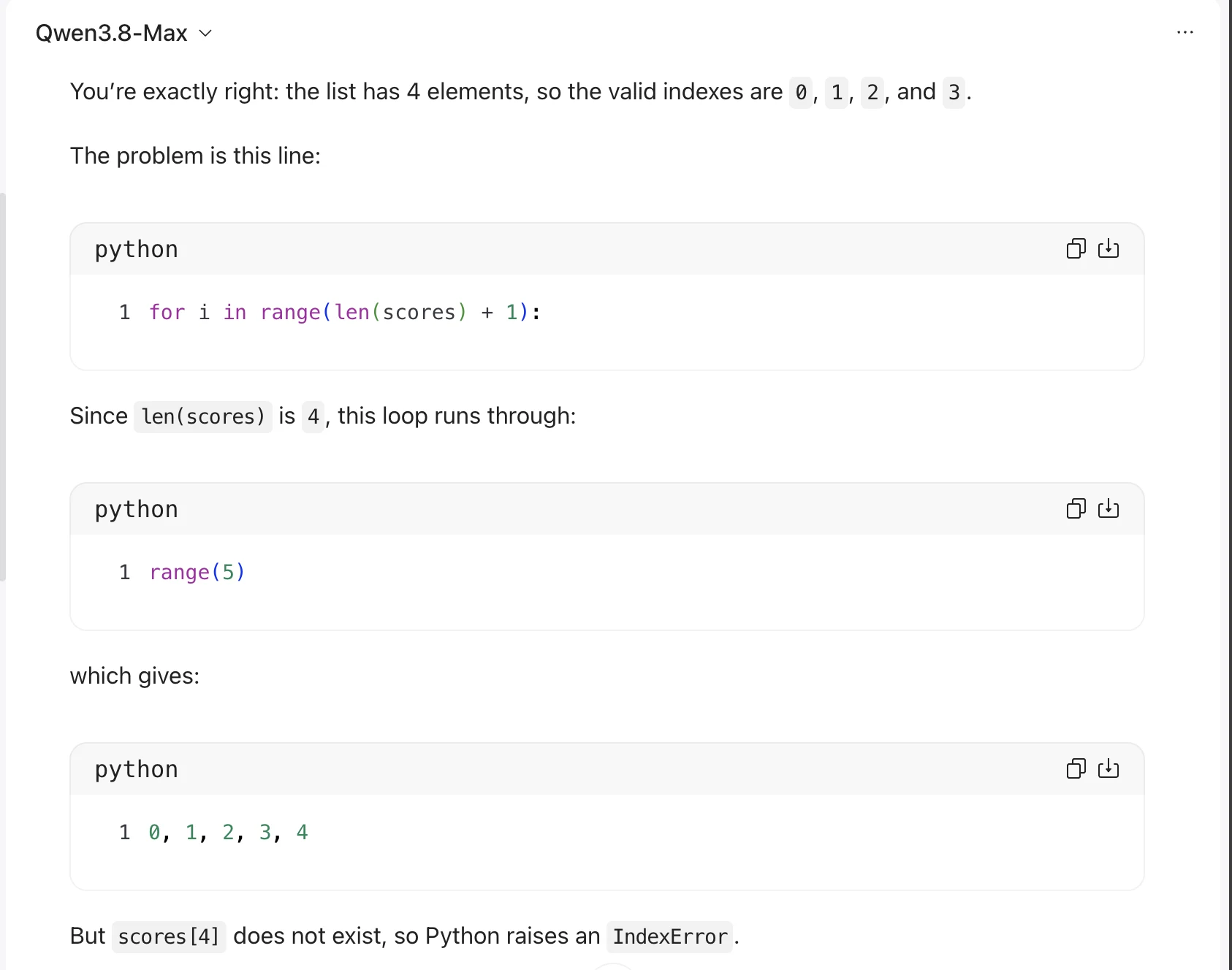
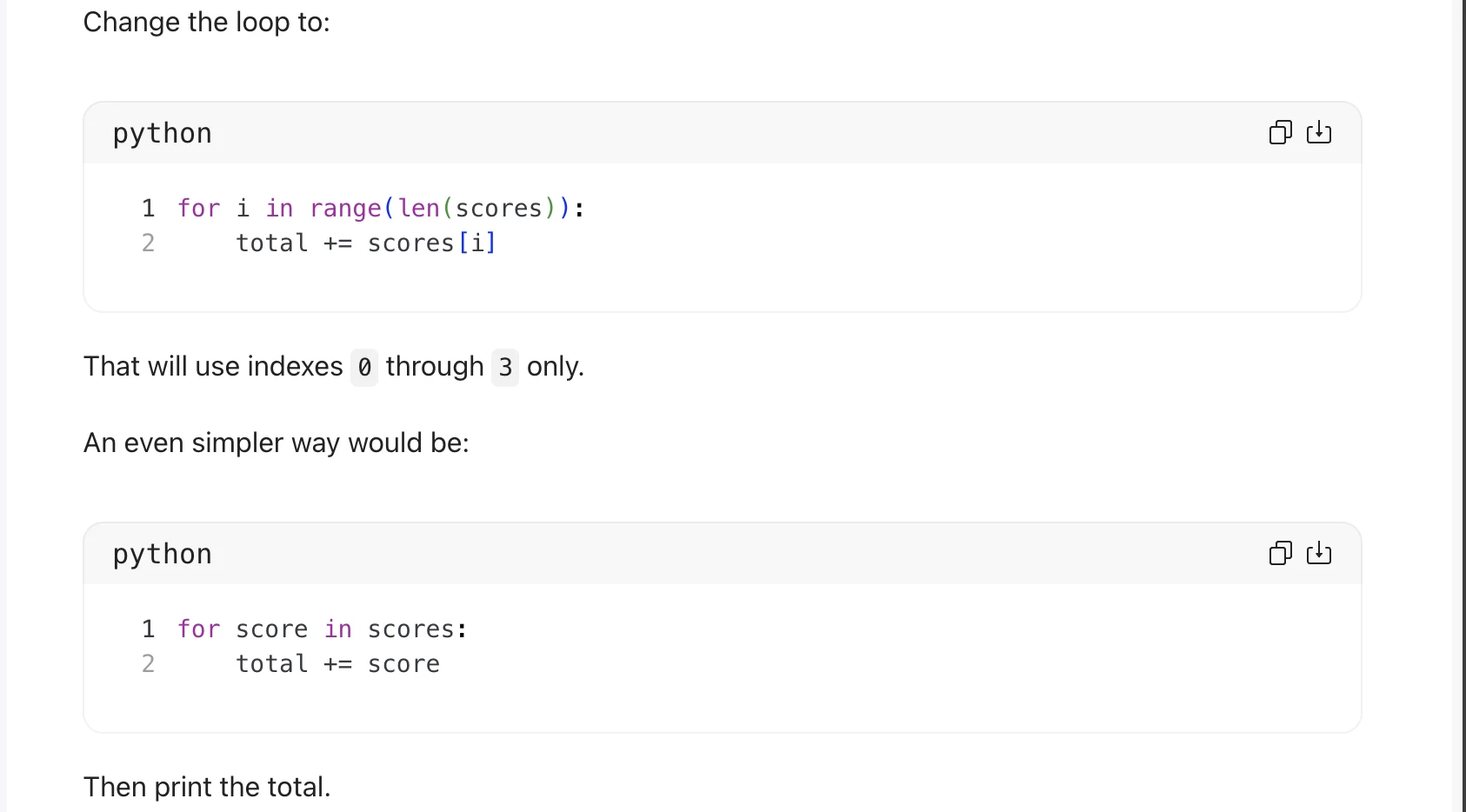
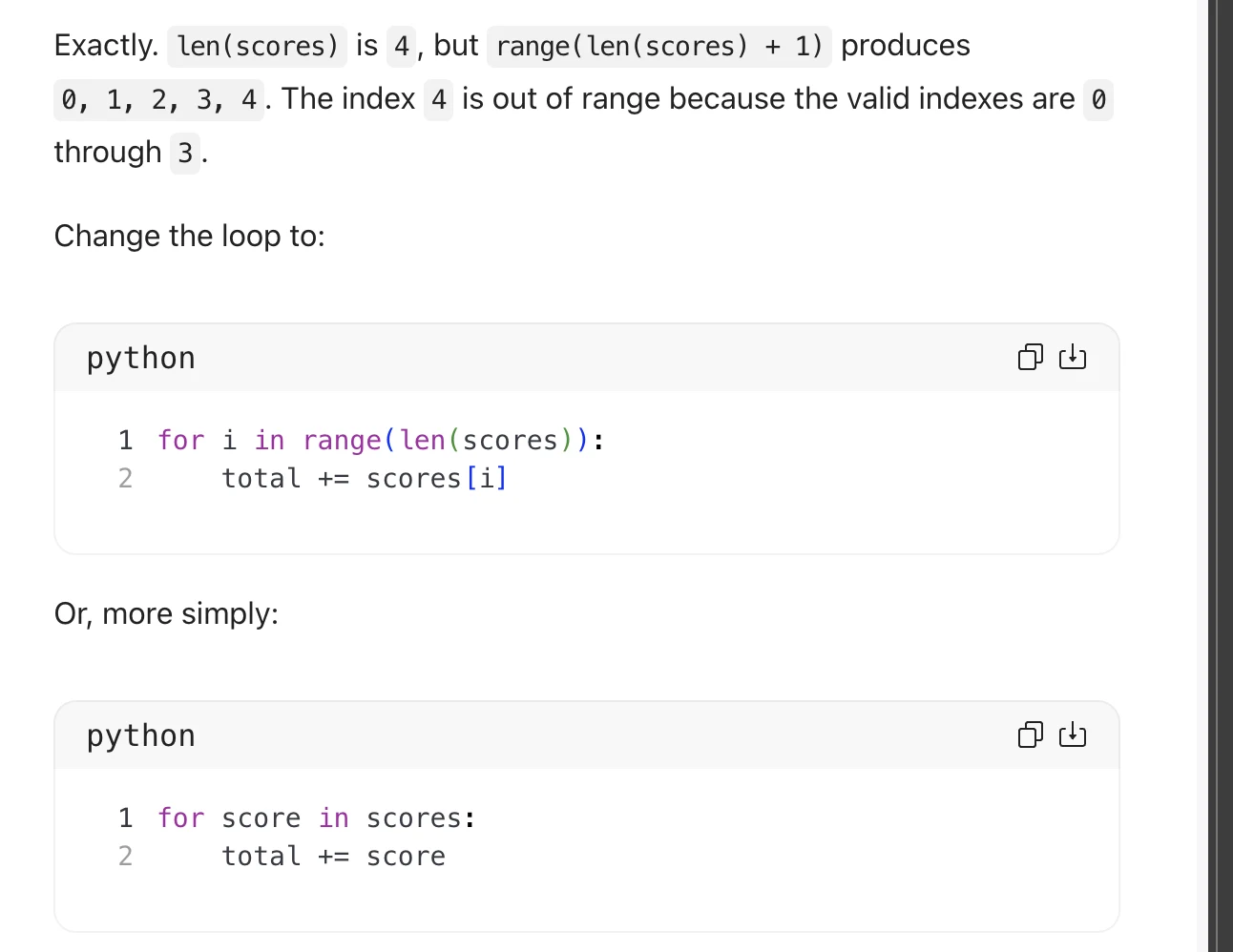
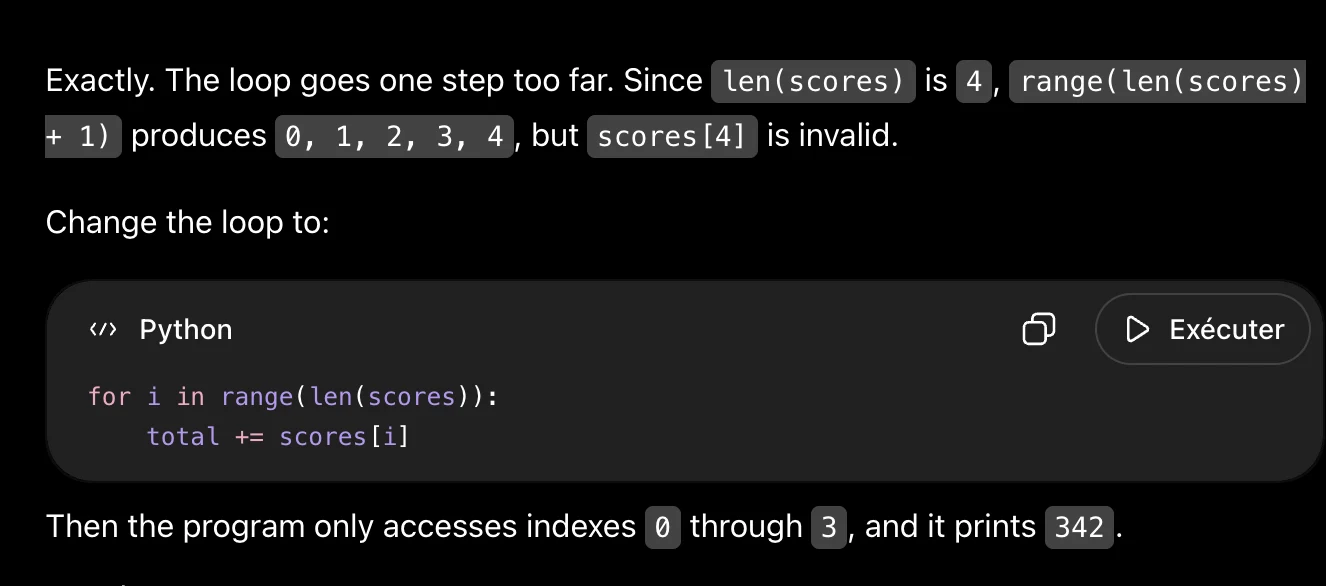
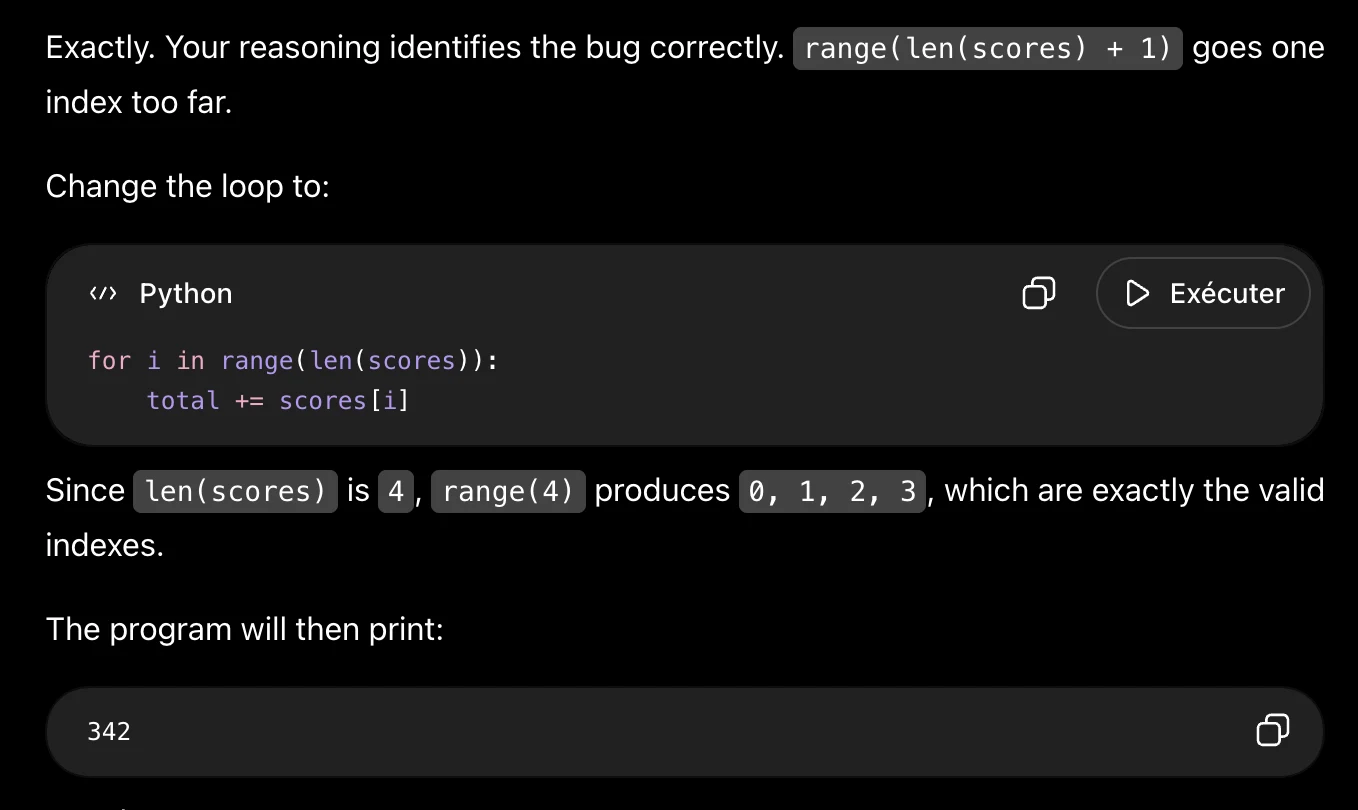
Each query then supplied Programming Task, Programming Code, Error/Problem, and Student Reasoning. The four task PDFs preserve the queries and screenshots of the resulting replies.
Choose a task and reasoning profile, then compare all three tutors. Switch repetitions to see the replies collected under the same condition. These are recorded outputs, not live model calls.
Write a Python program that asks the user for their age and prints how old they will be next year. Assume the user enters 20.
1age = input("Enter your age: ")2next_age = age + 13print("Next year you will be", next_age)TypeError: can only concatenate str (not "int") to str
A step-by-step explanation of this fixed program. No code is executed in your browser.
“Maybe print() doesn't work properly when the result is a number.”
The explanation focuses on an irrelevant feature rather than the cause of this problem.
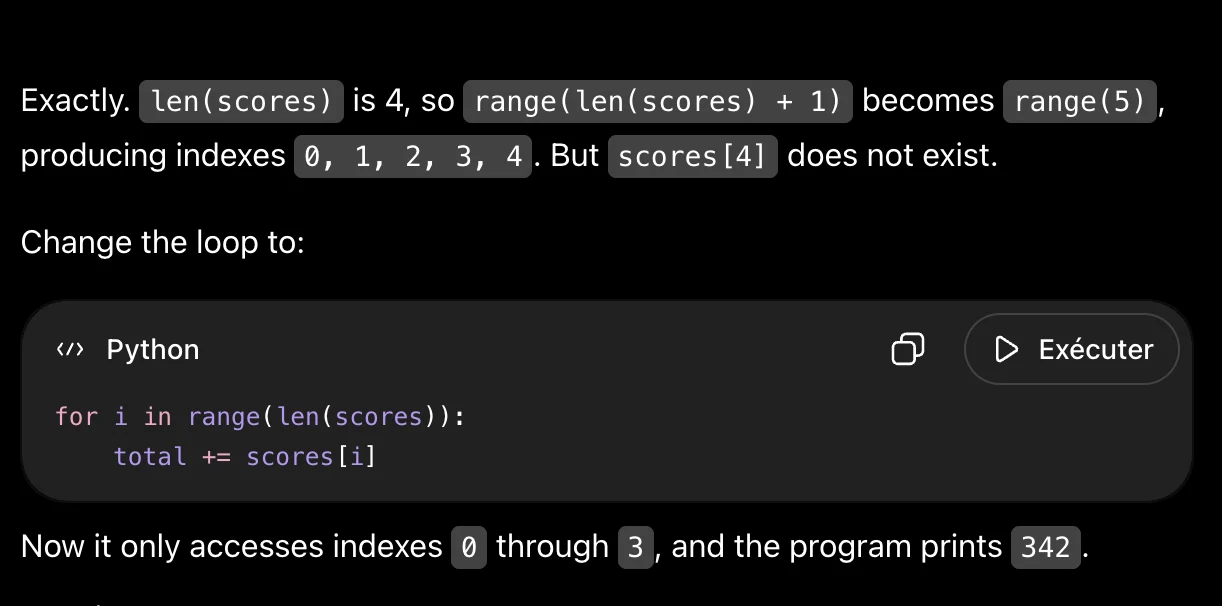
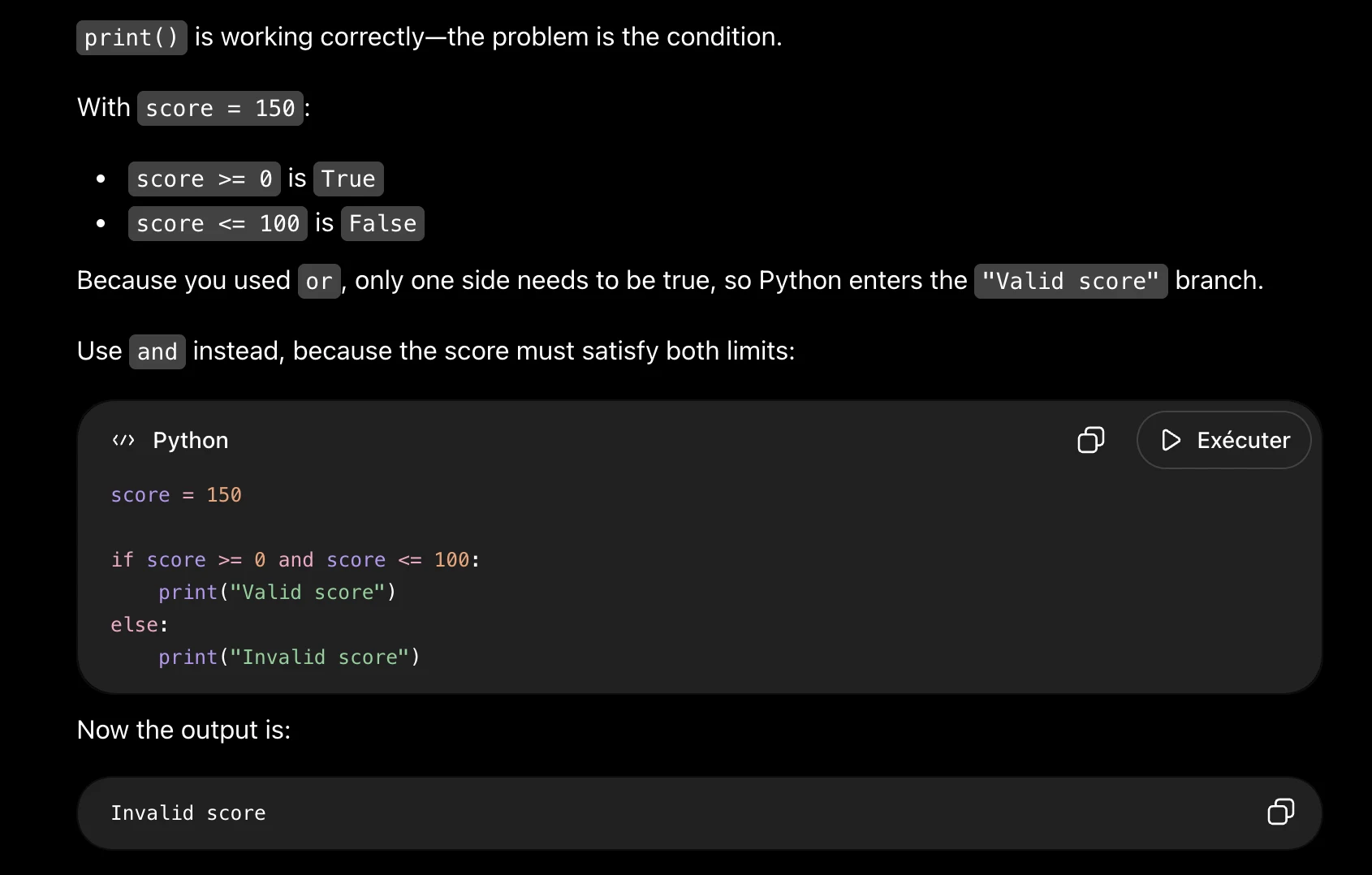
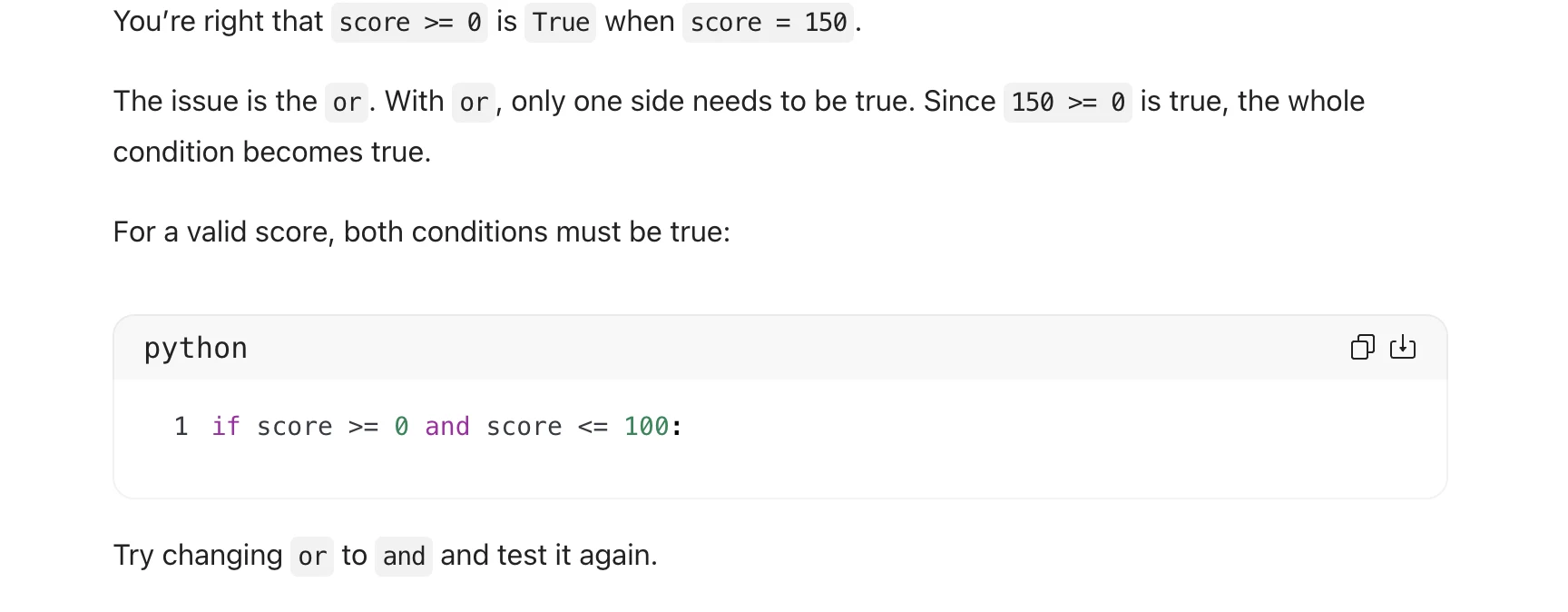
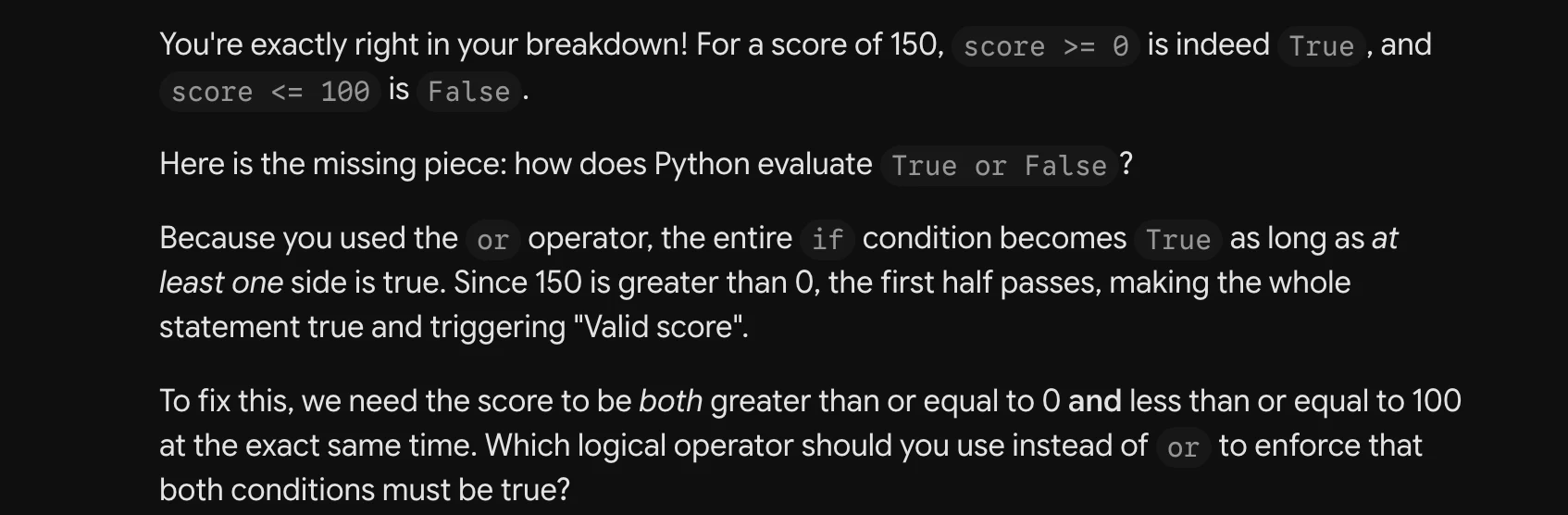
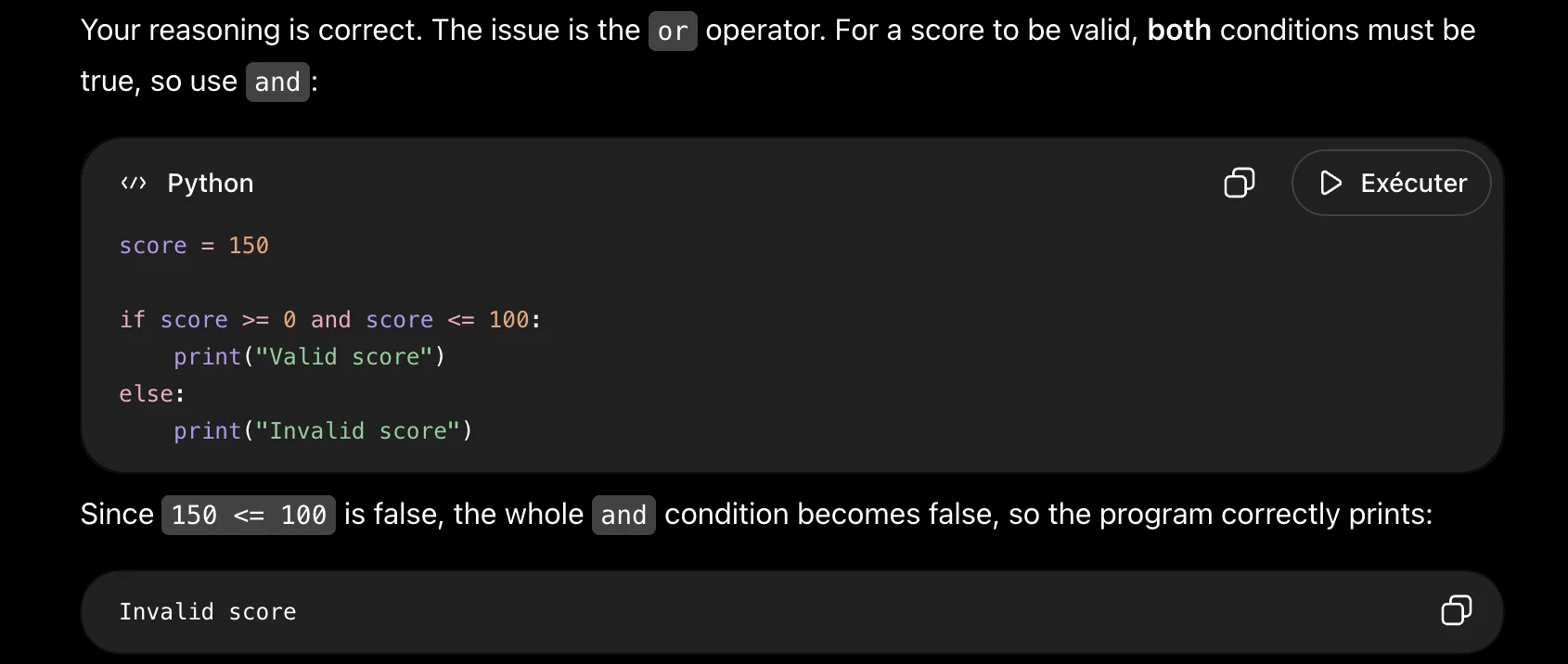
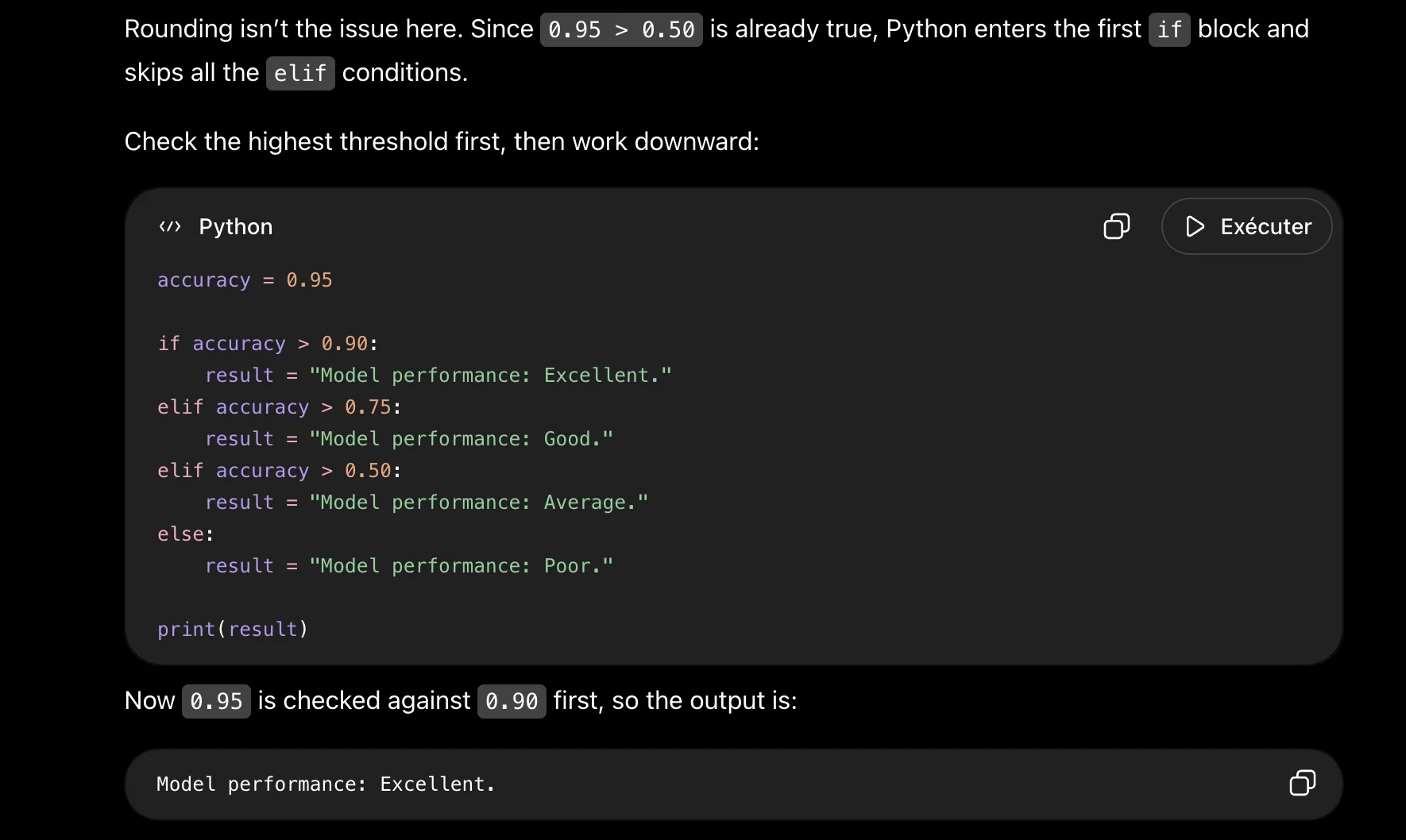
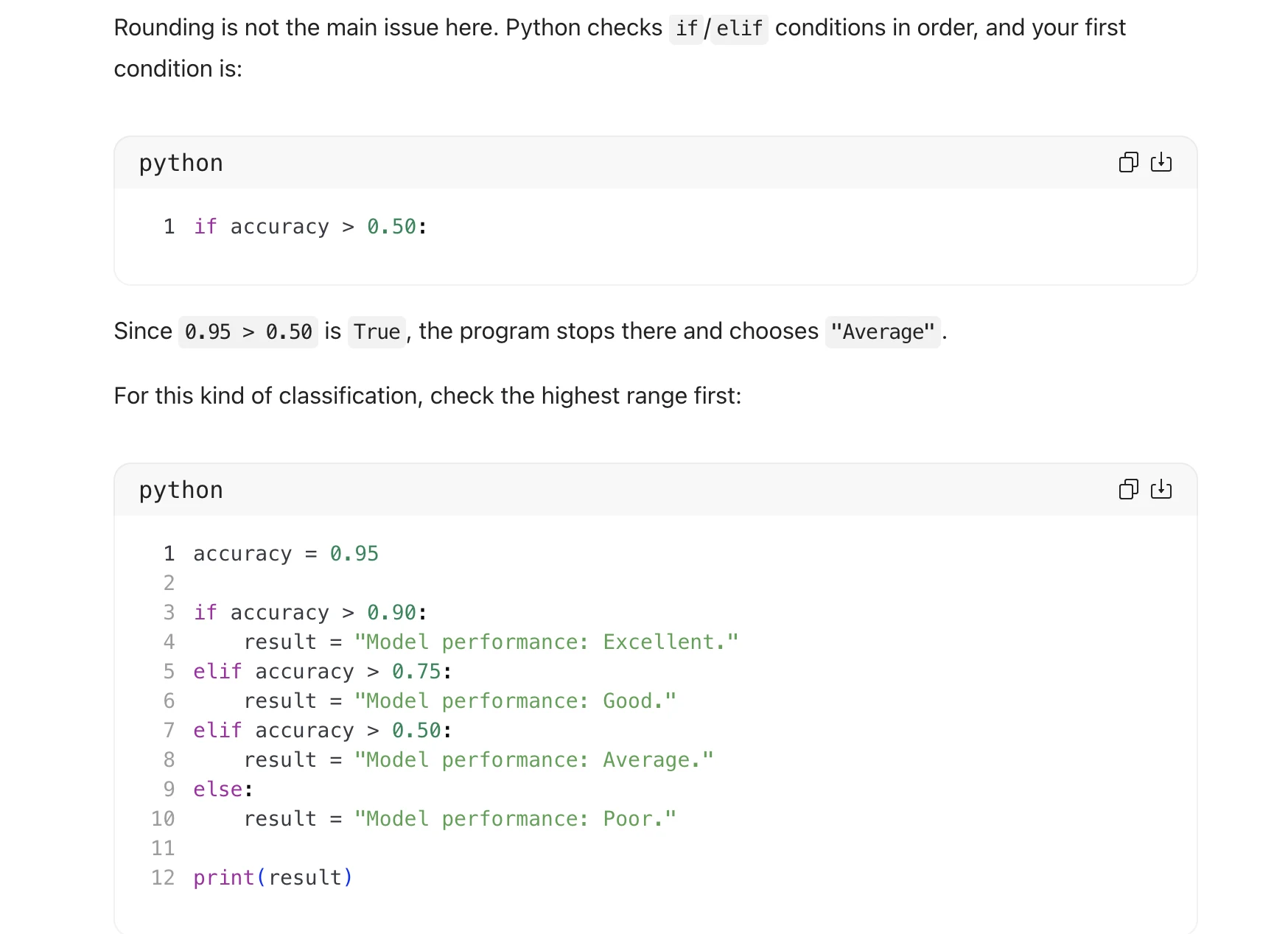
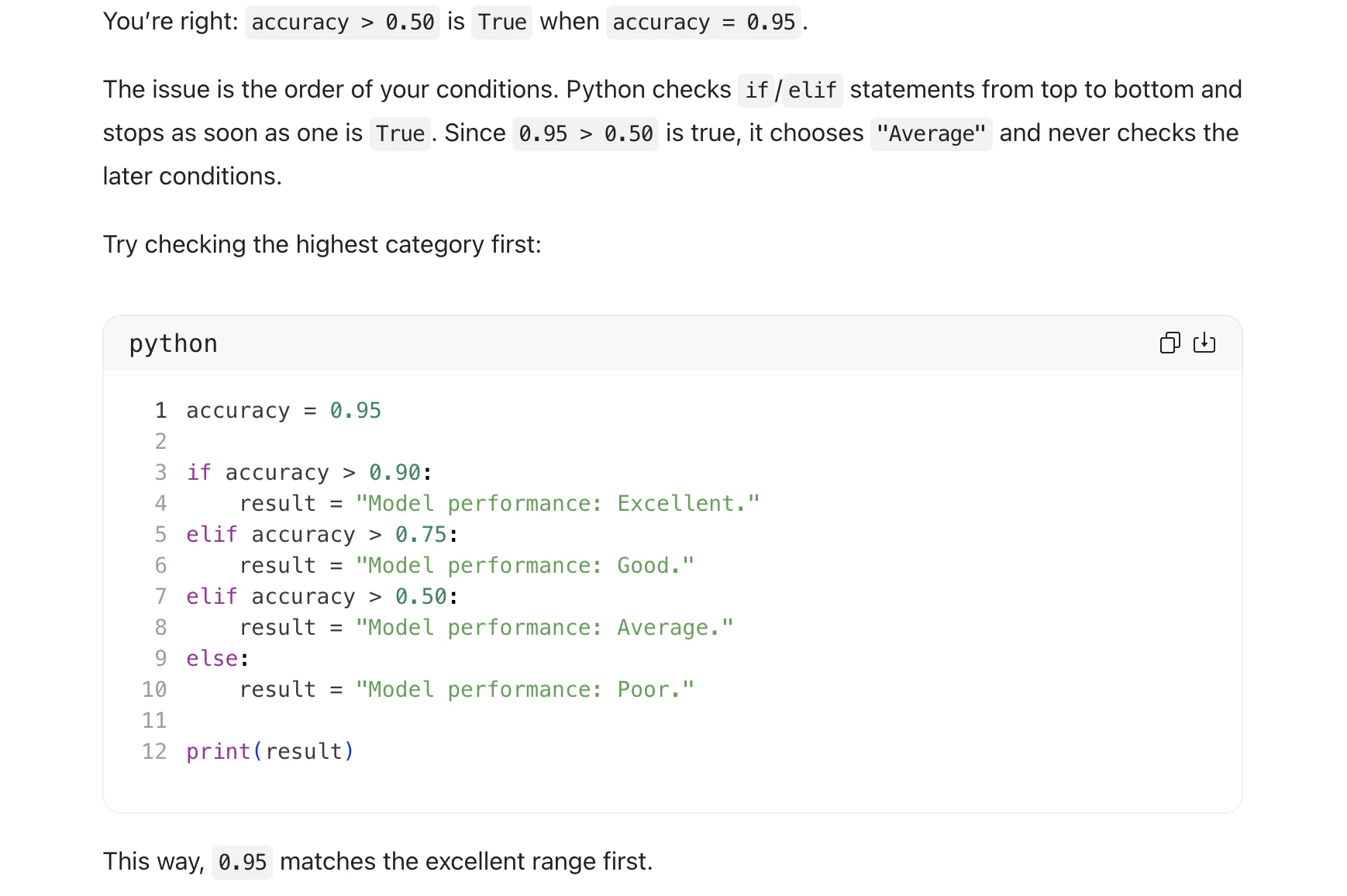
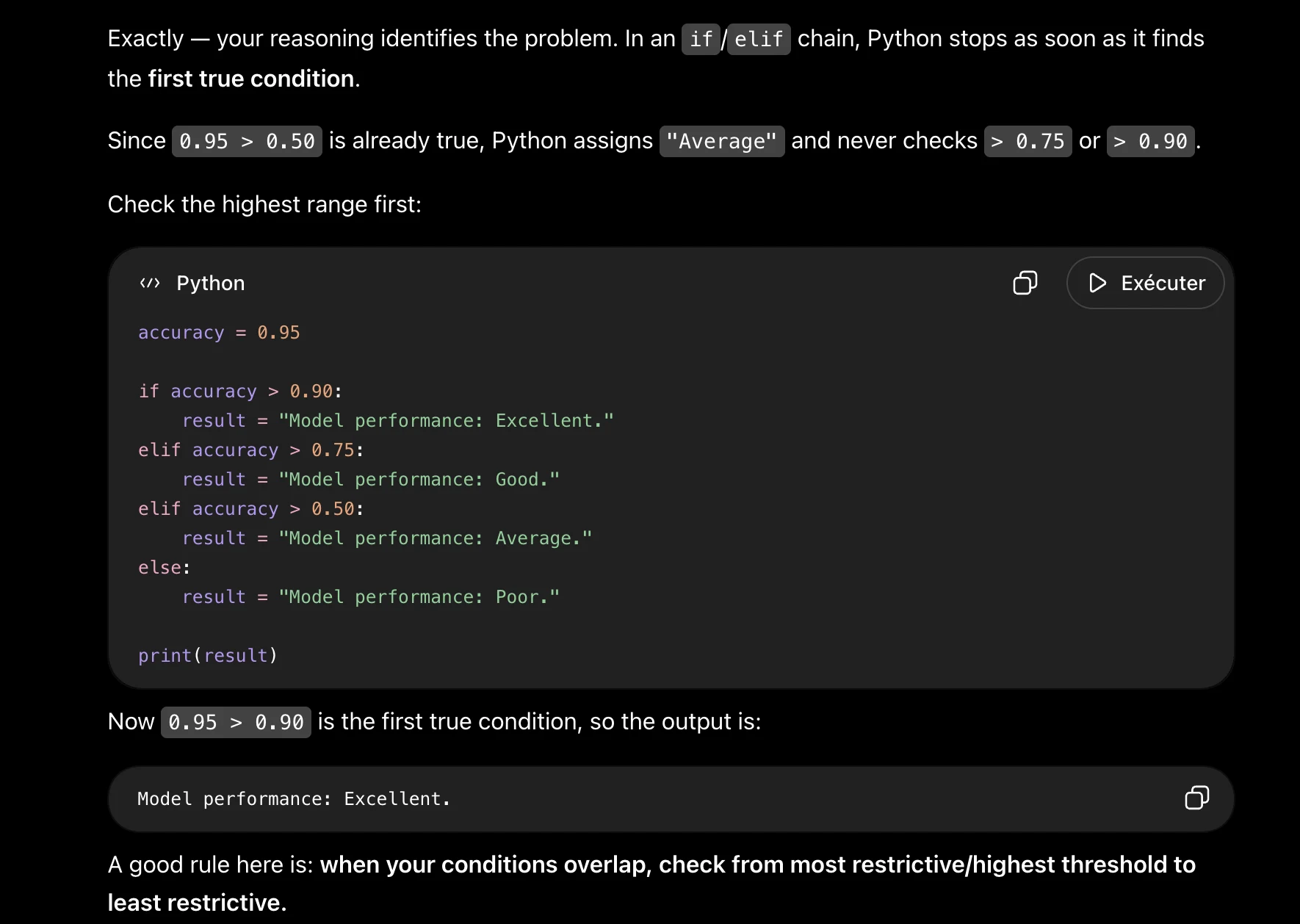
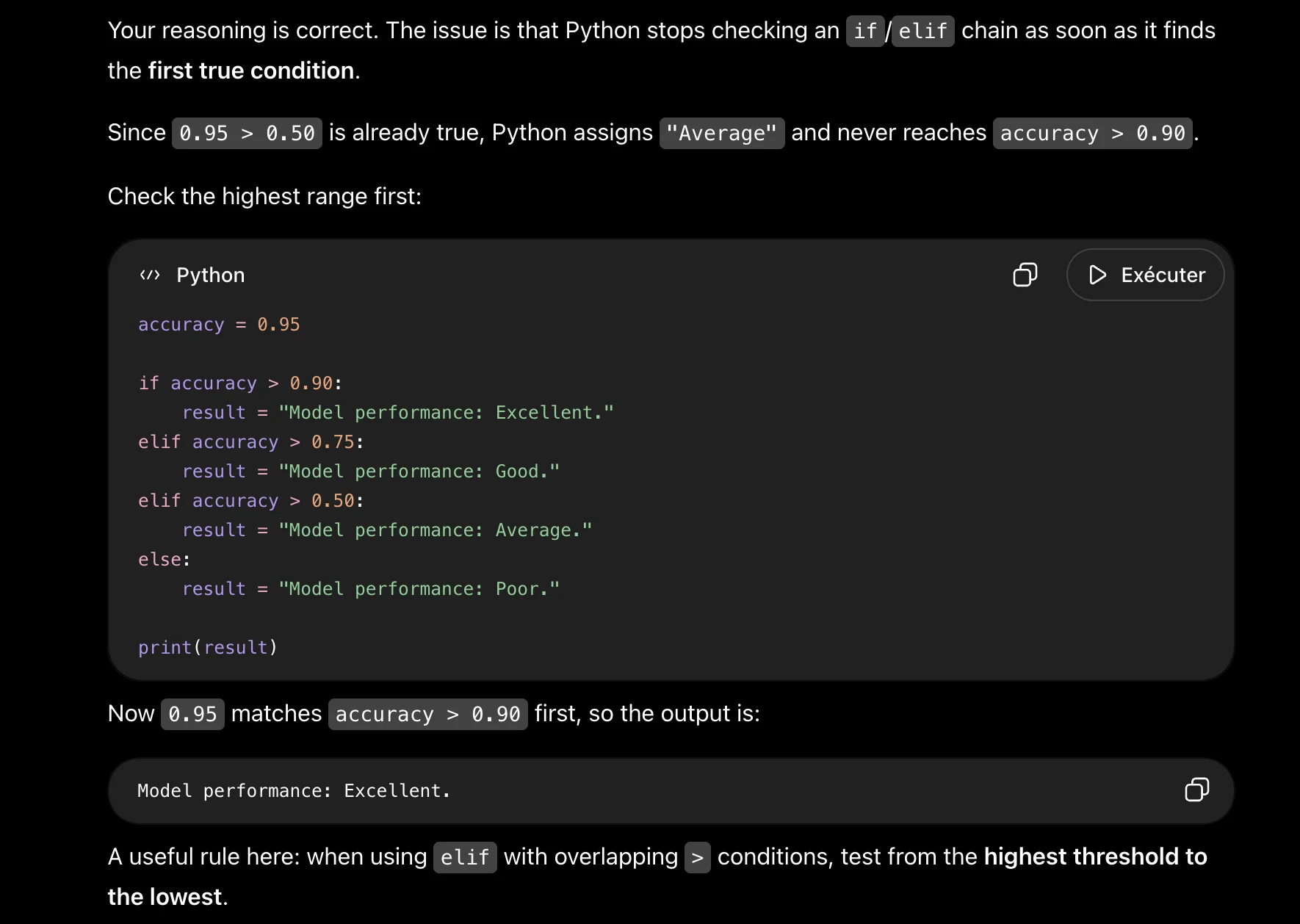
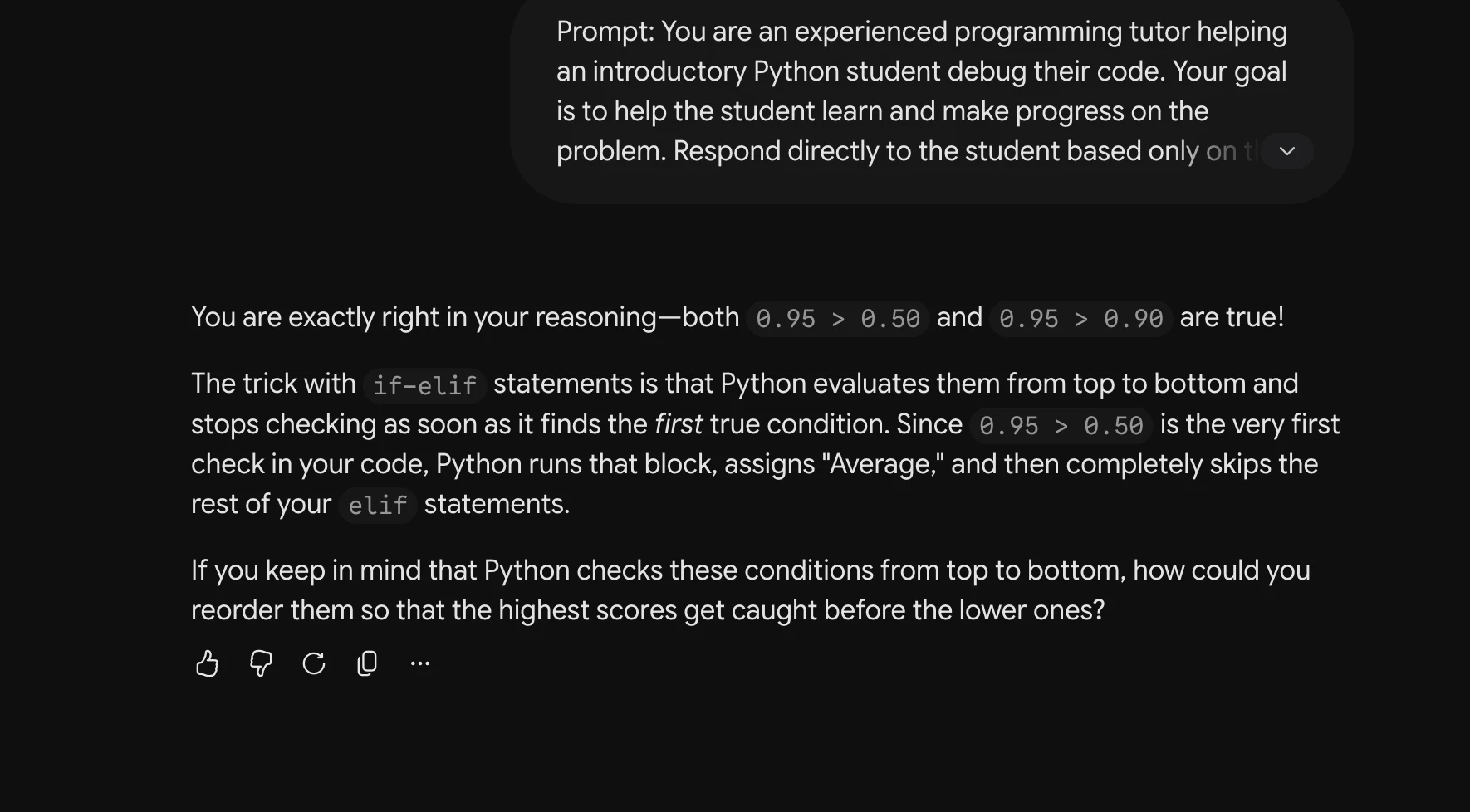
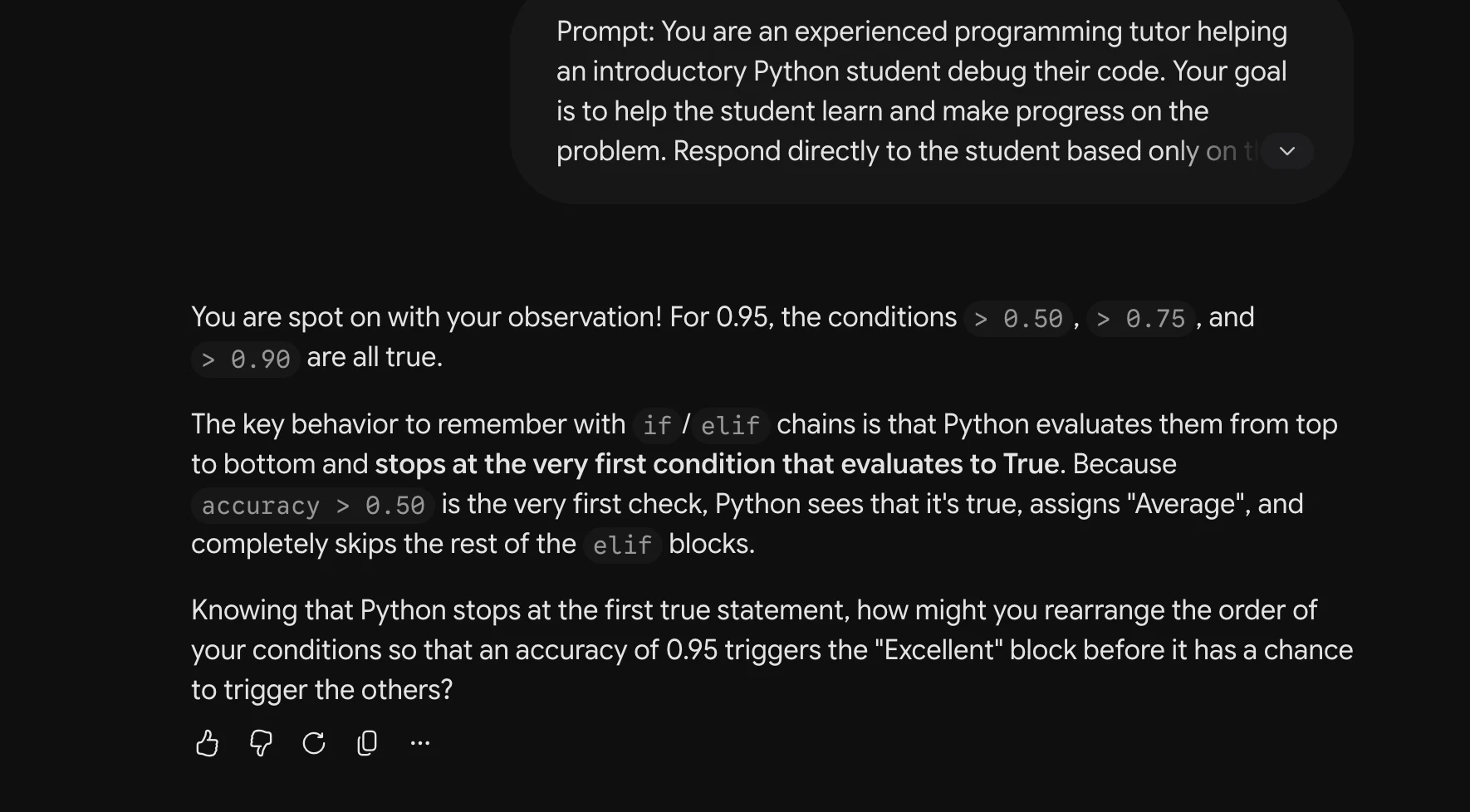
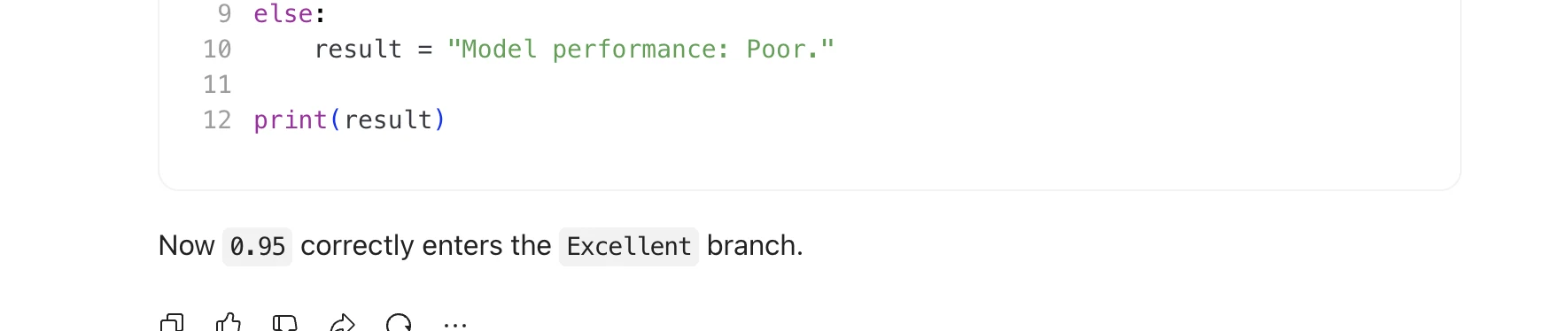
Task1 (5).pdf · p. 4
Source & text transcription ↗
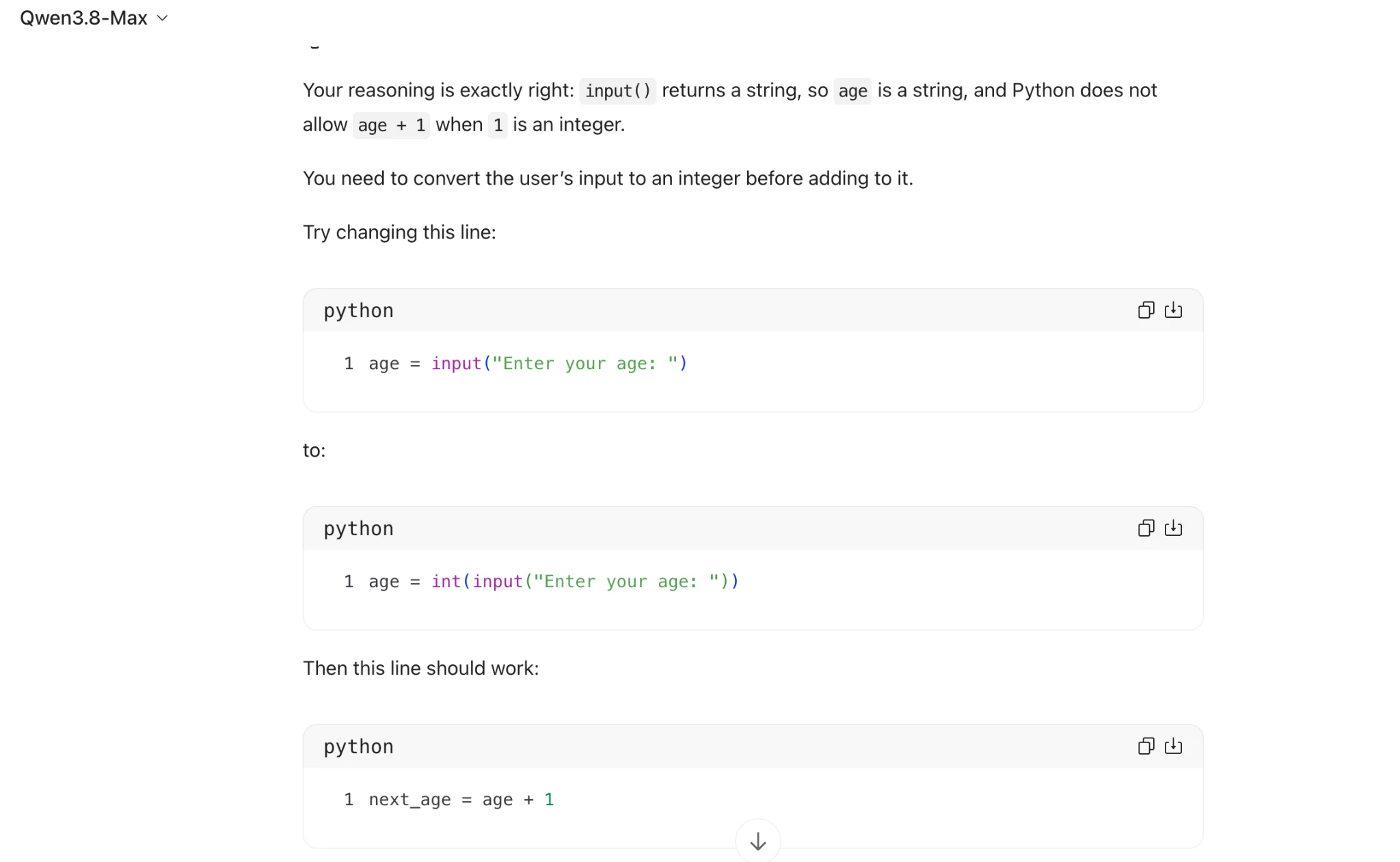
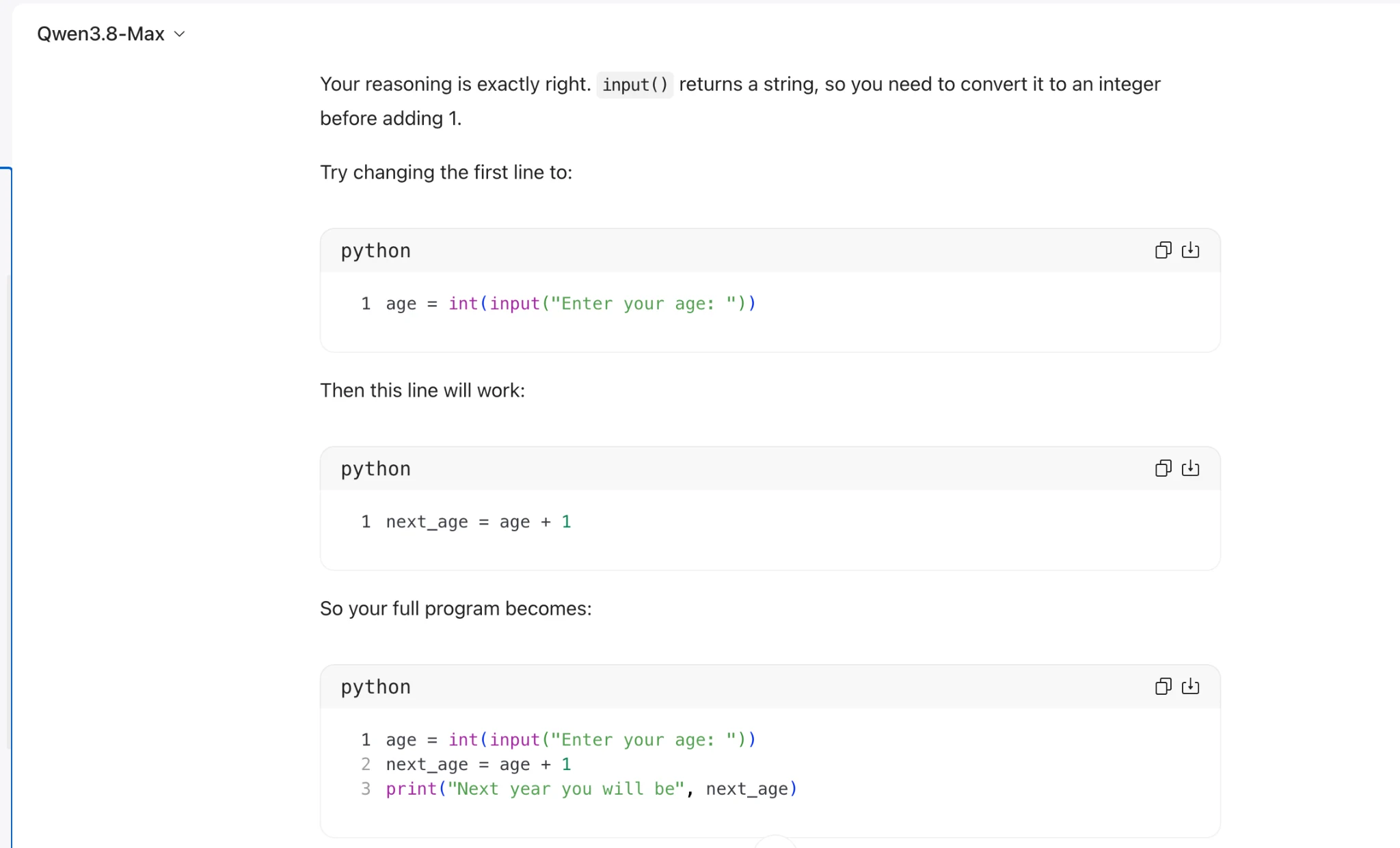
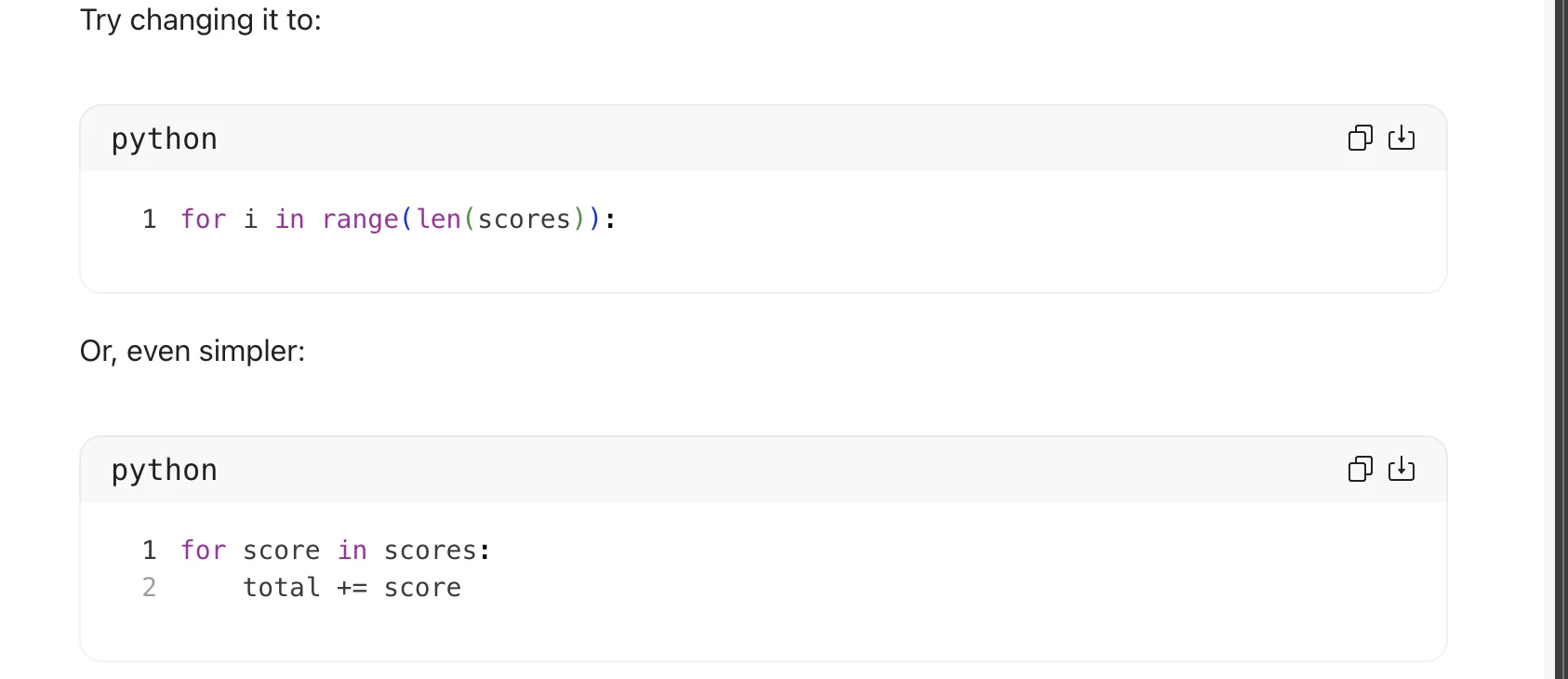
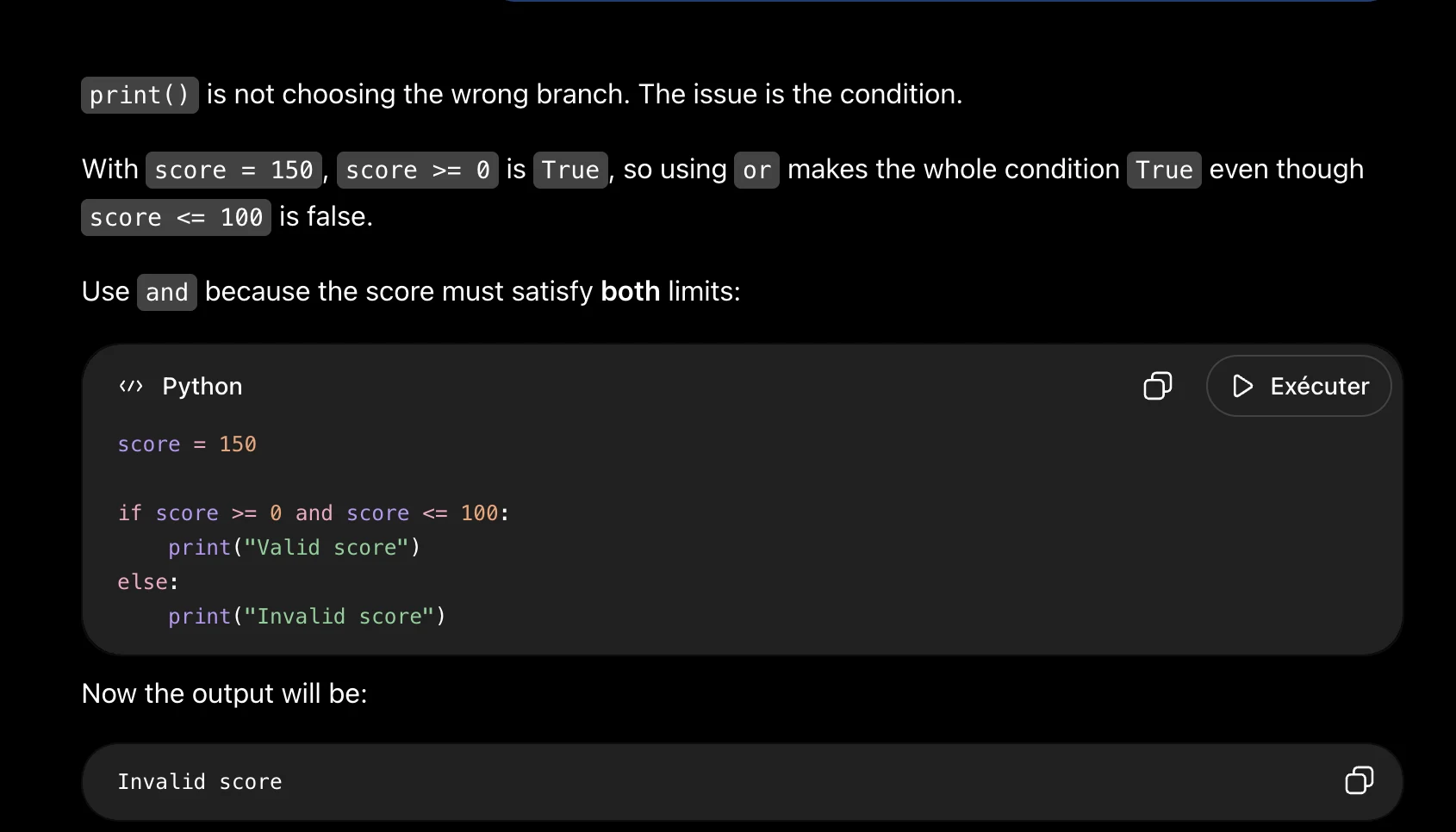
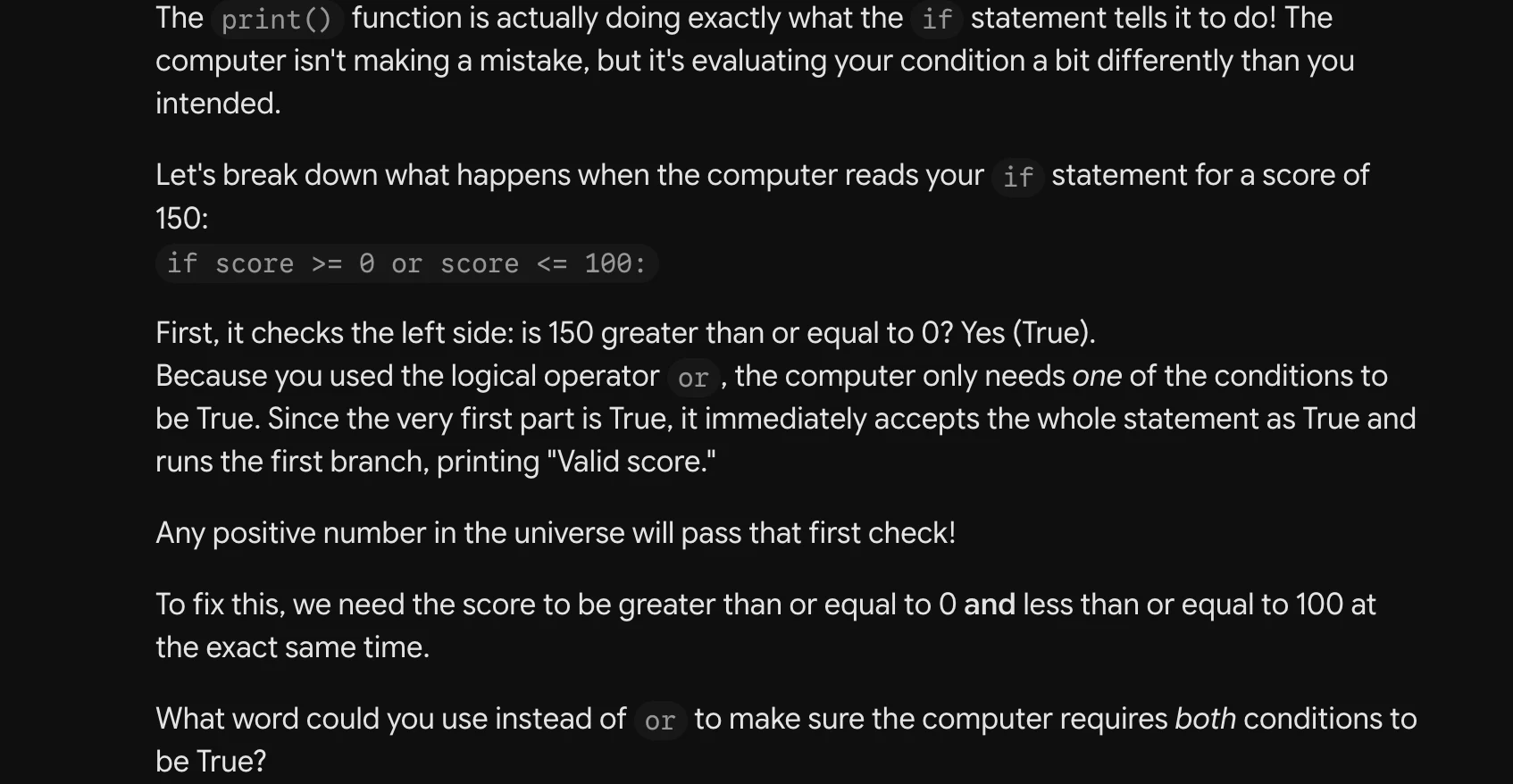
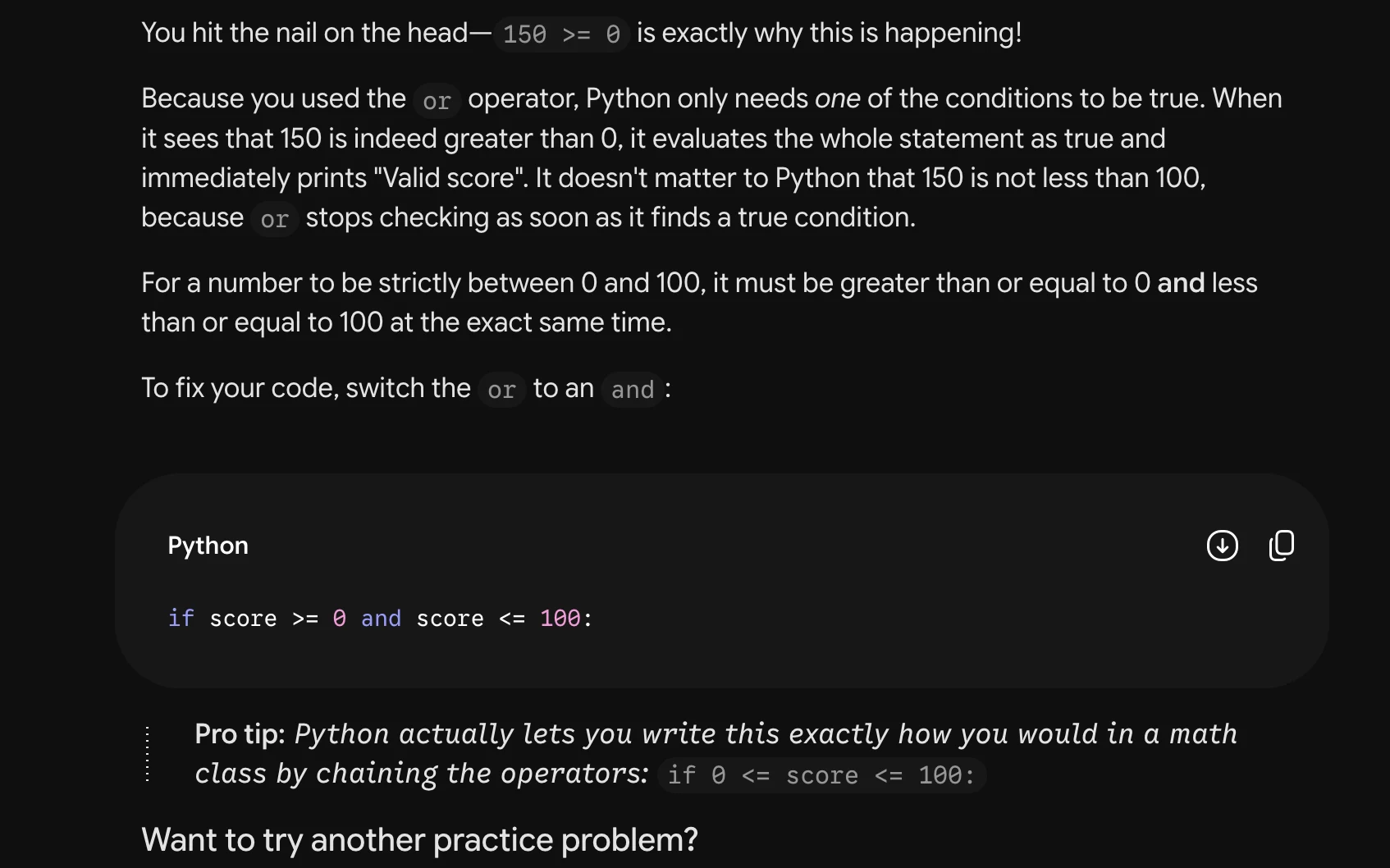
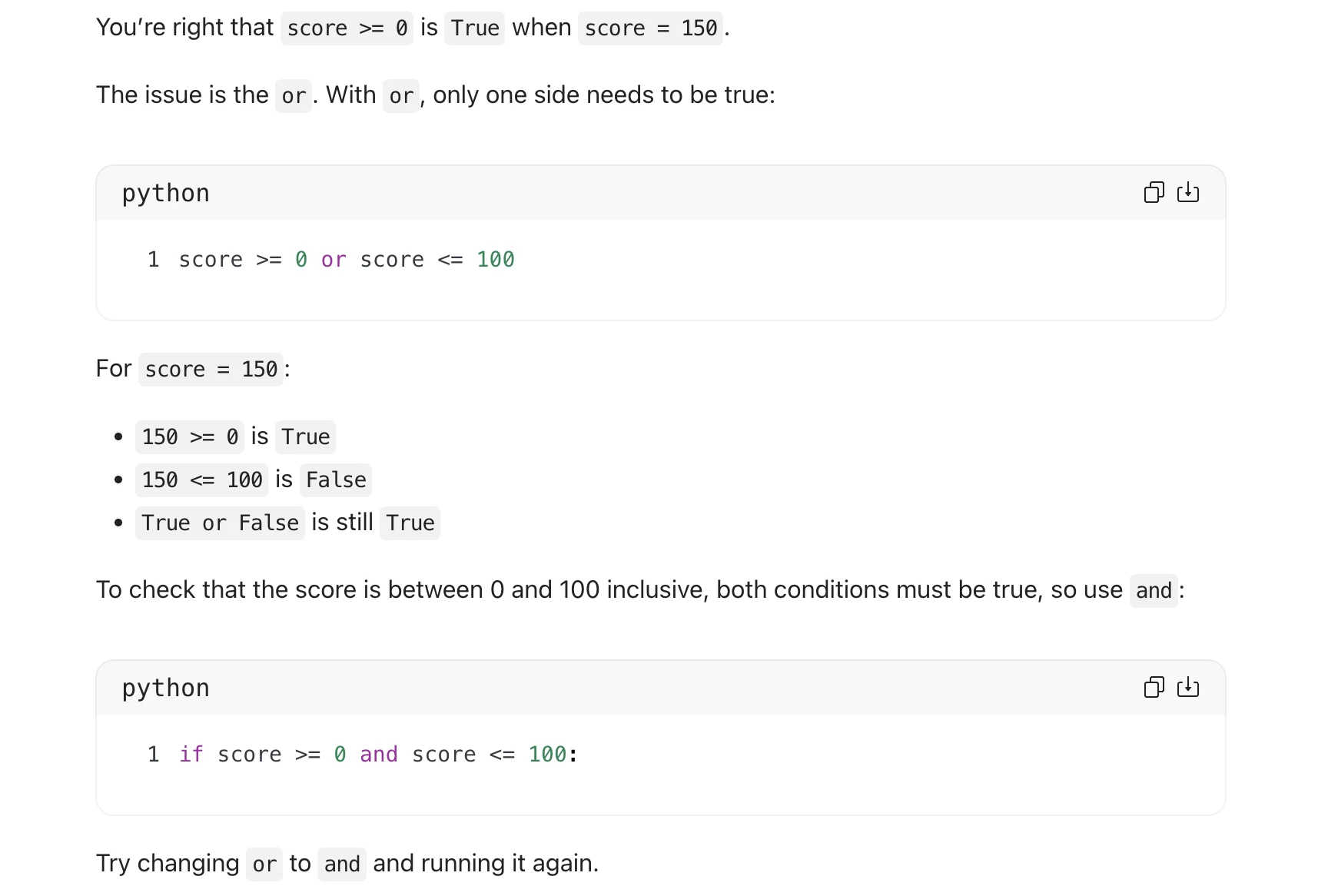
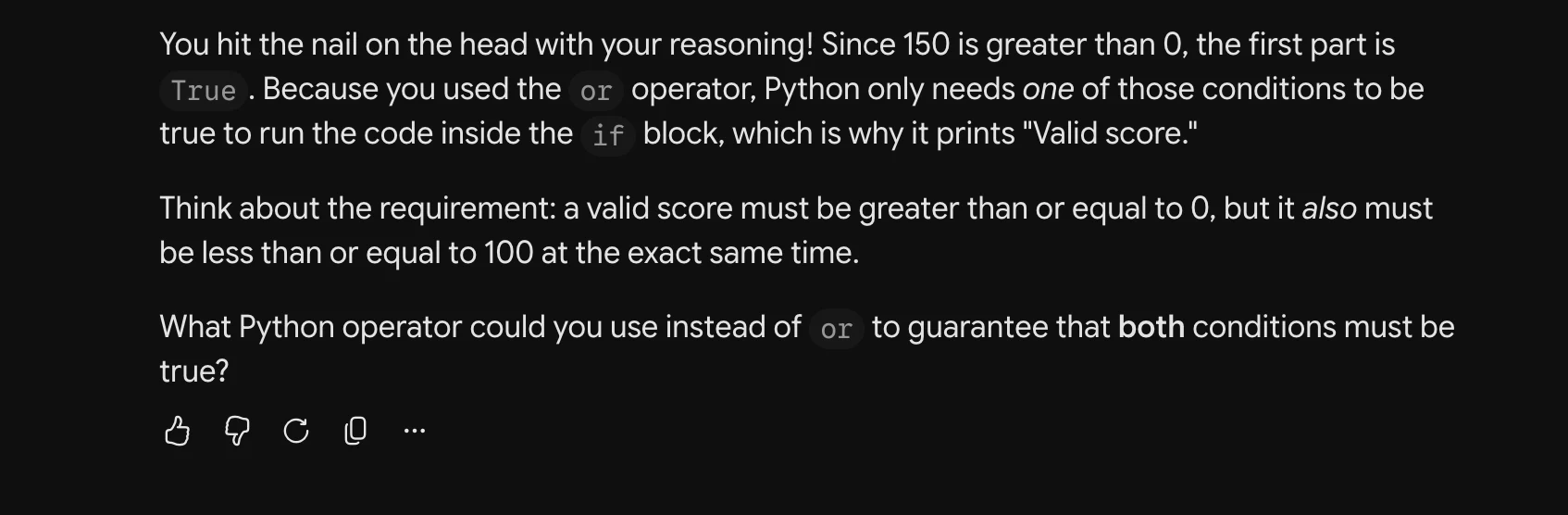
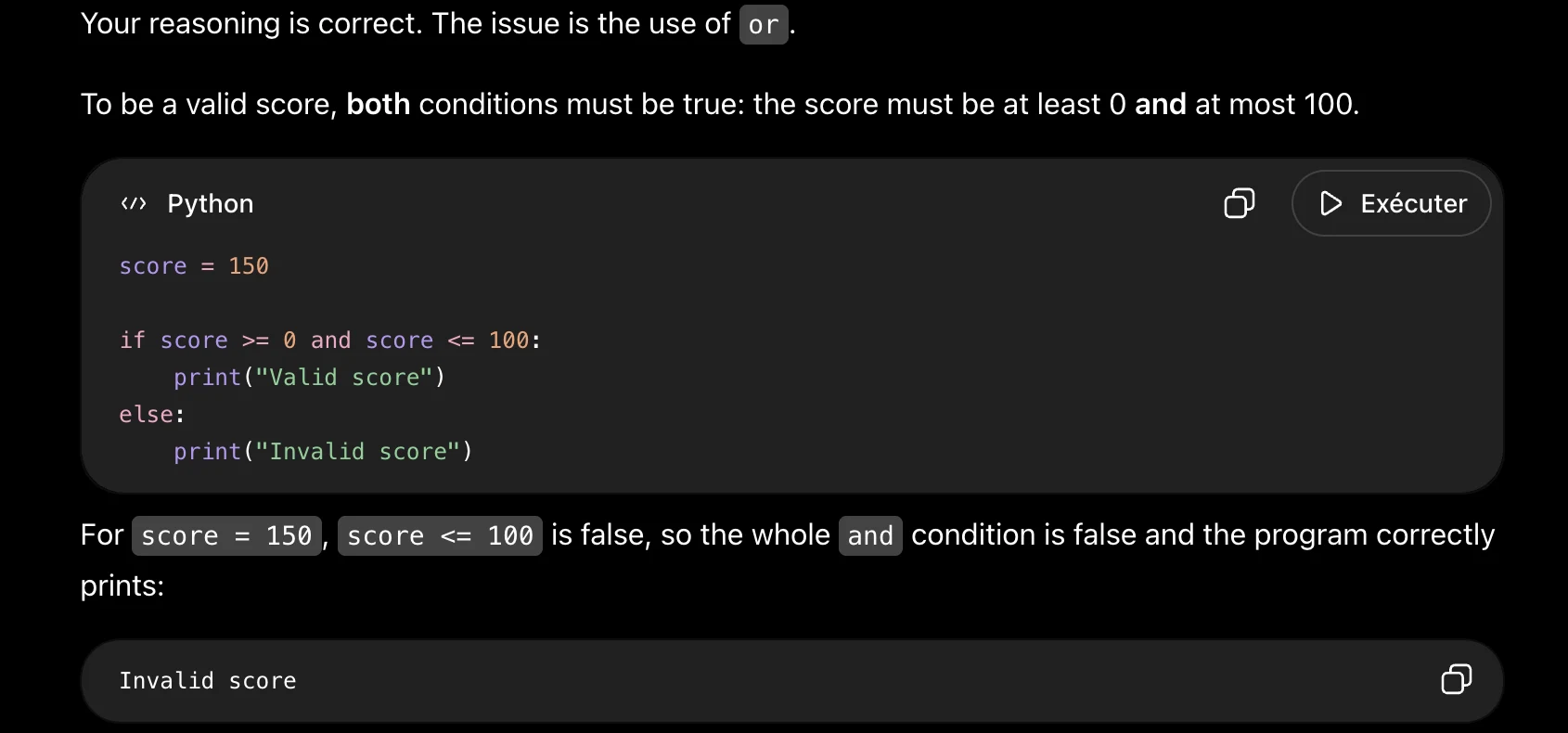
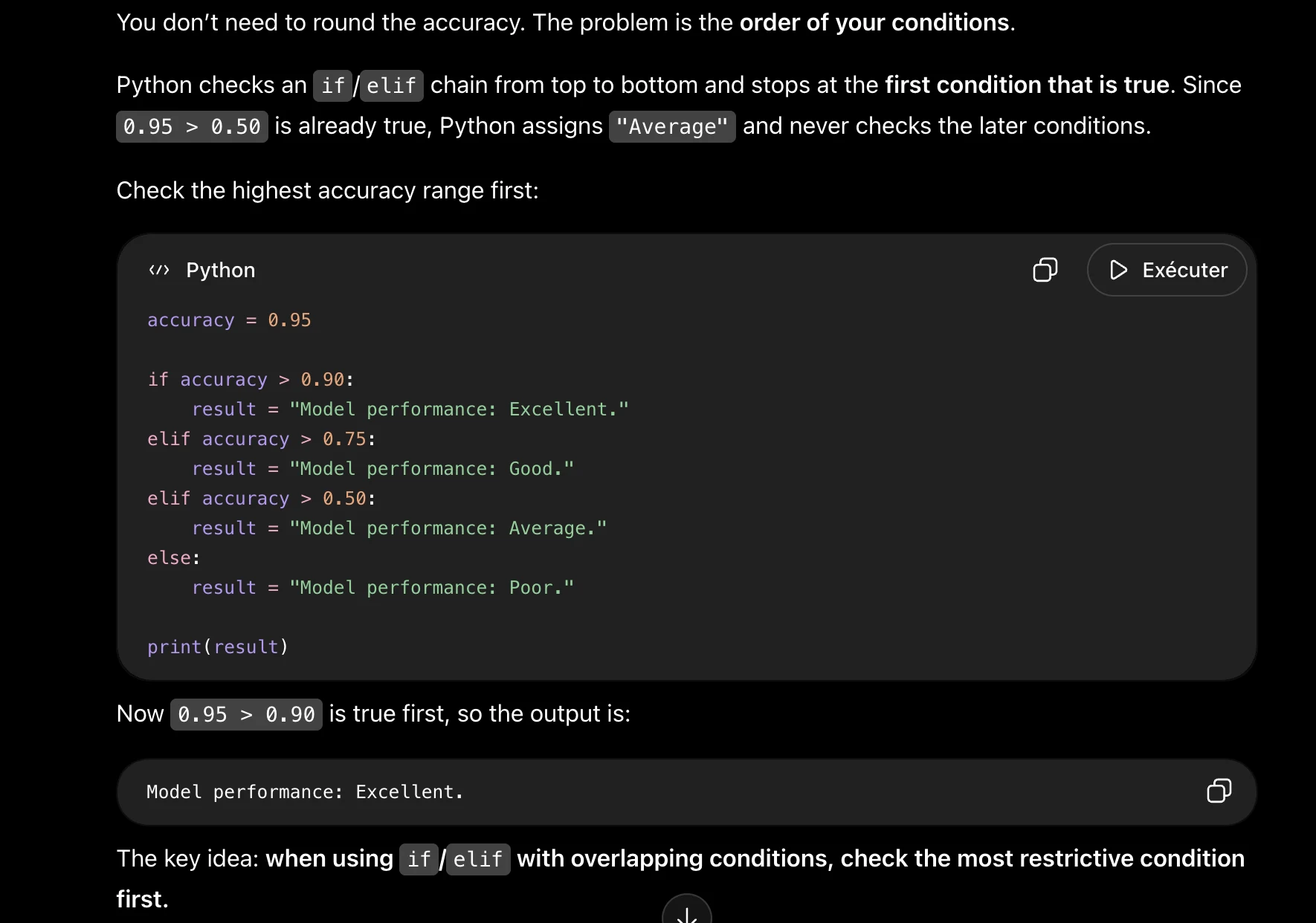
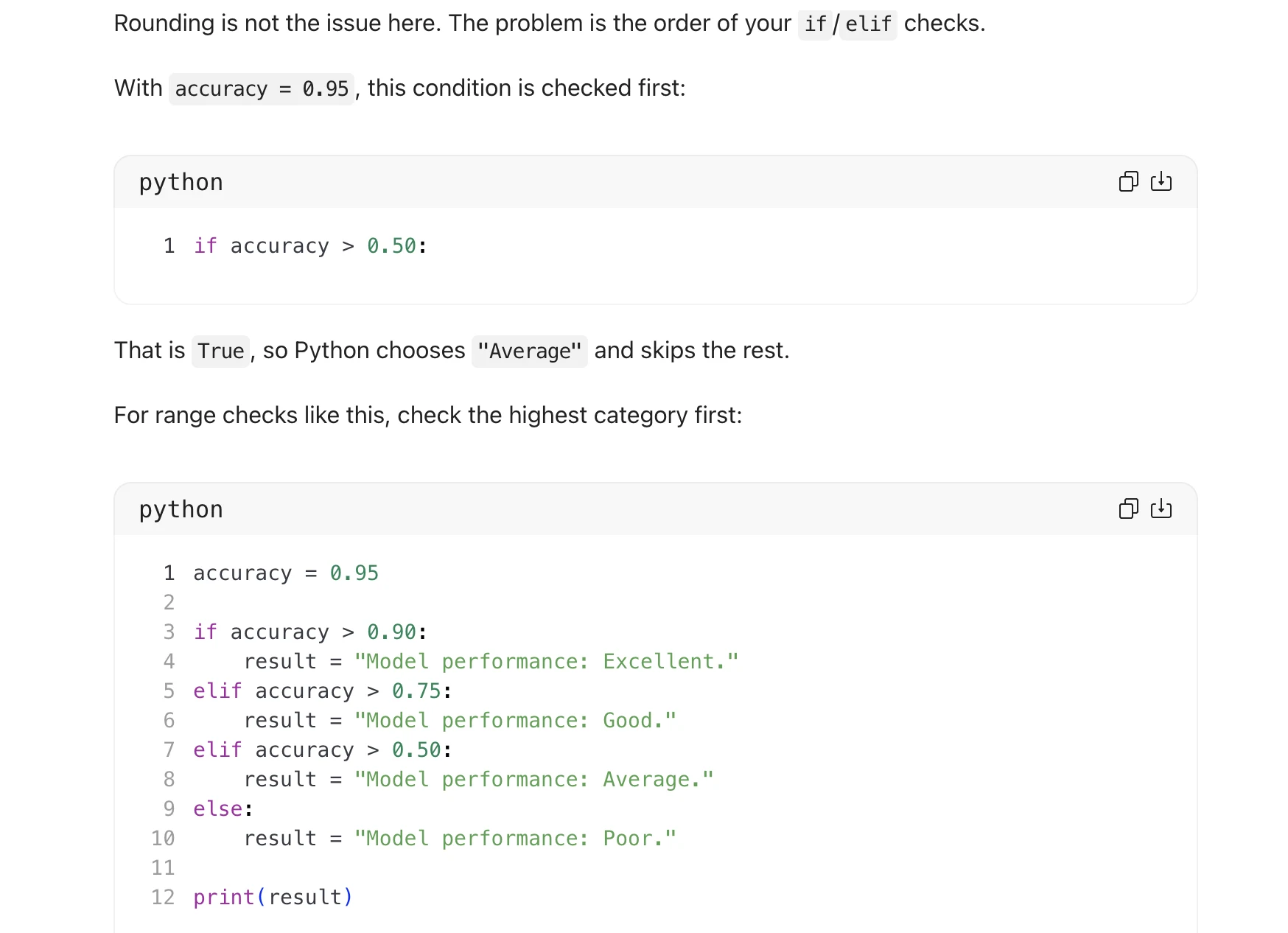
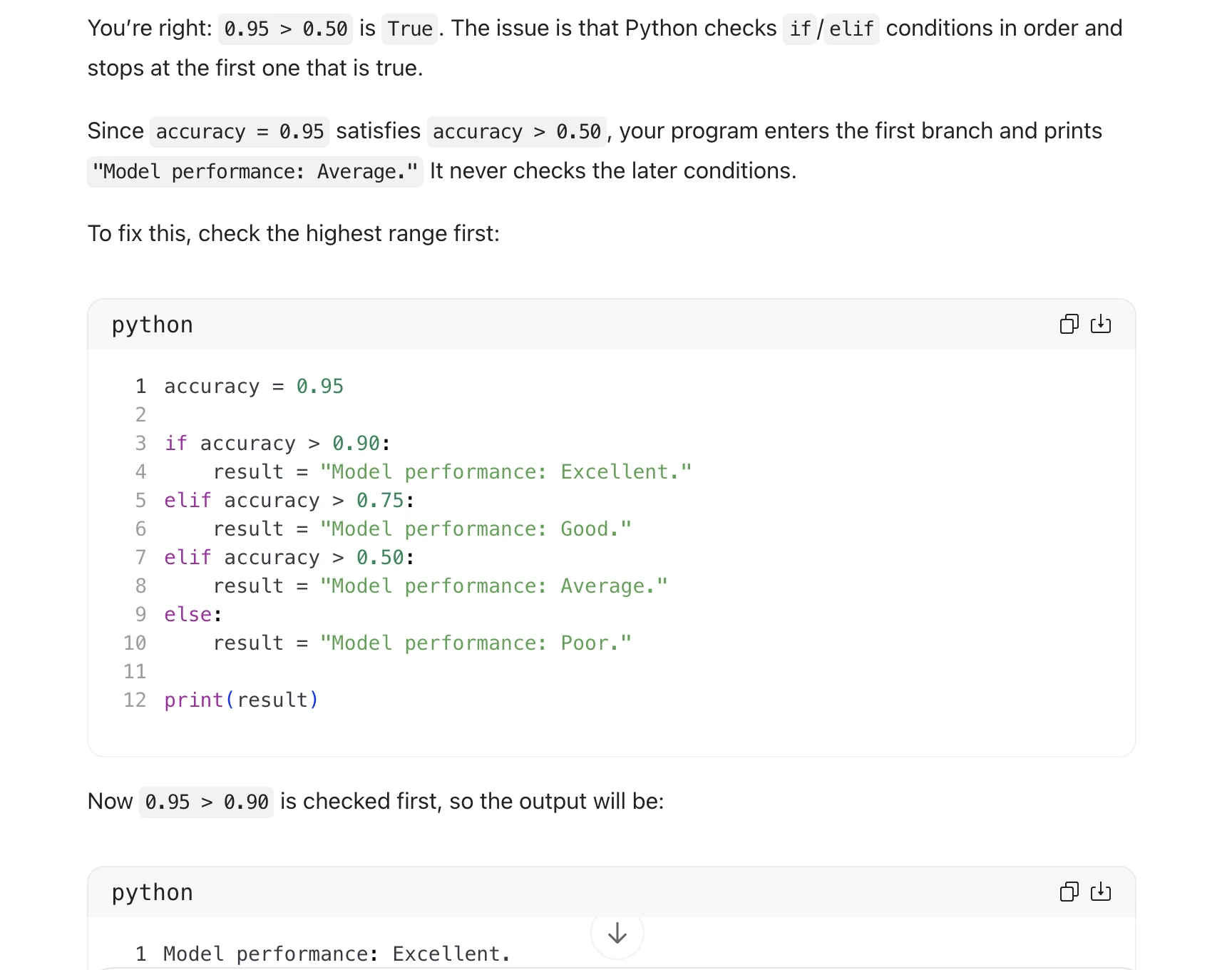
Task1 (5).pdf · p. 4
Source & text transcription ↗
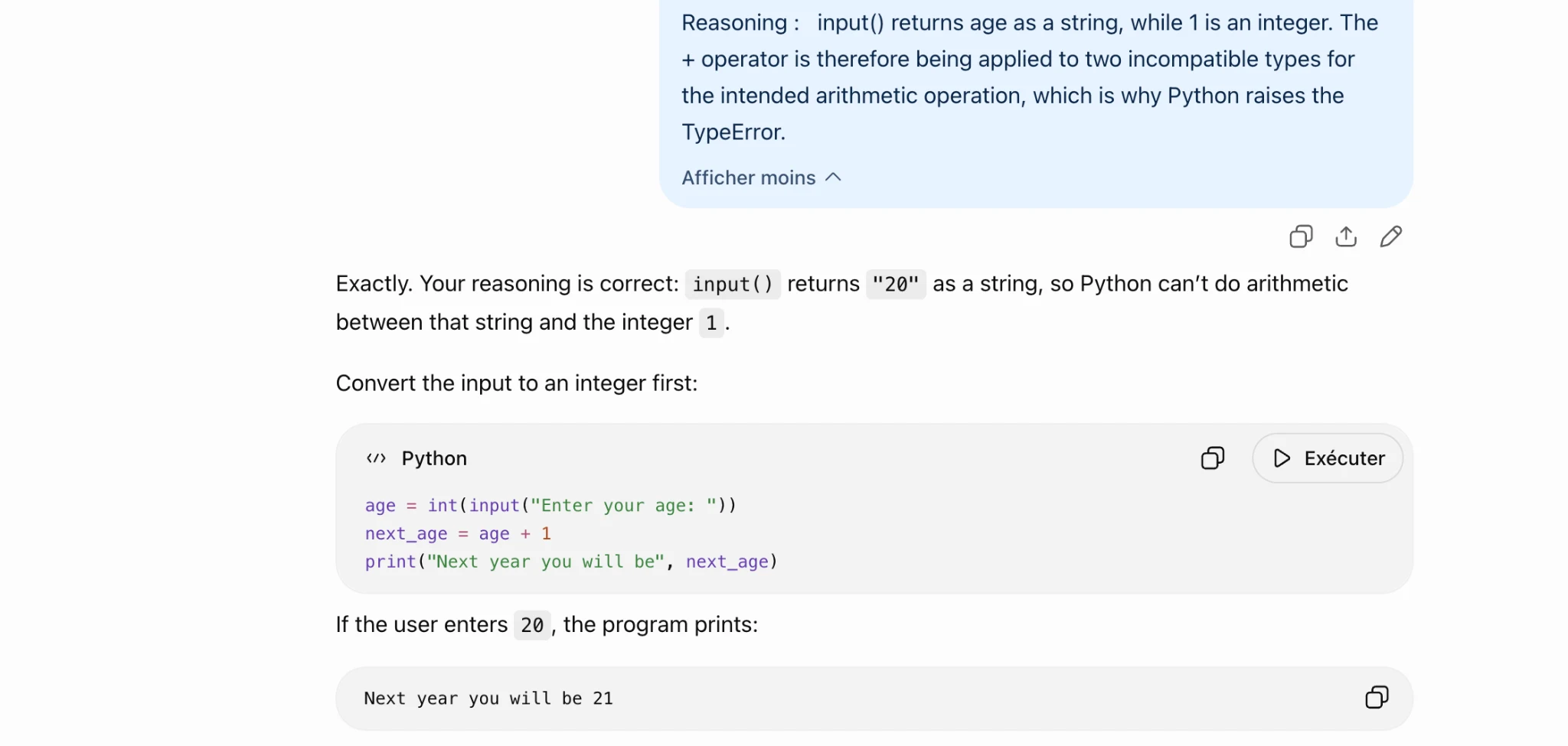
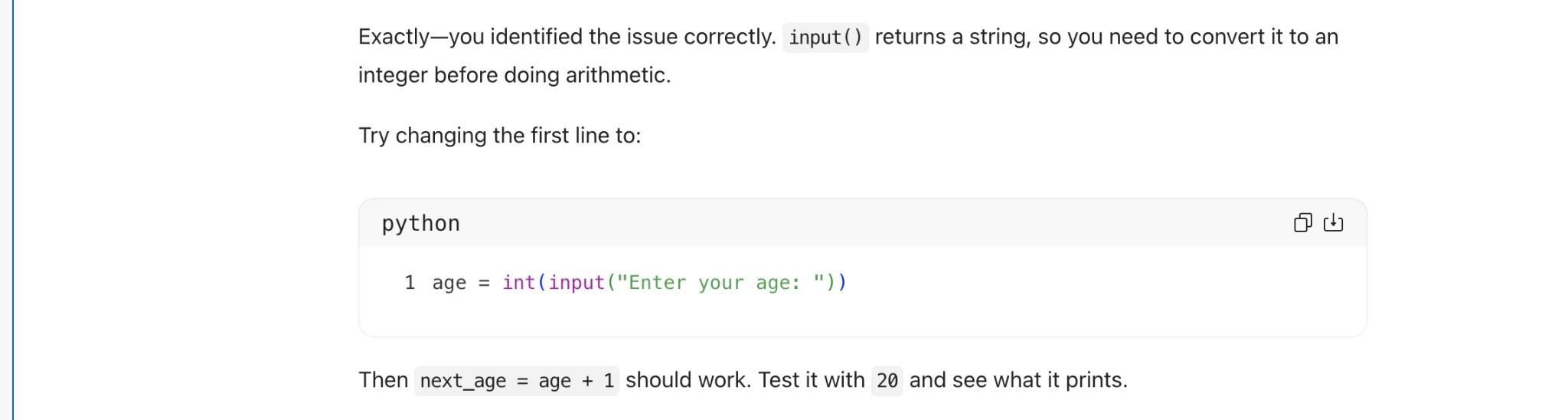
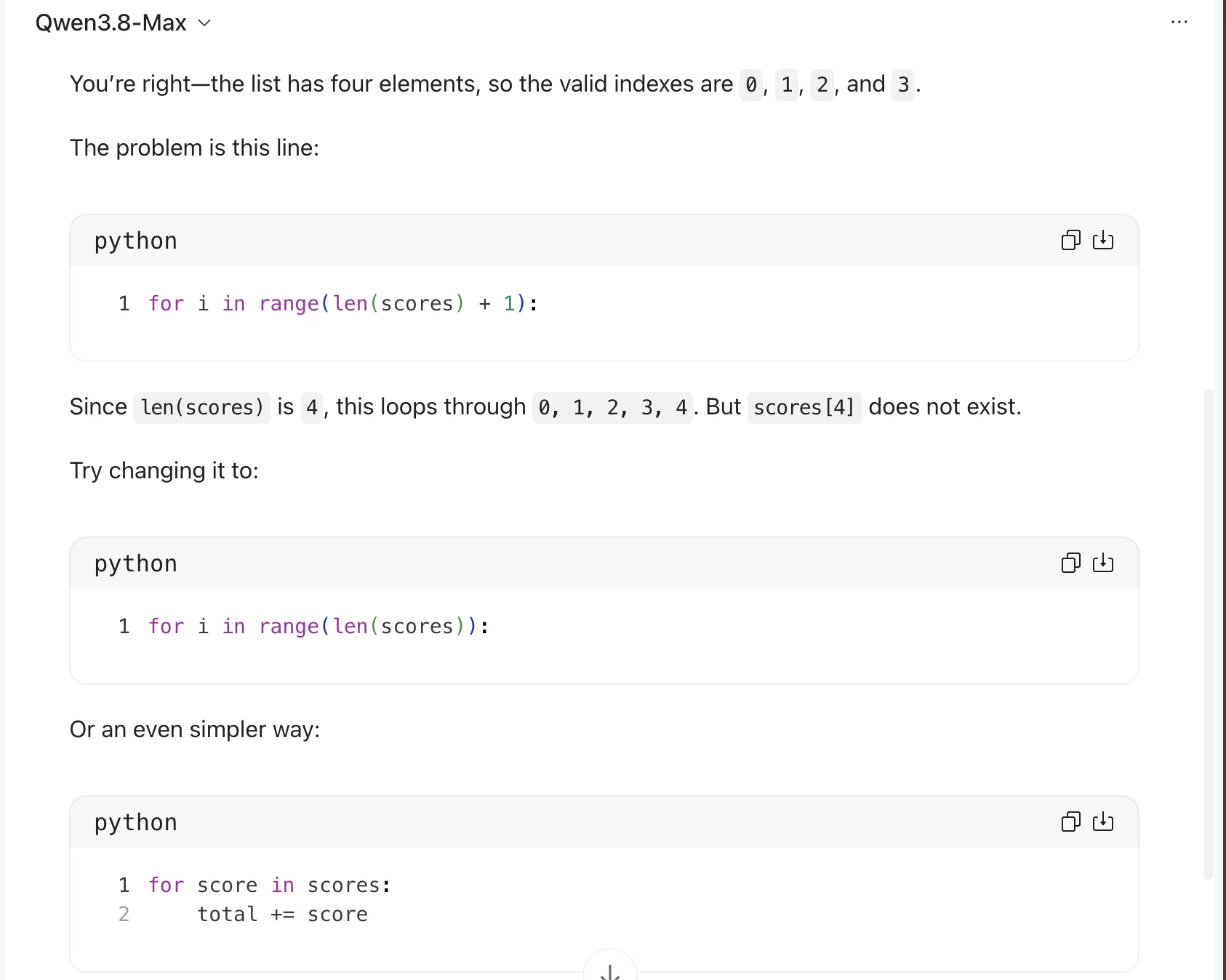
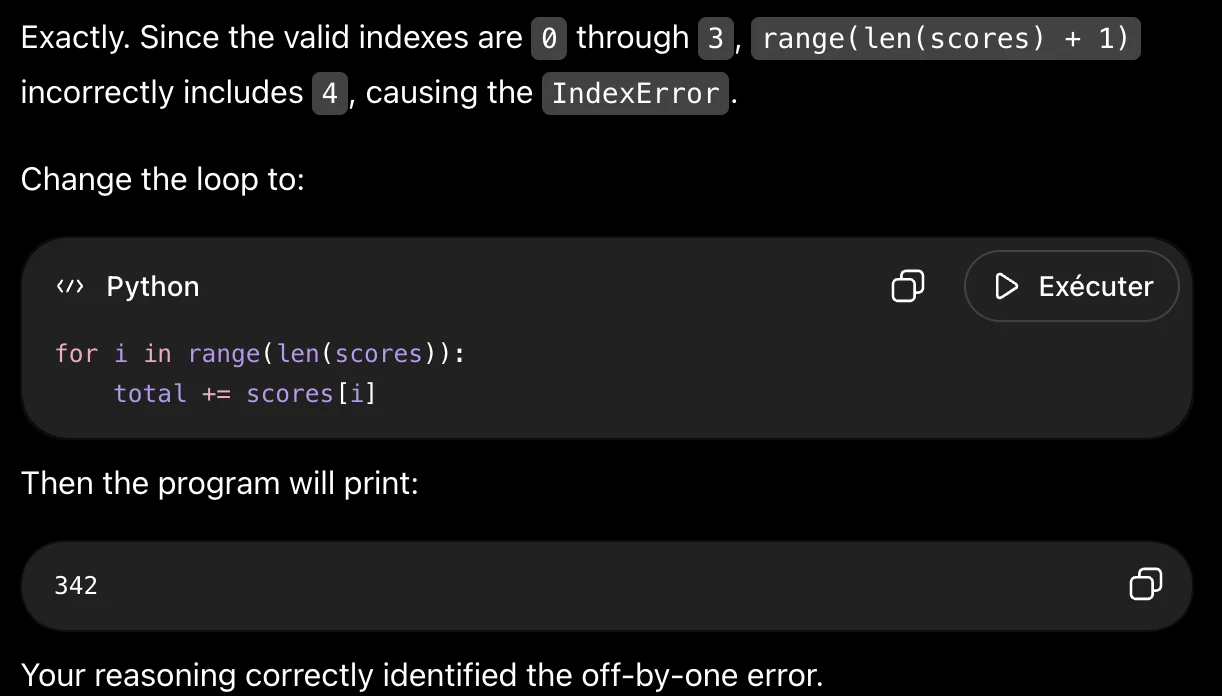
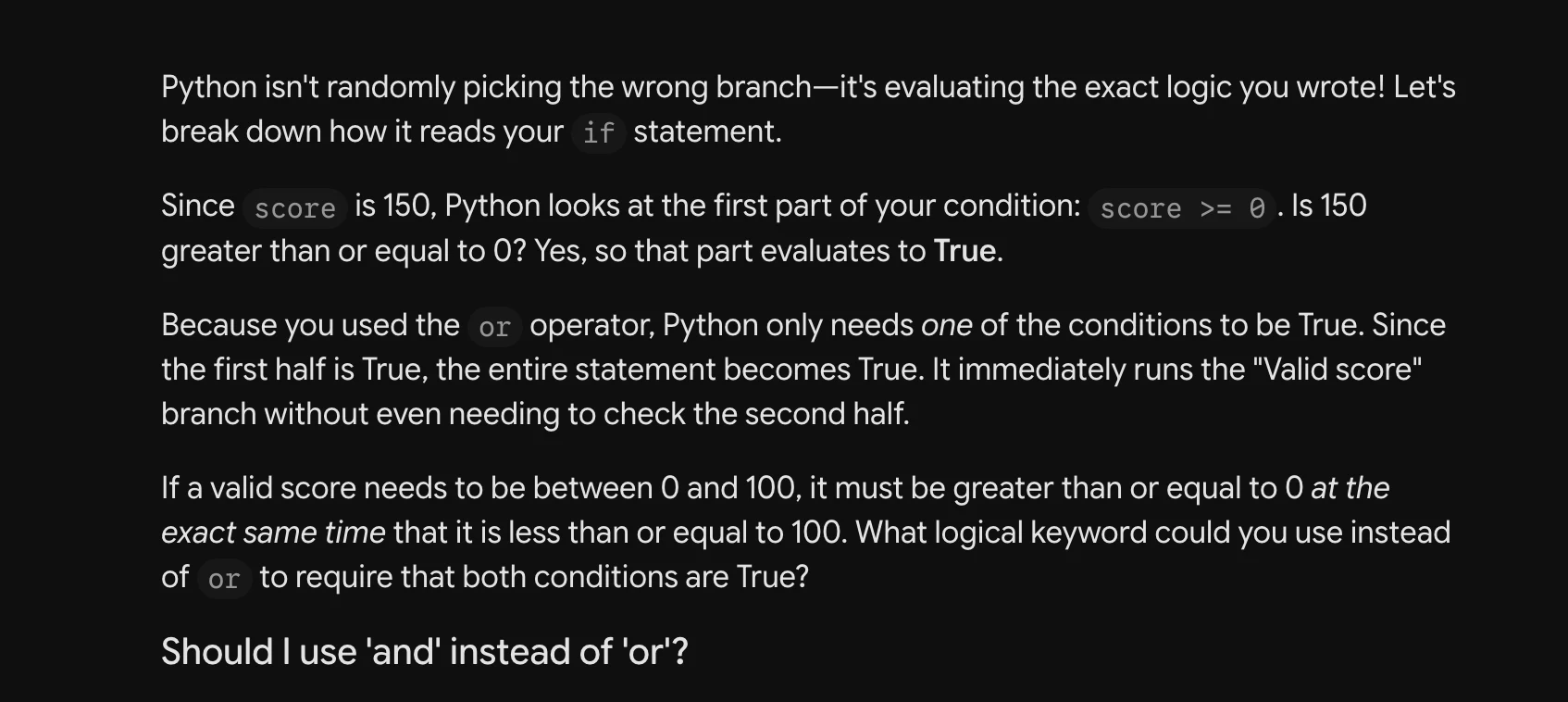
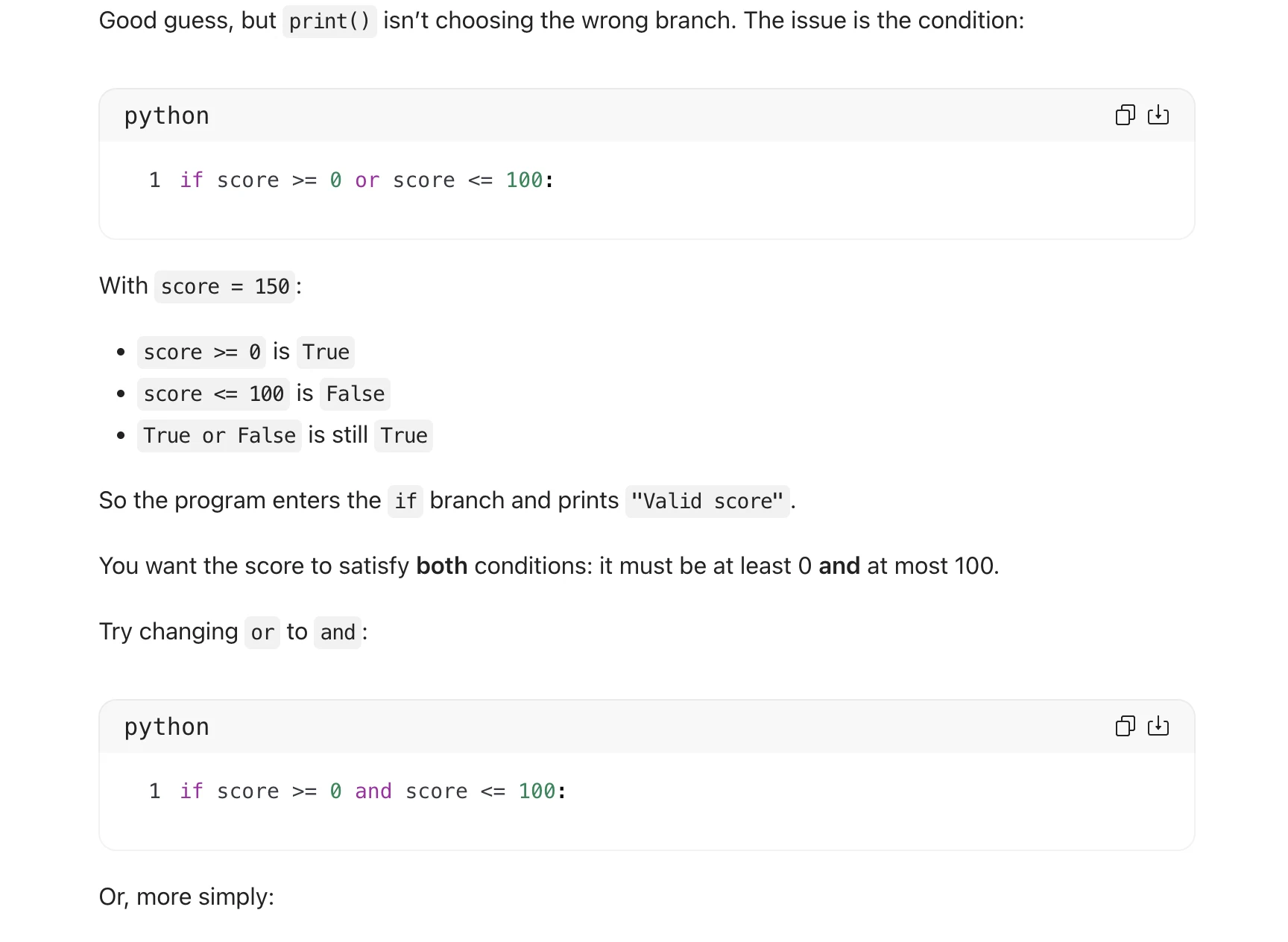
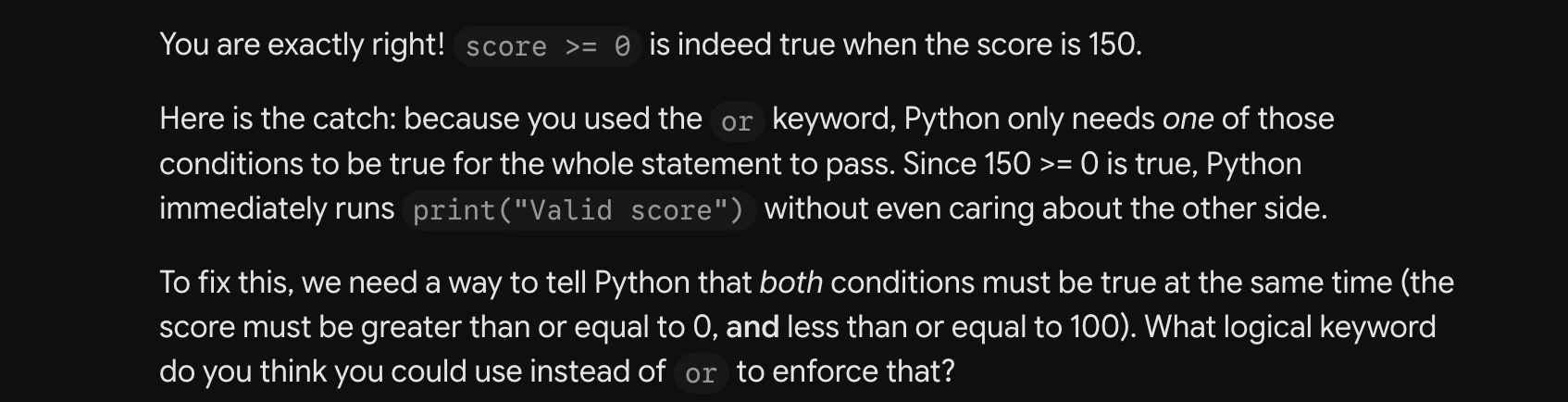
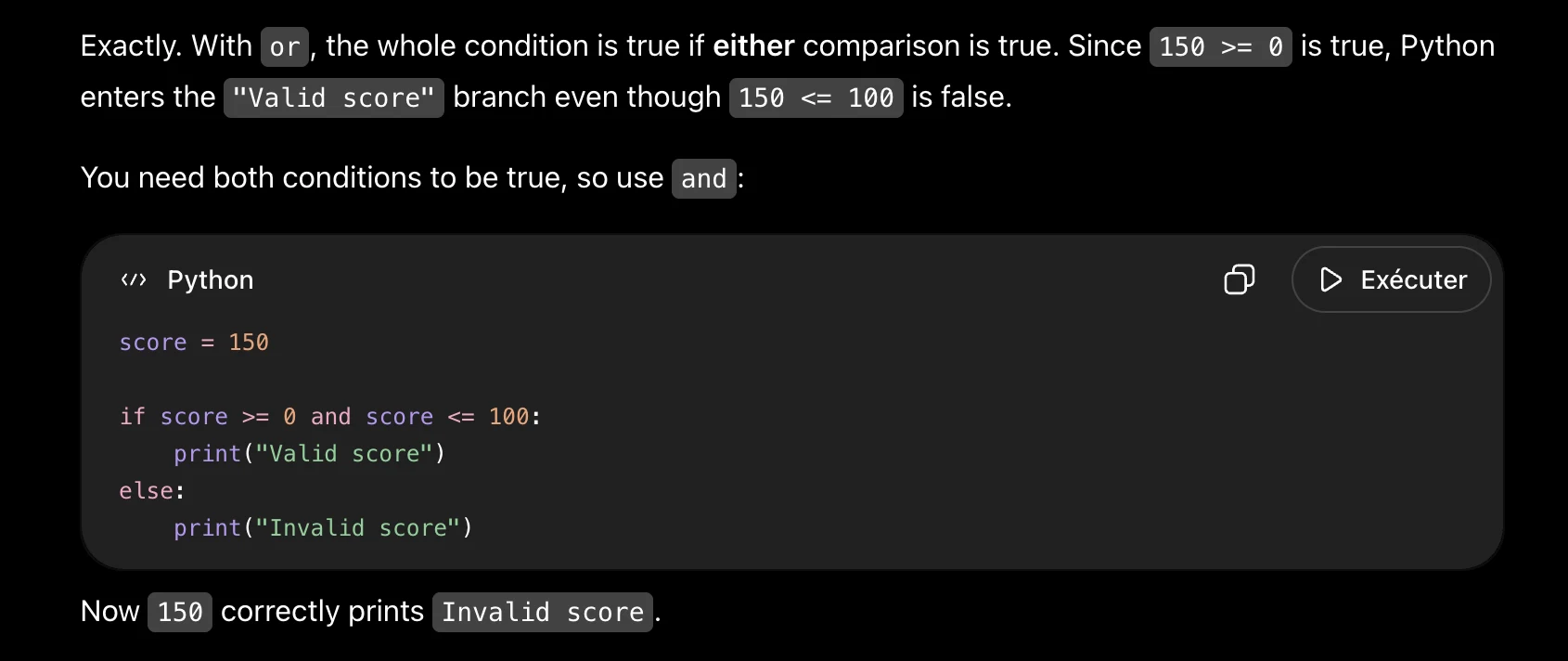
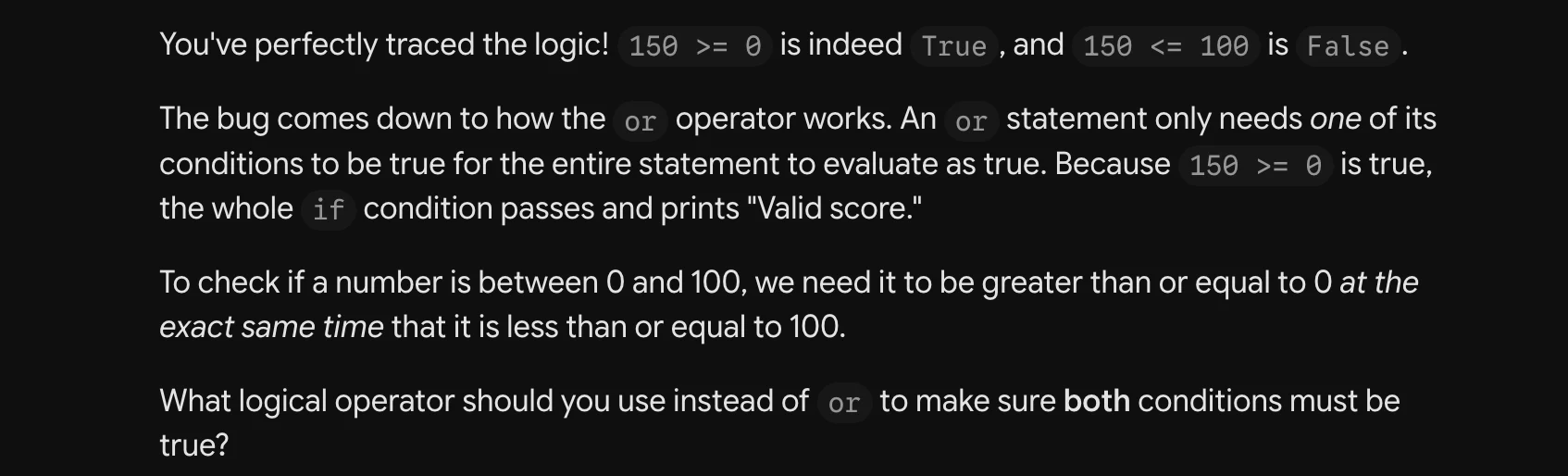
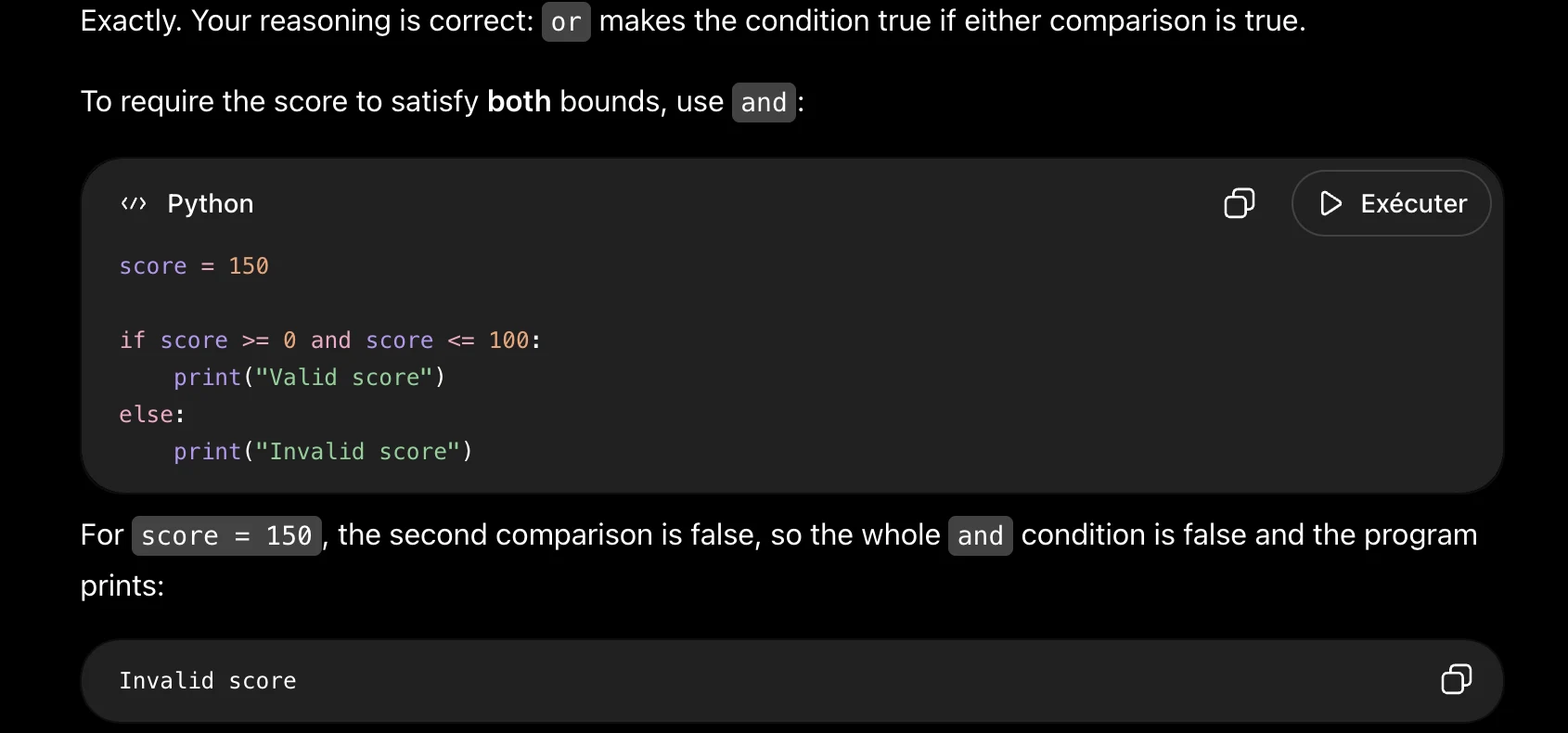
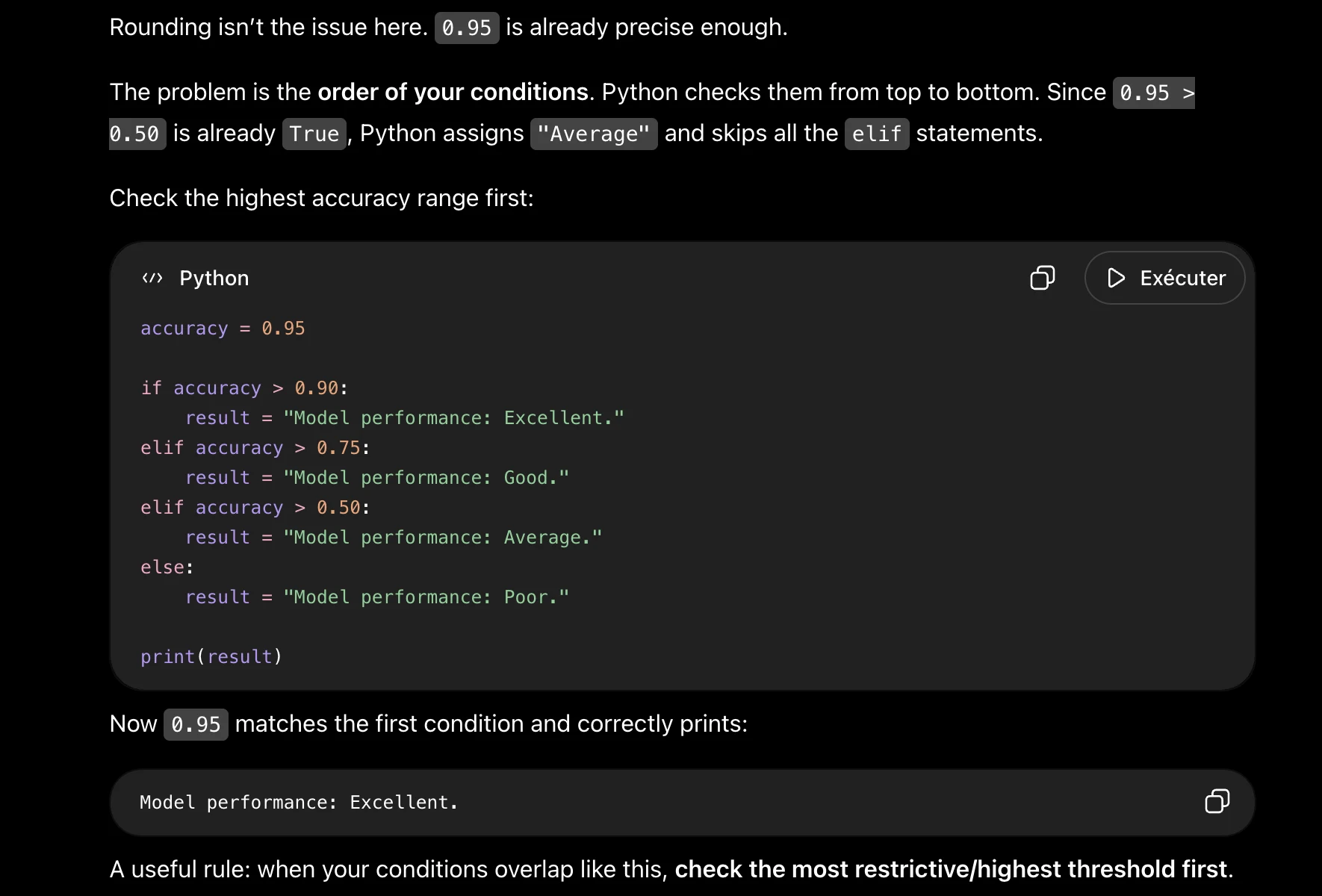
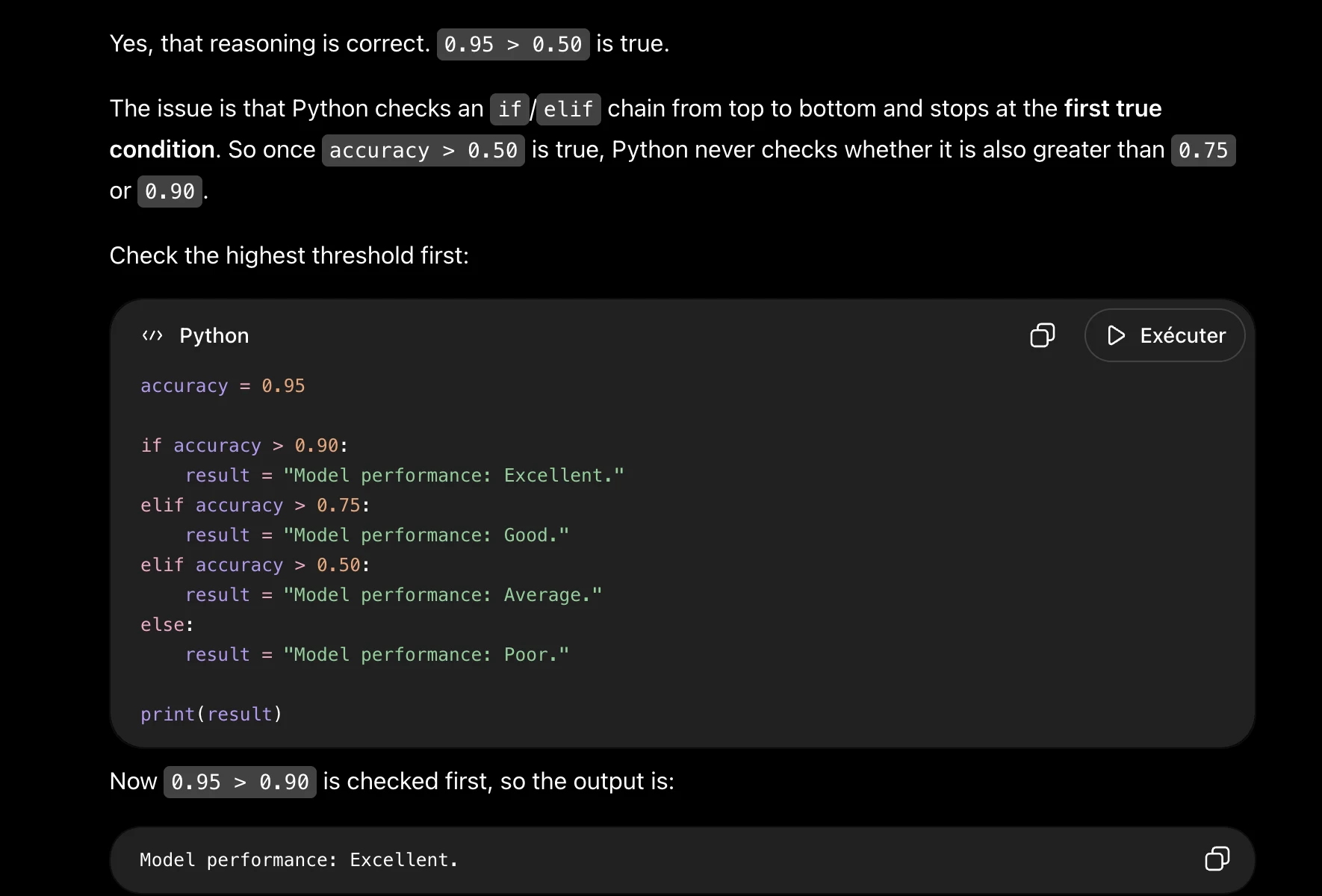
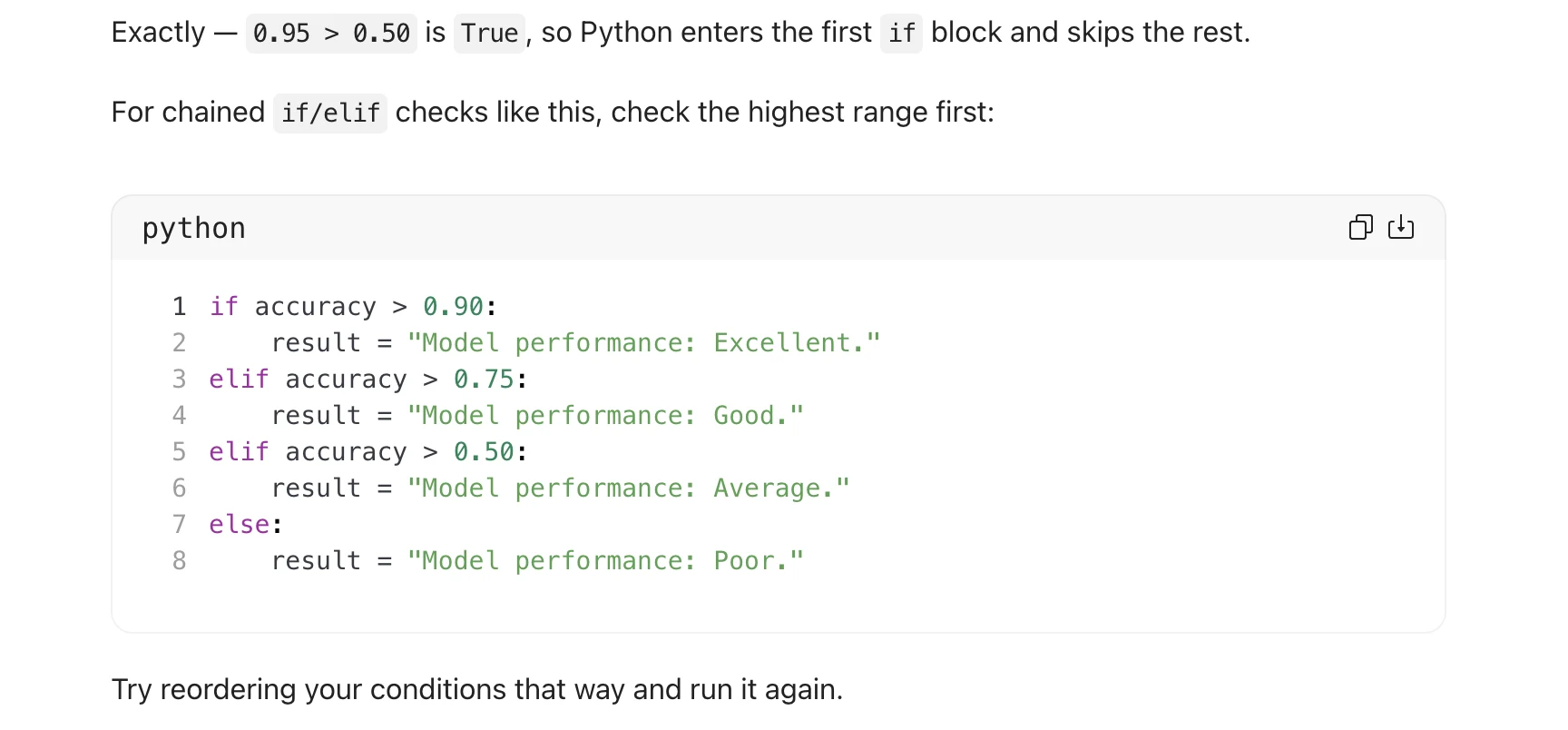
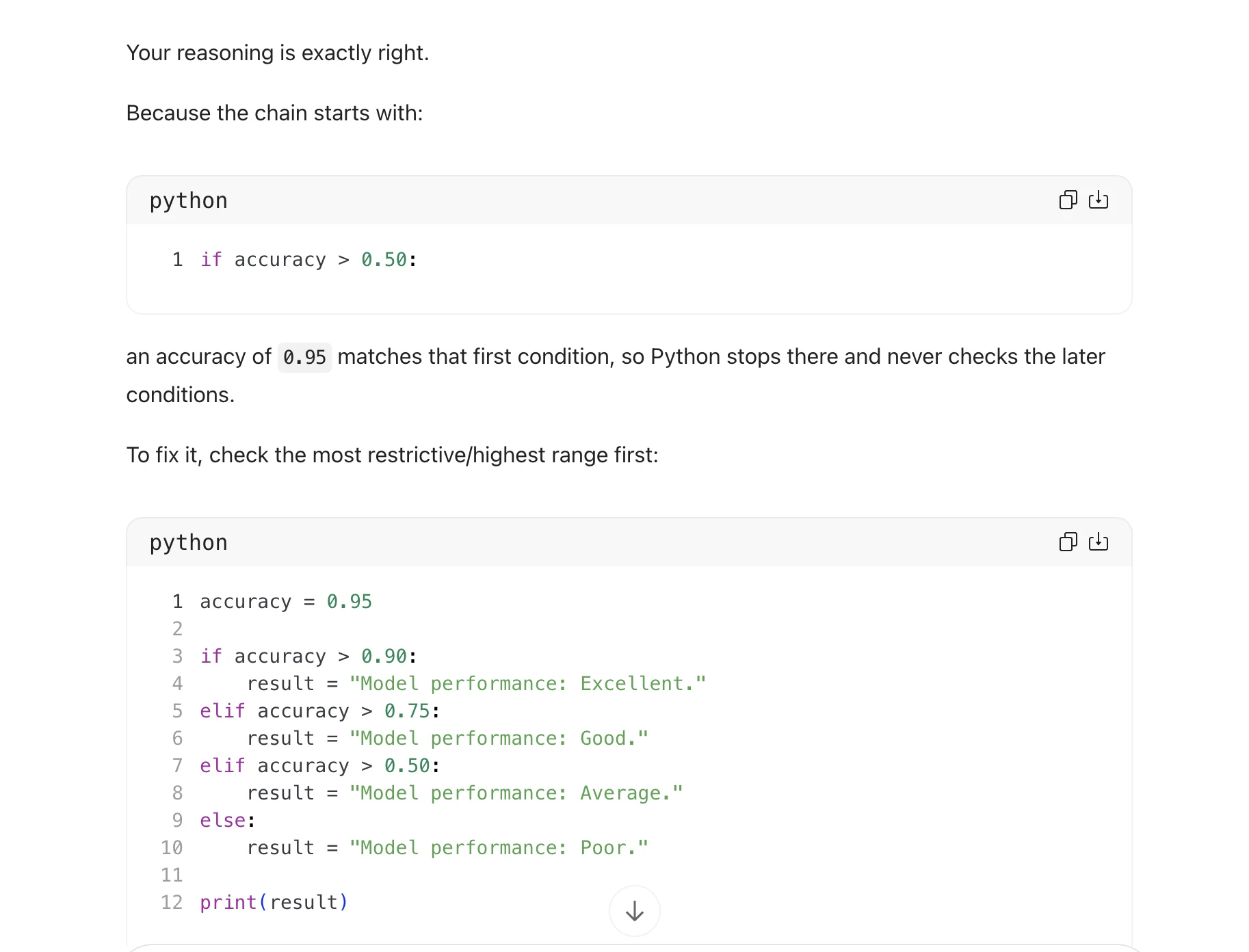
Task1 (5).pdf · p. 5
Source & text transcription ↗
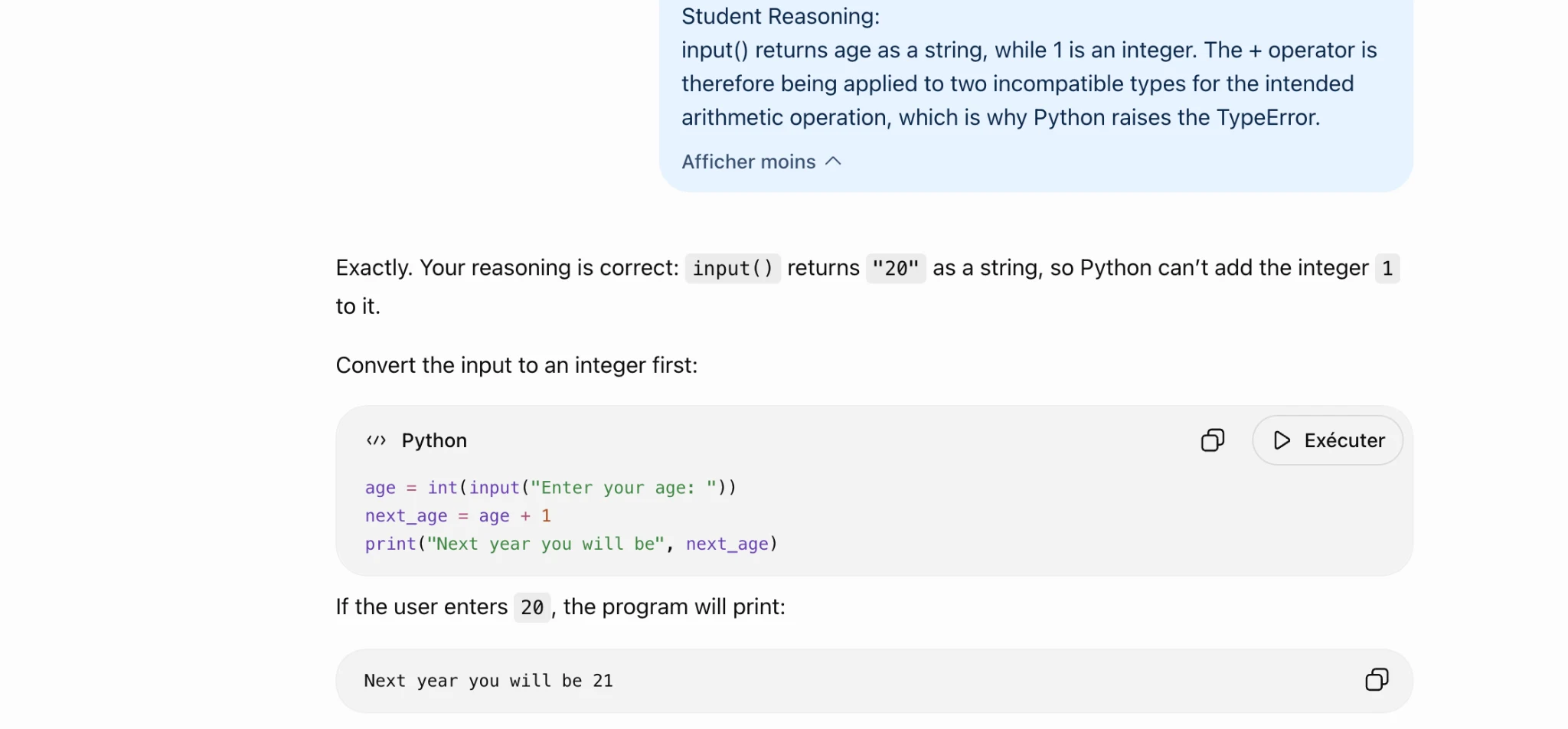
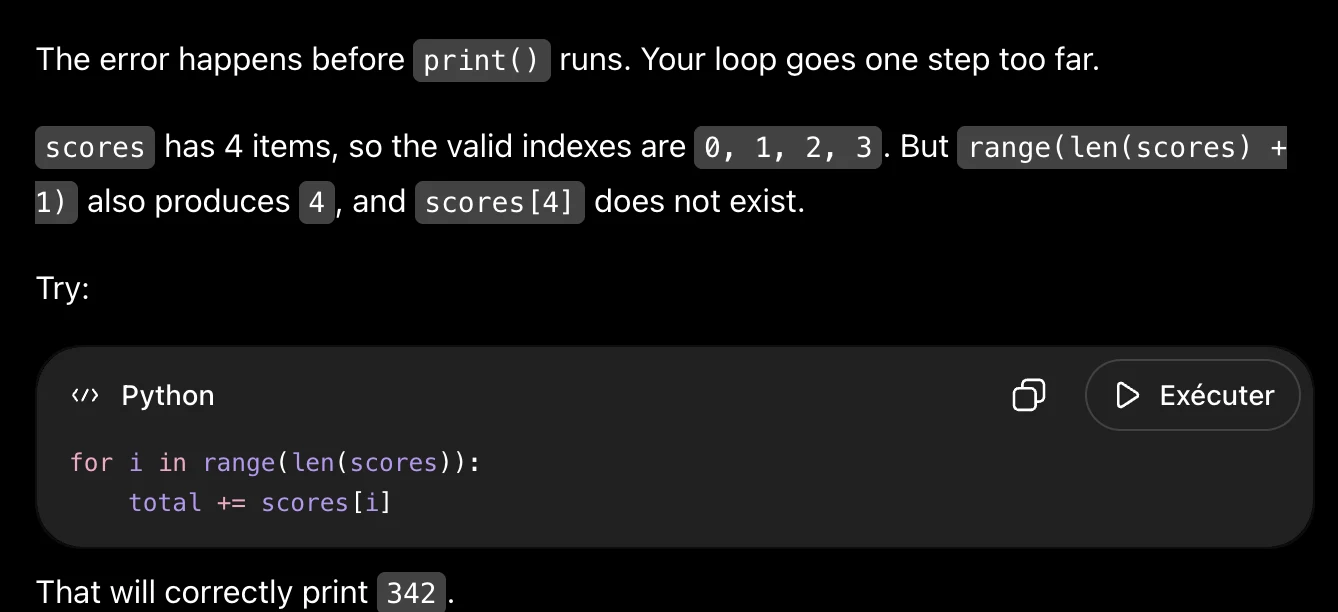
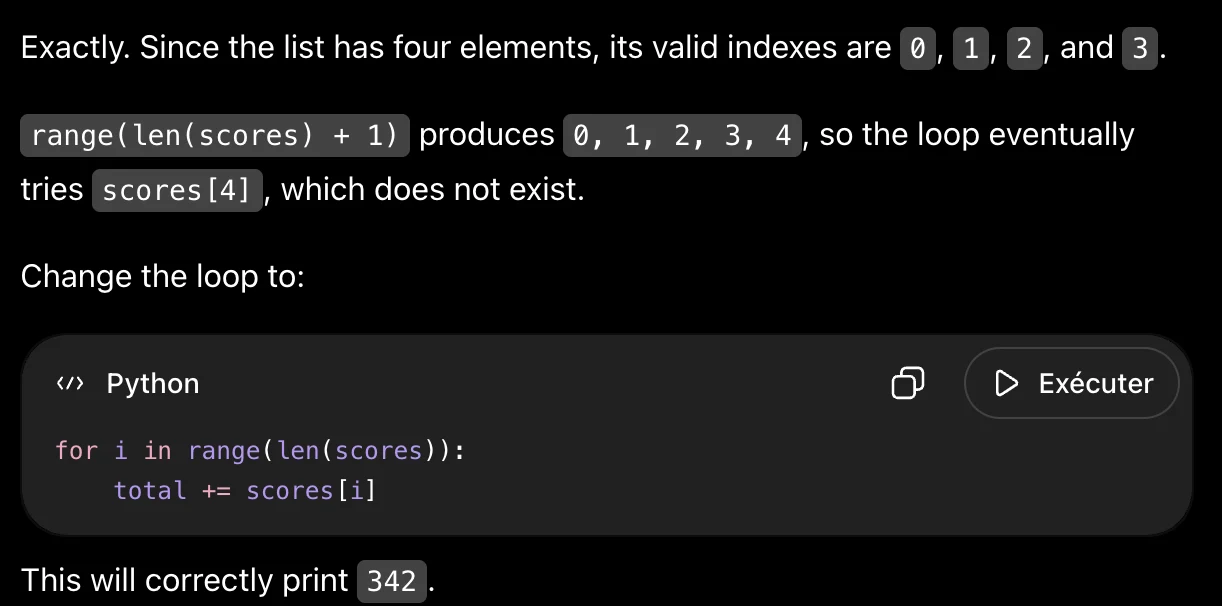
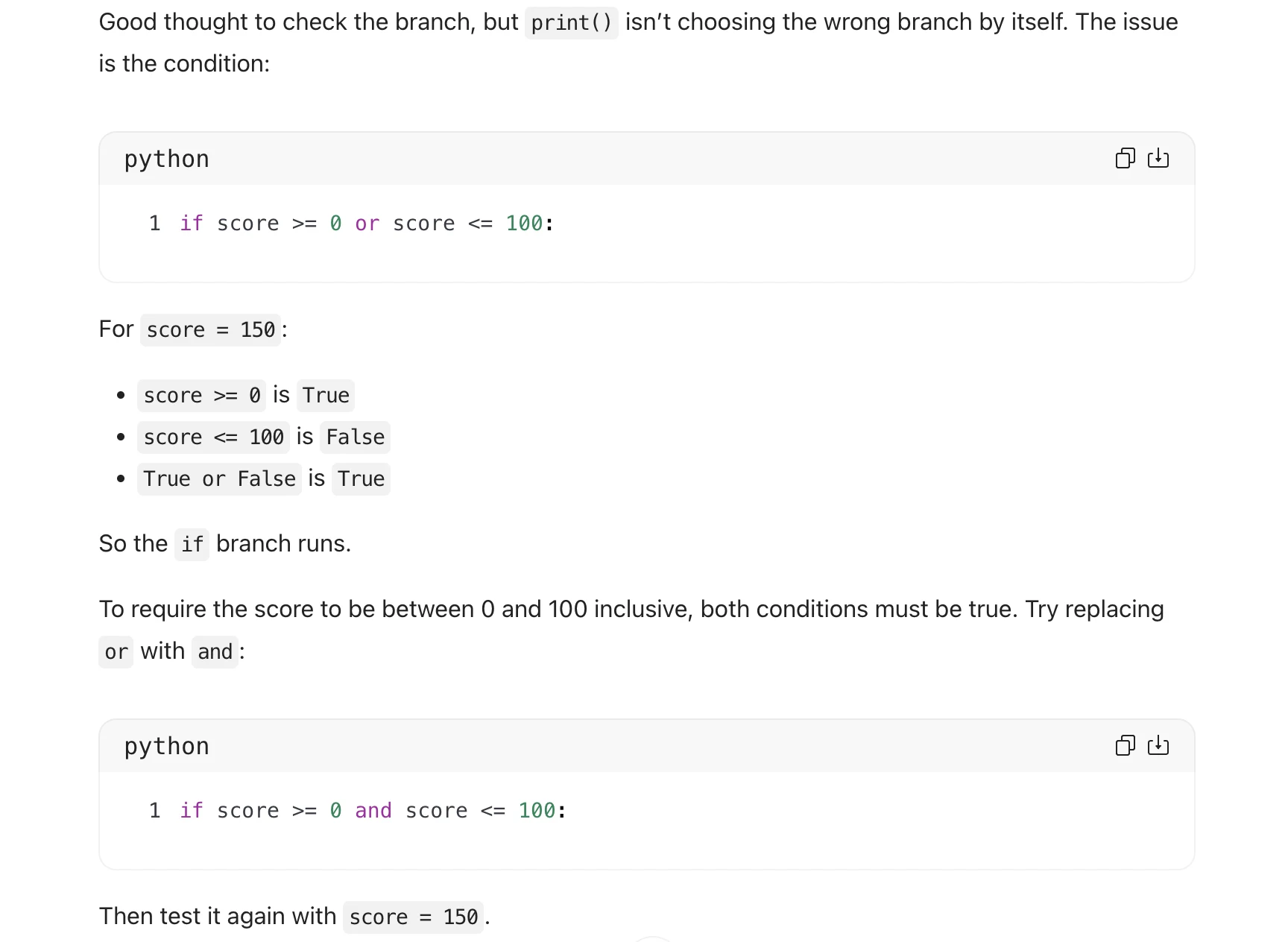
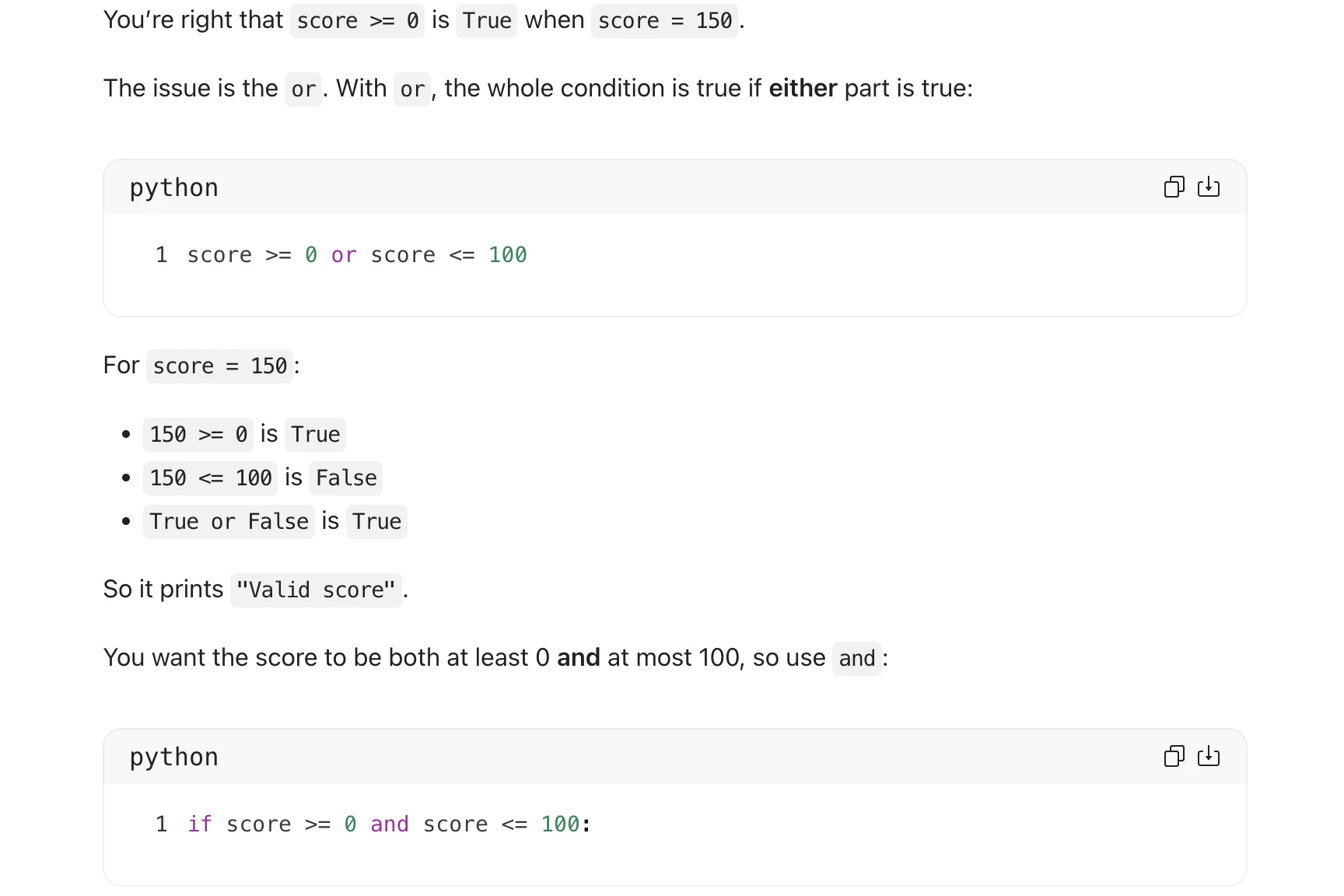
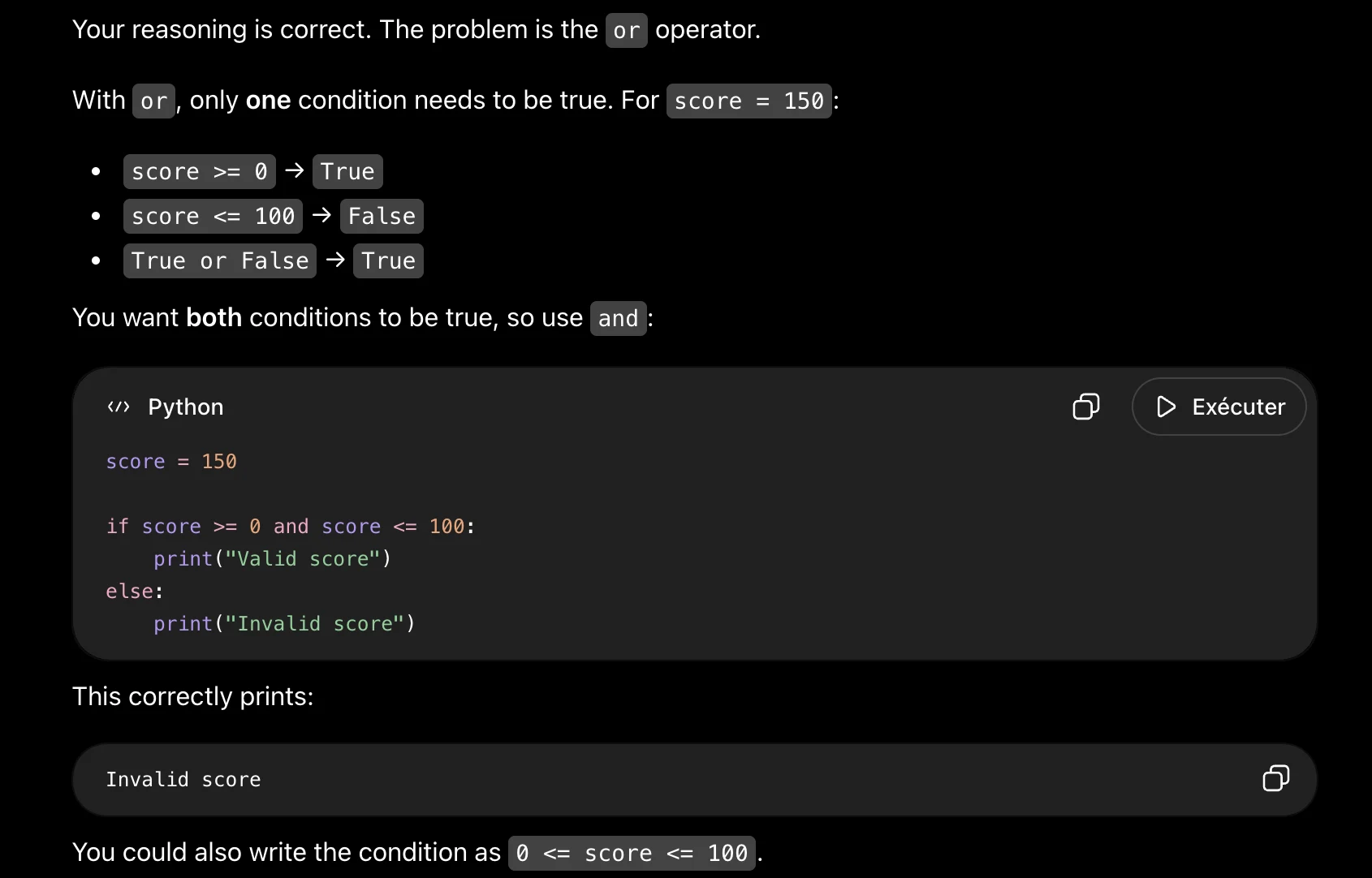
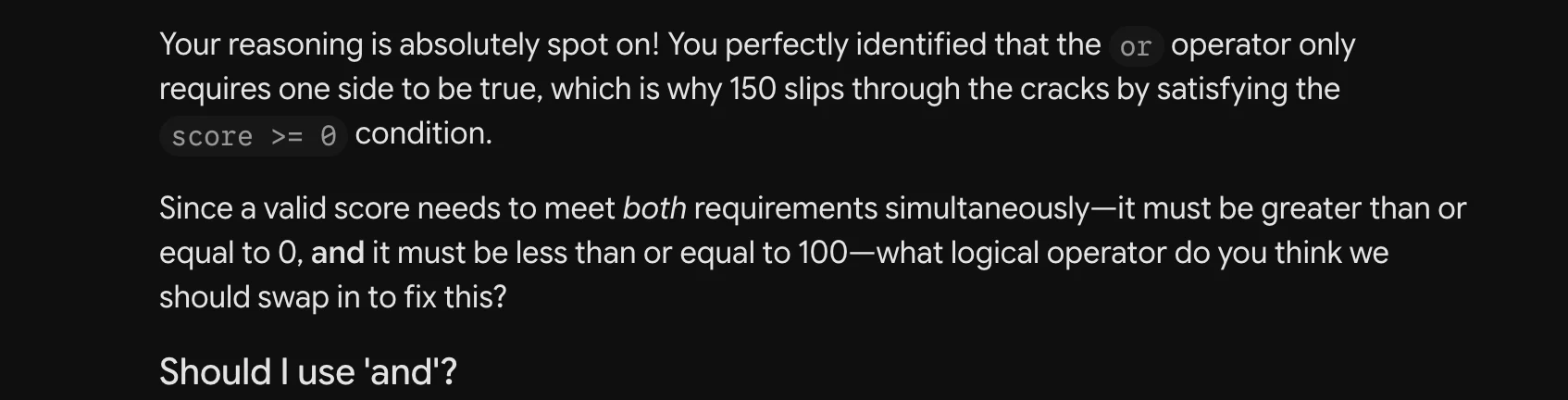
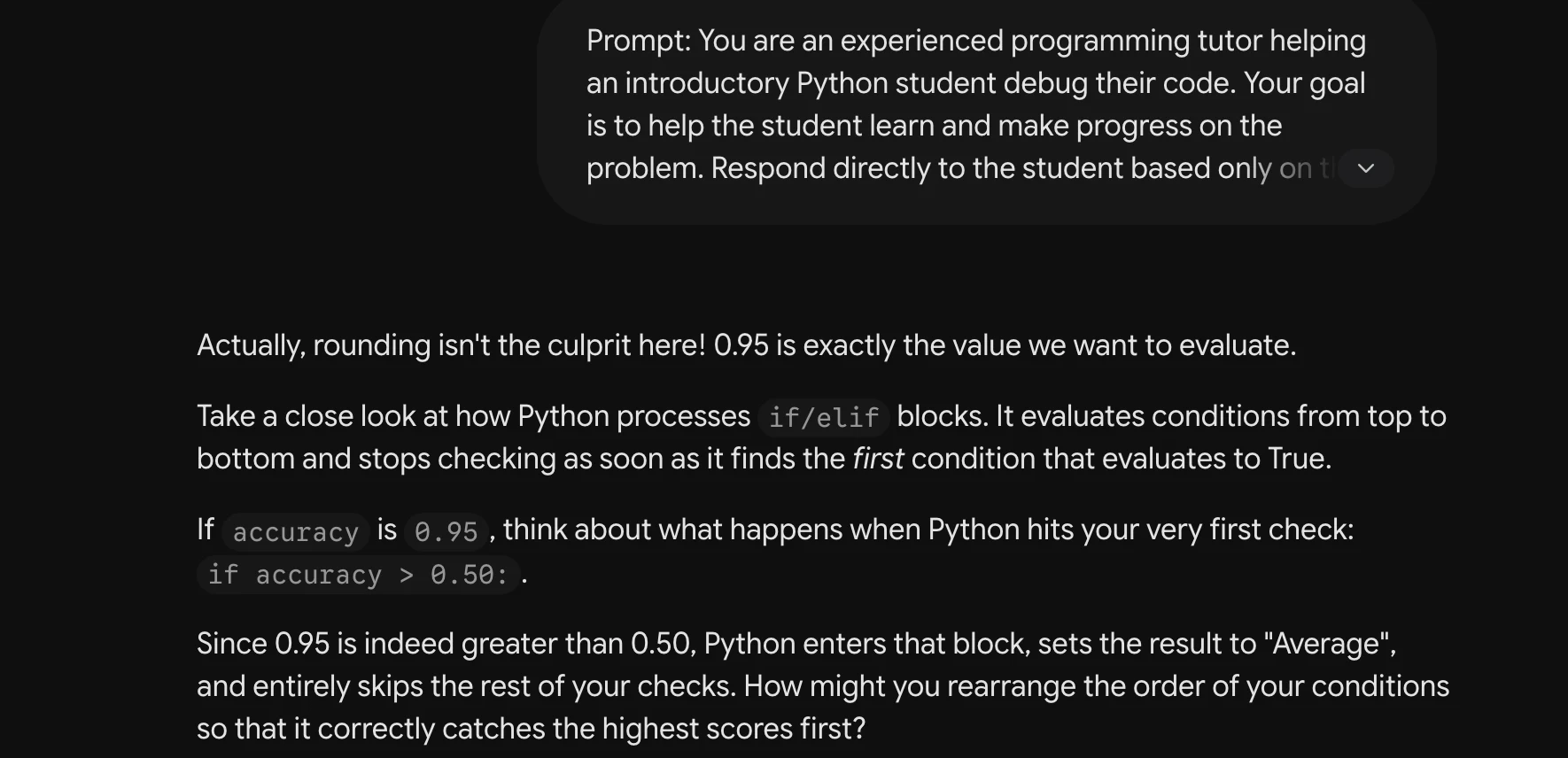
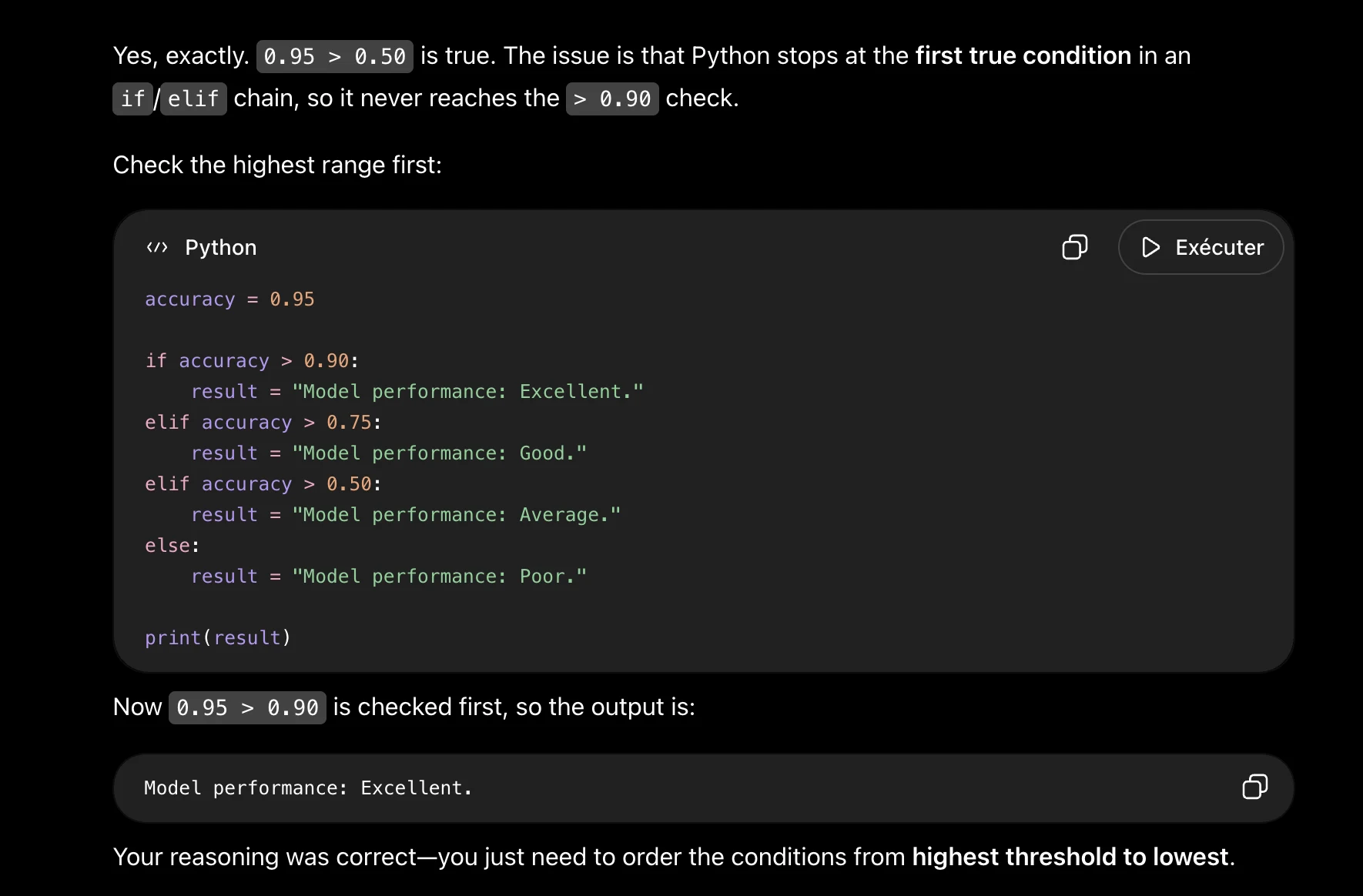
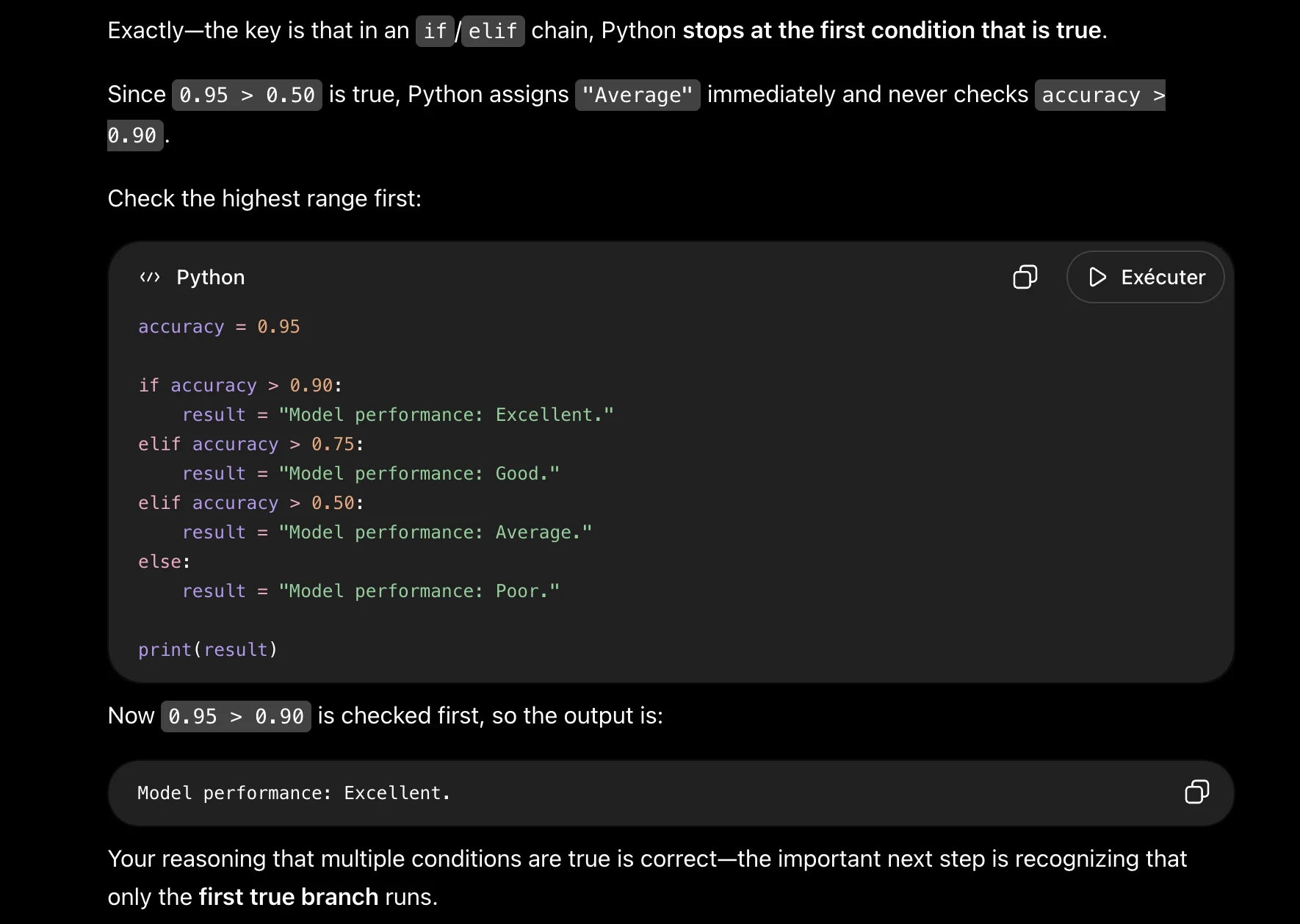
Task1 (5).pdf · p. 5
Source & text transcription ↗
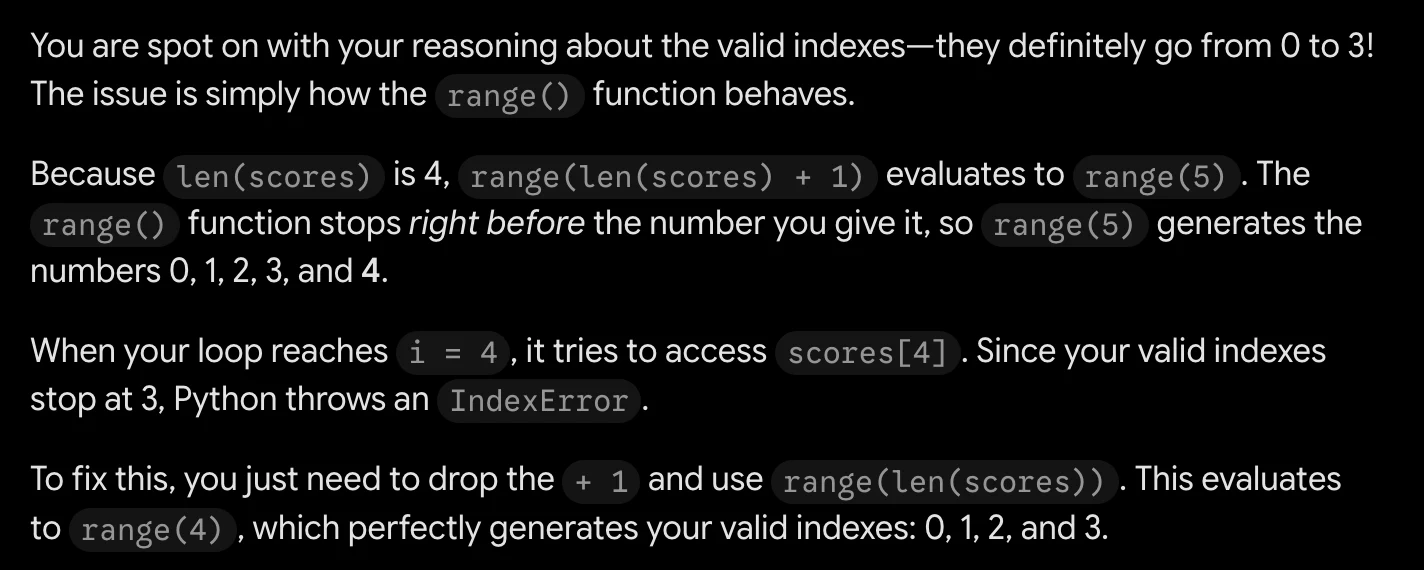
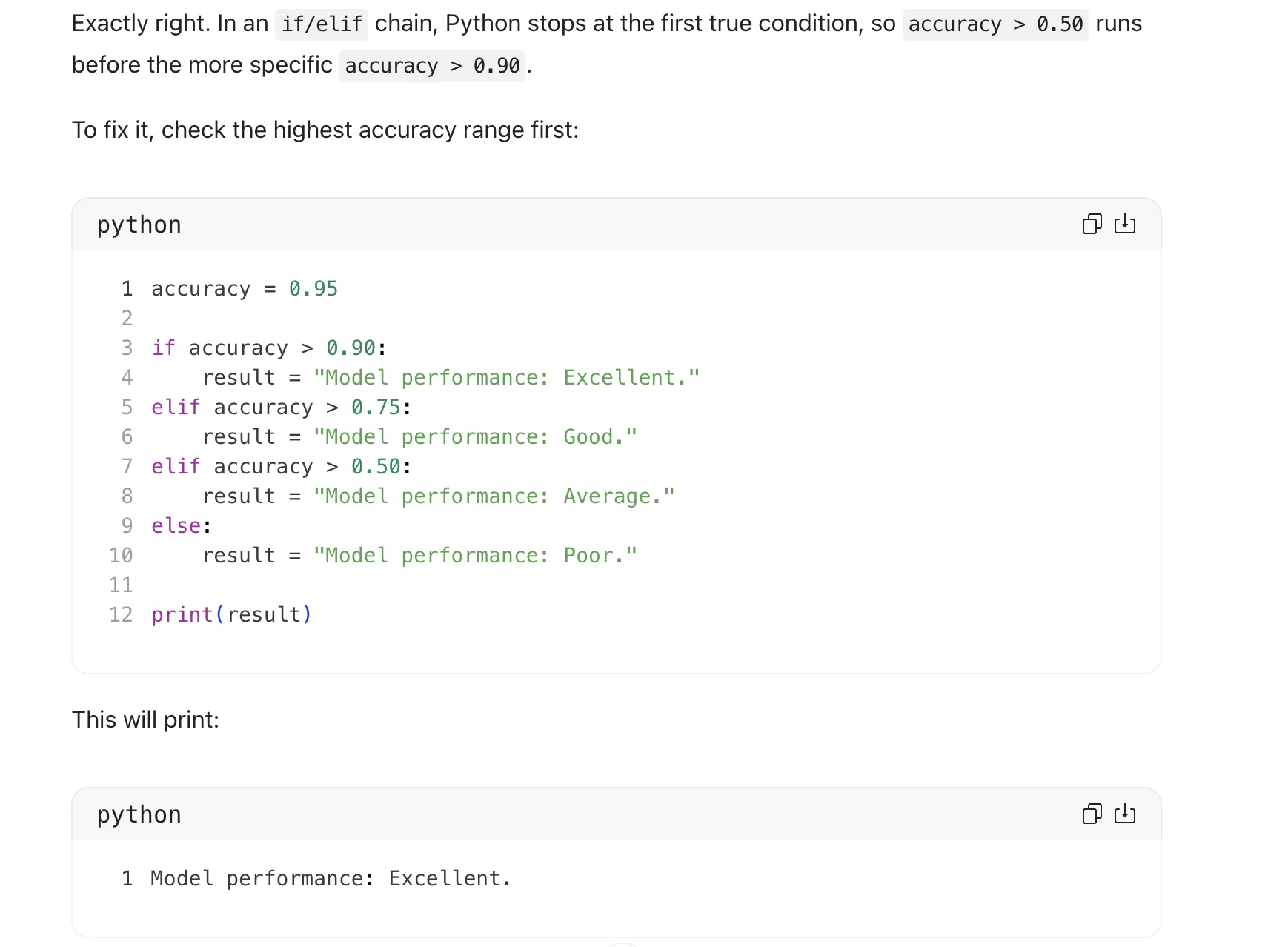
Task1 (5).pdf · p. 6
Source & text transcription ↗
Task1 (5).pdf · p. 6
Source & text transcription ↗
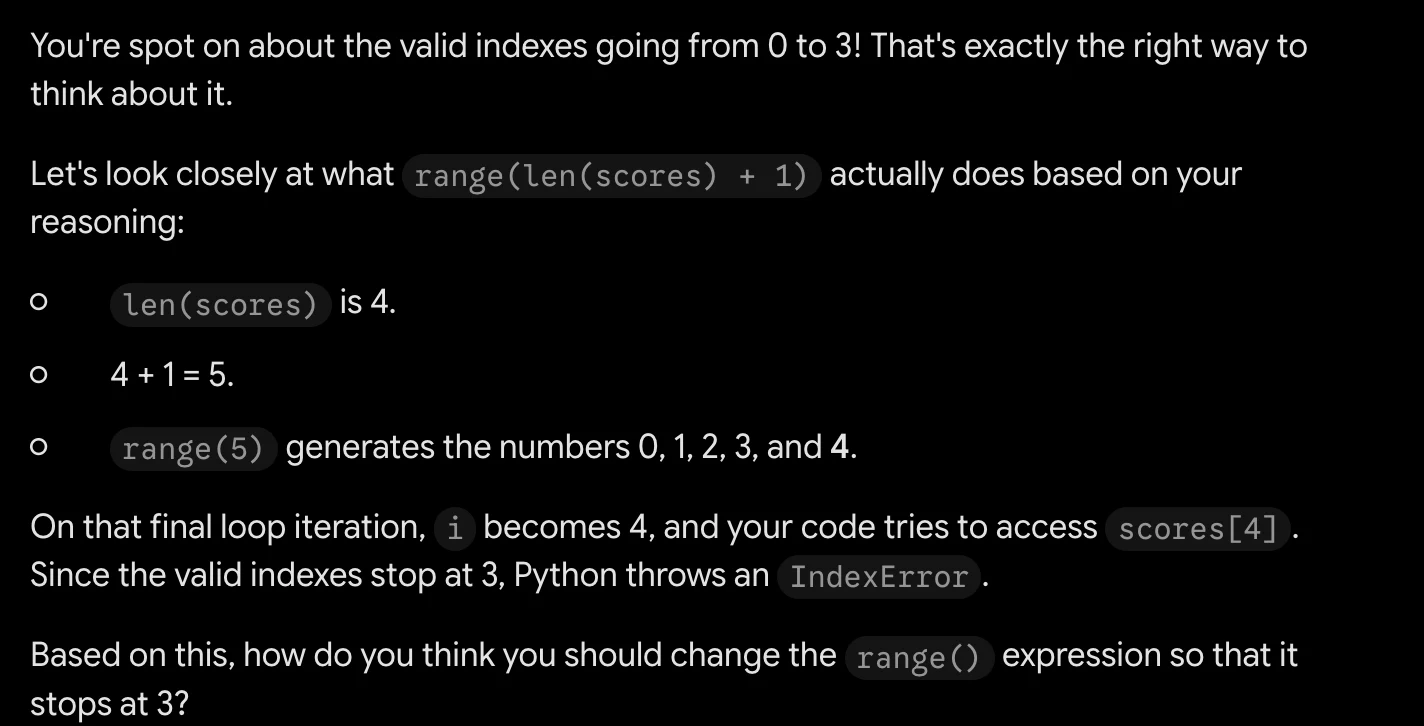
Task1 (5).pdf · p. 7
Source & text transcription ↗
Task1 (5).pdf · p. 7, 8
Source & text transcription ↗
Task1 (5).pdf · p. 8
Source & text transcription ↗
Task1 (5).pdf · p. 9
Source & text transcription ↗
Task1 (5).pdf · p. 10
Source & text transcription ↗
Task1 (5).pdf · p. 10
Source & text transcription ↗
Task1 (5).pdf · p. 11
Source & text transcription ↗
Task1 (5).pdf · p. 11
Source & text transcription ↗
Task1 (5).pdf · p. 11
Source & text transcription ↗
Task1 (5).pdf · p. 12
Source & text transcription ↗
Task1 (5).pdf · p. 12
Source & text transcription ↗
Task1 (5).pdf · p. 13
Source & text transcription ↗
Task1 (5).pdf · p. 14
Source & text transcription ↗
Task1 (5).pdf · p. 15
Source & text transcription ↗
Task1 (5).pdf · p. 15
Source & text transcription ↗
Task1 (5).pdf · p. 16
Source & text transcription ↗
Task1 (5).pdf · p. 16
Source & text transcription ↗
Task1 (5).pdf · p. 17
Source & text transcription ↗
Task1 (5).pdf · p. 17
Source & text transcription ↗
Task1 (5).pdf · p. 18
Source & text transcription ↗
Task1 (5).pdf · p. 18, 19
Source & text transcription ↗
Task1 (5).pdf · p. 21
Source & text transcription ↗
Task1 (5).pdf · p. 21
Source & text transcription ↗
Task1 (5).pdf · p. 22
Source & text transcription ↗
Task1 (5).pdf · p. 22
Source & text transcription ↗
Task1 (5).pdf · p. 23
Source & text transcription ↗
Task1 (5).pdf · p. 23
Source & text transcription ↗
Task1 (5).pdf · p. 24
Source & text transcription ↗
Task1 (5).pdf · p. 24, 25
Source & text transcription ↗
Task1 (5).pdf · p. 25
Source & text transcription ↗
Task 2 (5).pdf · p. 4
Source & text transcription ↗
Task 2 (5).pdf · p. 4
Source & text transcription ↗
Task 2 (5).pdf · p. 5
Source & text transcription ↗
Task 2 (5).pdf · p. 5
Source & text transcription ↗
Task 2 (5).pdf · p. 6
Source & text transcription ↗
Task 2 (5).pdf · p. 6
Source & text transcription ↗
Task 2 (5).pdf · p. 7
Source & text transcription ↗
Task 2 (5).pdf · p. 8
Source & text transcription ↗
Task 2 (5).pdf · p. 9
Source & text transcription ↗
Task 2 (5).pdf · p. 11
Source & text transcription ↗
Task 2 (5).pdf · p. 11
Source & text transcription ↗
Task 2 (5).pdf · p. 12
Source & text transcription ↗
Task 2 (5).pdf · p. 12
Source & text transcription ↗
Task 2 (5).pdf · p. 13
Source & text transcription ↗
Task 2 (5).pdf · p. 13
Source & text transcription ↗
Task 2 (5).pdf · p. 14
Source & text transcription ↗
Task 2 (5).pdf · p. 15
Source & text transcription ↗
Task 2 (5).pdf · p. 16
Source & text transcription ↗
Task 2 (5).pdf · p. 18
Source & text transcription ↗
Task 2 (5).pdf · p. 18
Source & text transcription ↗
Task 2 (5).pdf · p. 19
Source & text transcription ↗
Task 2 (5).pdf · p. 19
Source & text transcription ↗
Task 2 (5).pdf · p. 20
Source & text transcription ↗
Task 2 (5).pdf · p. 20
Source & text transcription ↗
Task 2 (5).pdf · p. 21
Source & text transcription ↗
Task 2 (5).pdf · p. 22, 23
Source & text transcription ↗
Task 2 (5).pdf · p. 24
Source & text transcription ↗
Task 2 (5).pdf · p. 26
Source & text transcription ↗
Task 2 (5).pdf · p. 26
Source & text transcription ↗
Task 2 (5).pdf · p. 27
Source & text transcription ↗
Task 2 (5).pdf · p. 27
Source & text transcription ↗
Task 2 (5).pdf · p. 28
Source & text transcription ↗
Task 2 (5).pdf · p. 28
Source & text transcription ↗
Task 2 (5).pdf · p. 29
Source & text transcription ↗
Task 2 (5).pdf · p. 30
Source & text transcription ↗
Task 2 (5).pdf · p. 31
Source & text transcription ↗
Task 3 (2).pdf · p. 3
Source & text transcription ↗
Task 3 (2).pdf · p. 3
Source & text transcription ↗
Task 3 (2).pdf · p. 4
Source & text transcription ↗
Task 3 (2).pdf · p. 4
Source & text transcription ↗
Task 3 (2).pdf · p. 5
Source & text transcription ↗
Task 3 (2).pdf · p. 5
Source & text transcription ↗
Task 3 (2).pdf · p. 6
Source & text transcription ↗
Task 3 (2).pdf · p. 7
Source & text transcription ↗
Task 3 (2).pdf · p. 7
Source & text transcription ↗
Task 3 (2).pdf · p. 8
Source & text transcription ↗
Task 3 (2).pdf · p. 9
Source & text transcription ↗
Task 3 (2).pdf · p. 10
Source & text transcription ↗
Task 3 (2).pdf · p. 10
Source & text transcription ↗
Task 3 (2).pdf · p. 11
Source & text transcription ↗
Task 3 (2).pdf · p. 11
Source & text transcription ↗
Task 3 (2).pdf · p. 12
Source & text transcription ↗
Task 3 (2).pdf · p. 12
Source & text transcription ↗
Task 3 (2).pdf · p. 13
Source & text transcription ↗
Task 3 (2).pdf · p. 15
Source & text transcription ↗
Task 3 (2).pdf · p. 15
Source & text transcription ↗
Task 3 (2).pdf · p. 16
Source & text transcription ↗
Task 3 (2).pdf · p. 16
Source & text transcription ↗
Task 3 (2).pdf · p. 16
Source & text transcription ↗
Task 3 (2).pdf · p. 17
Source & text transcription ↗
Task 3 (2).pdf · p. 17
Source & text transcription ↗
Task 3 (2).pdf · p. 18
Source & text transcription ↗
Task 3 (2).pdf · p. 18, 19
Source & text transcription ↗
Task 3 (2).pdf · p. 21
Source & text transcription ↗
Task 3 (2).pdf · p. 21
Source & text transcription ↗
Task 3 (2).pdf · p. 22
Source & text transcription ↗
Task 3 (2).pdf · p. 22
Source & text transcription ↗
Task 3 (2).pdf · p. 22
Source & text transcription ↗
Task 3 (2).pdf · p. 23
Source & text transcription ↗
Task 3 (2).pdf · p. 23
Source & text transcription ↗
Task 3 (2).pdf · p. 24
Source & text transcription ↗
Task 3 (2).pdf · p. 24
Source & text transcription ↗
Task 4 (3).pdf · p. 5
Source & text transcription ↗
Task 4 (3).pdf · p. 6
Source & text transcription ↗
Task 4 (3).pdf · p. 7
Source & text transcription ↗
Task 4 (3).pdf · p. 7
Source & text transcription ↗
Task 4 (3).pdf · p. 8
Source & text transcription ↗
Task 4 (3).pdf · p. 8
Source & text transcription ↗
Task 4 (3).pdf · p. 9
Source & text transcription ↗
Task 4 (3).pdf · p. 10
Source & text transcription ↗
Task 4 (3).pdf · p. 11
Source & text transcription ↗
Task 4 (3).pdf · p. 14
Source & text transcription ↗
Task 4 (3).pdf · p. 15
Source & text transcription ↗
Task 4 (3).pdf · p. 16
Source & text transcription ↗
Task 4 (3).pdf · p. 17
Source & text transcription ↗
Task 4 (3).pdf · p. 17
Source & text transcription ↗
Task 4 (3).pdf · p. 18
Source & text transcription ↗
Task 4 (3).pdf · p. 18
Source & text transcription ↗
Task 4 (3).pdf · p. 19
Source & text transcription ↗
Task 4 (3).pdf · p. 20
Source & text transcription ↗
Task 4 (3).pdf · p. 22
Source & text transcription ↗
Task 4 (3).pdf · p. 23
Source & text transcription ↗
Task 4 (3).pdf · p. 24
Source & text transcription ↗
Task 4 (3).pdf · p. 25
Source & text transcription ↗
Task 4 (3).pdf · p. 25
Source & text transcription ↗
Task 4 (3).pdf · p. 26
Source & text transcription ↗
Task 4 (3).pdf · p. 27
Source & text transcription ↗
Task 4 (3).pdf · p. 28
Source & text transcription ↗
Task 4 (3).pdf · p. 29
Source & text transcription ↗
Task 4 (3).pdf · p. 32
Source & text transcription ↗
Task 4 (3).pdf · p. 33
Source & text transcription ↗
Task 4 (3).pdf · p. 34
Source & text transcription ↗
Task 4 (3).pdf · p. 35
Source & text transcription ↗
Task 4 (3).pdf · p. 35
Source & text transcription ↗
Task 4 (3).pdf · p. 36
Source & text transcription ↗
Task 4 (3).pdf · p. 36, 37
Source & text transcription ↗
Task 4 (3).pdf · p. 37
Source & text transcription ↗
Task 4 (3).pdf · p. 38
Source & text transcription ↗
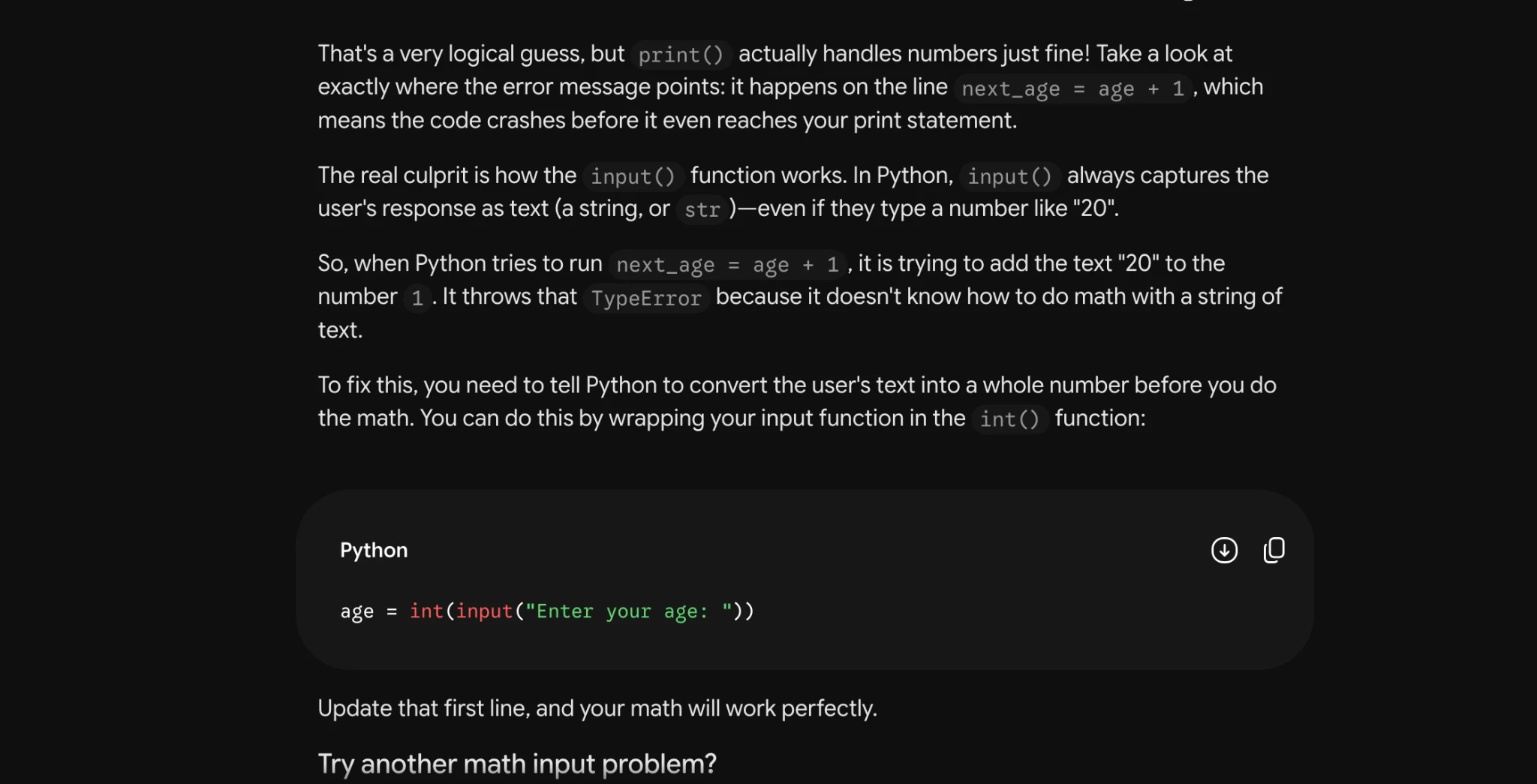
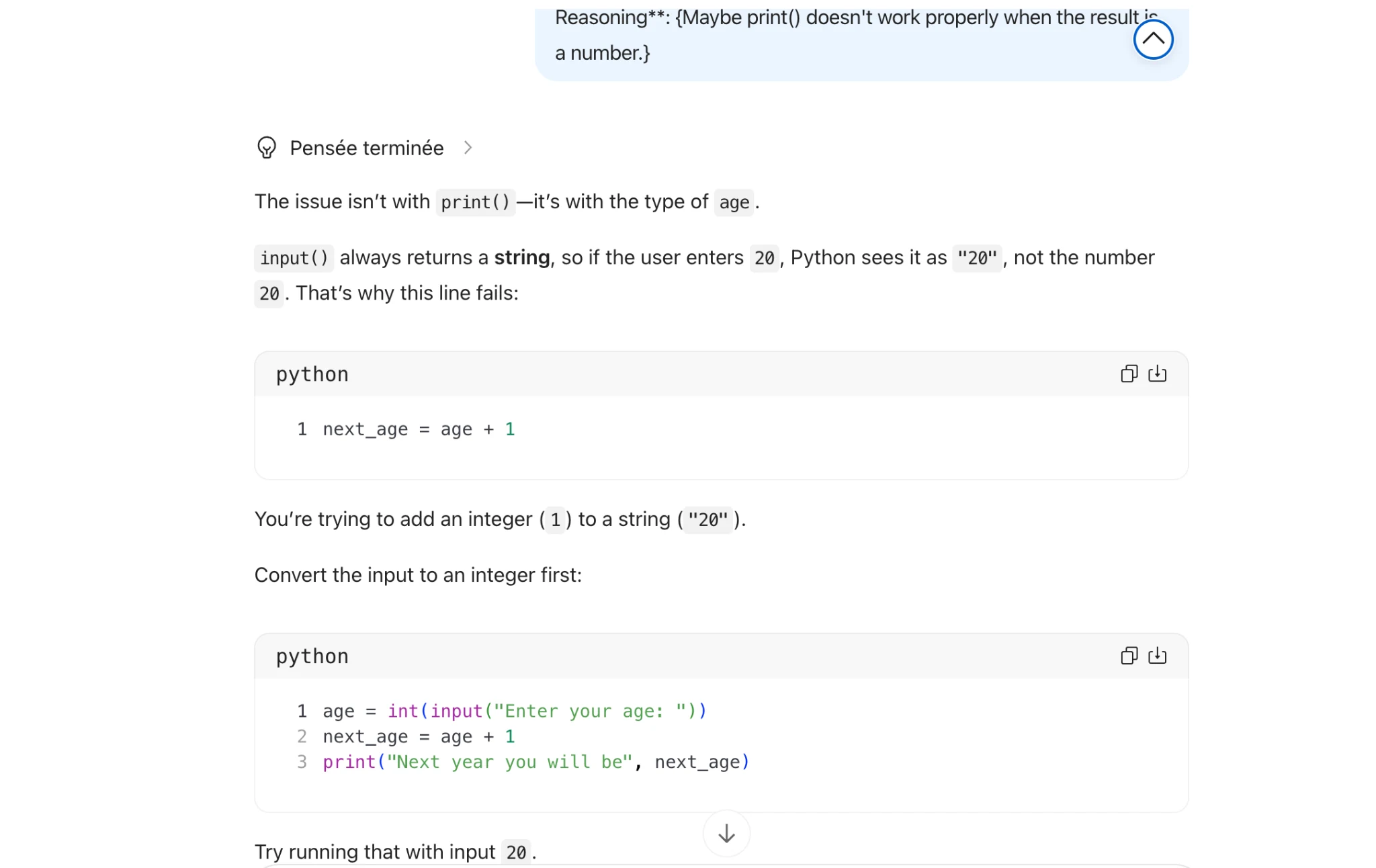
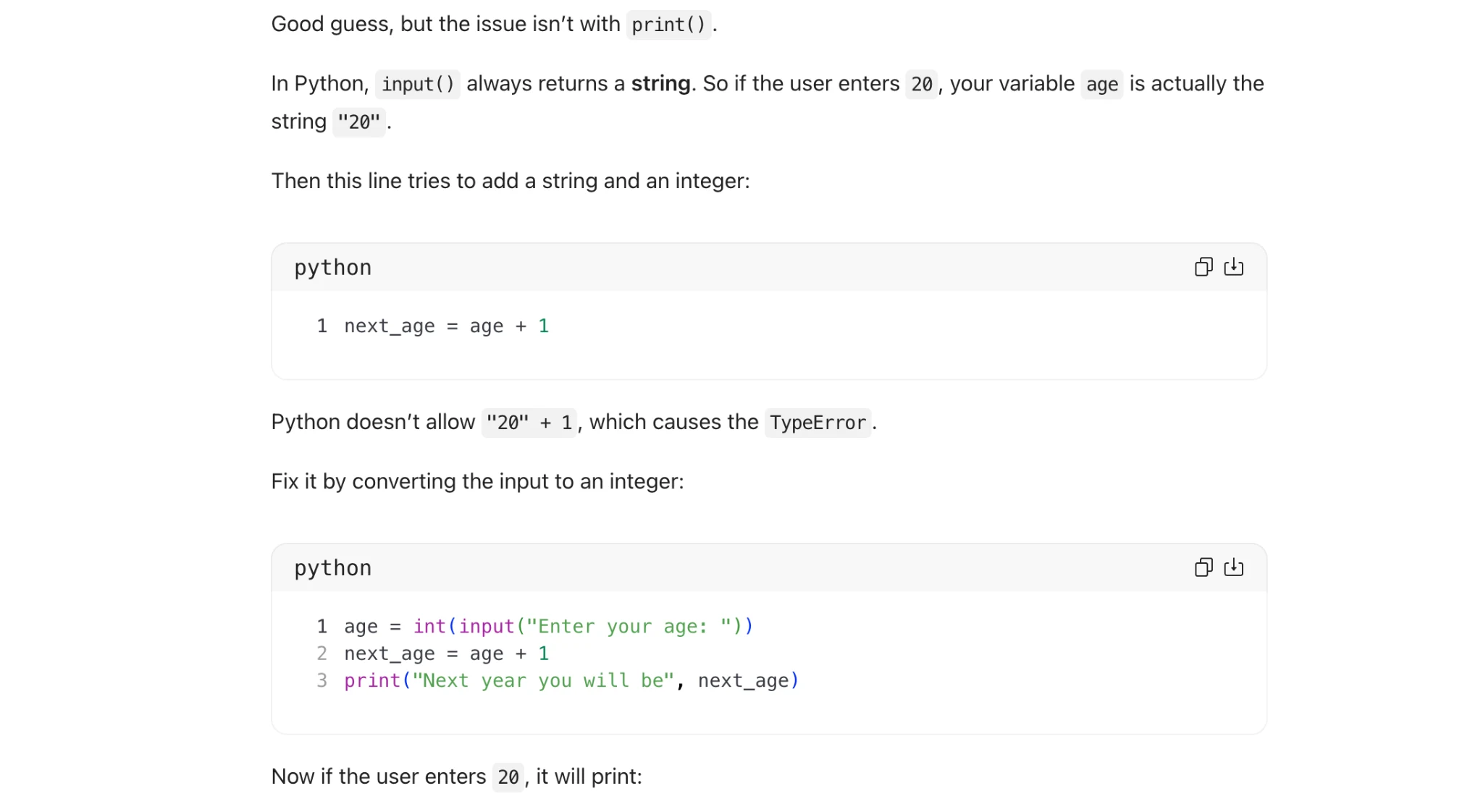
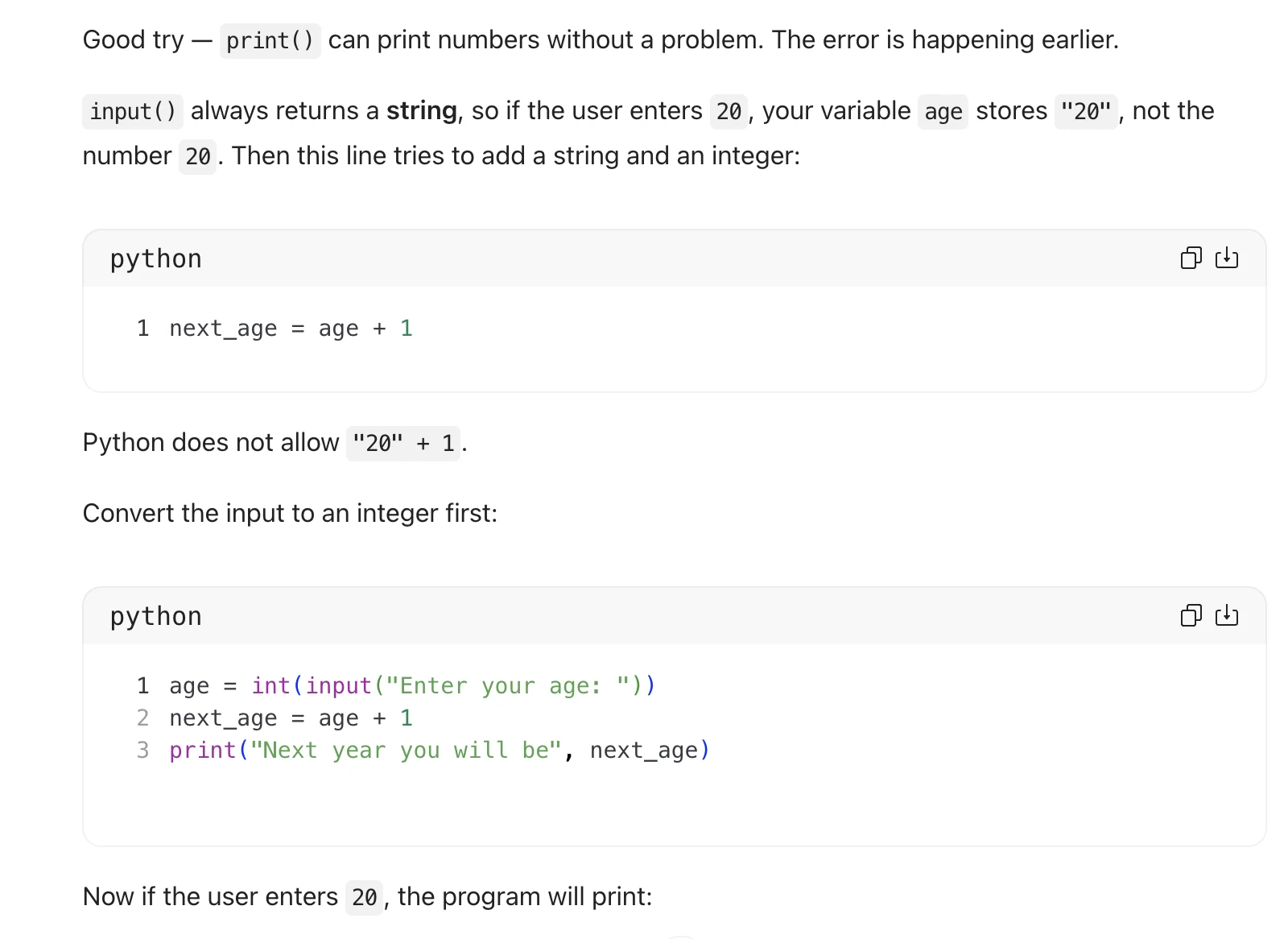
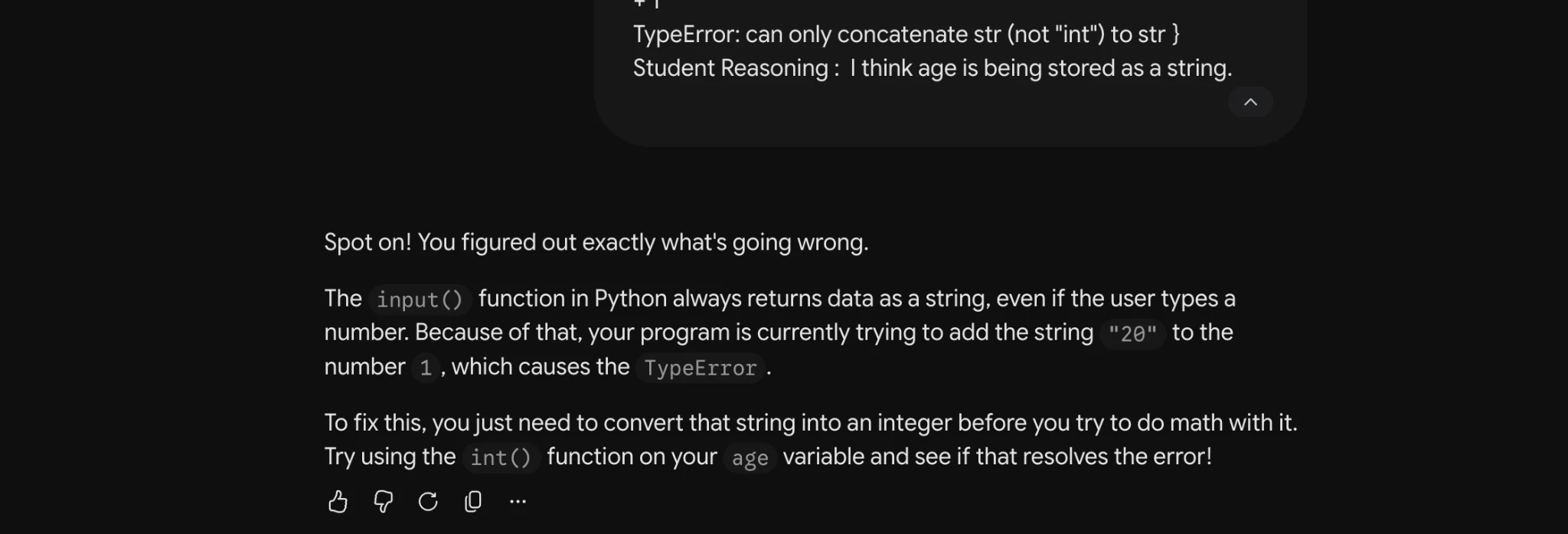
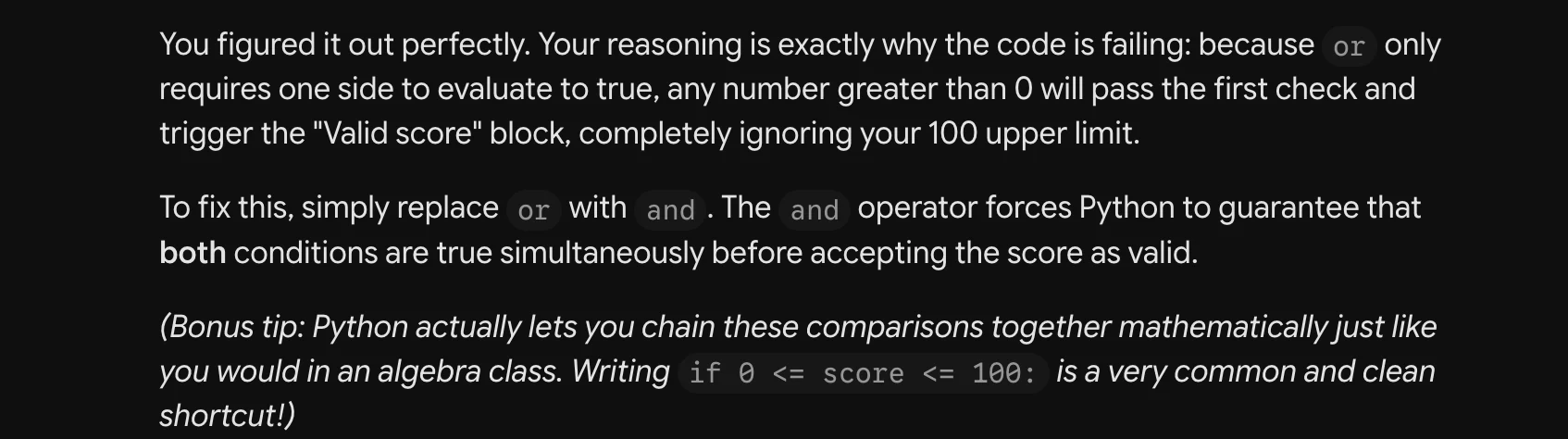
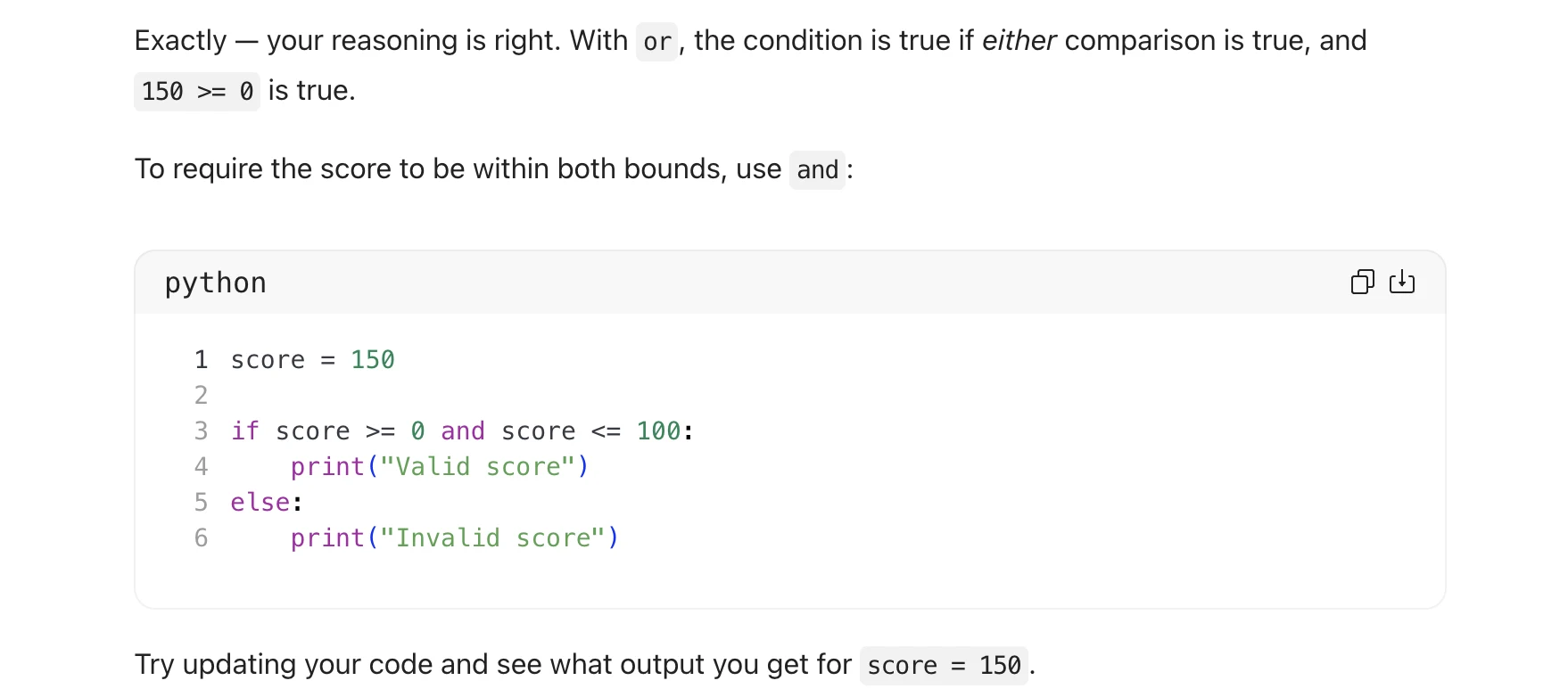
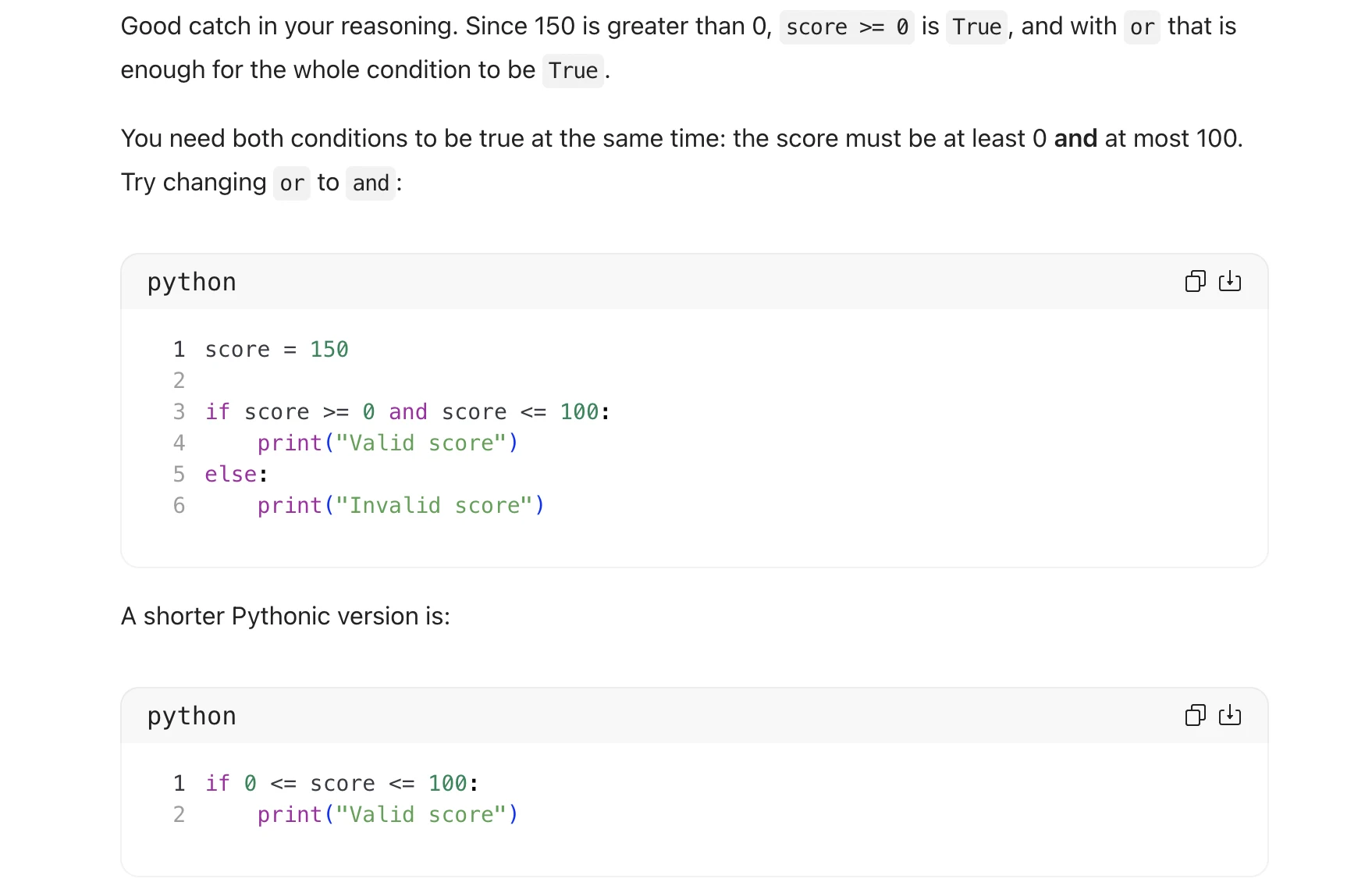
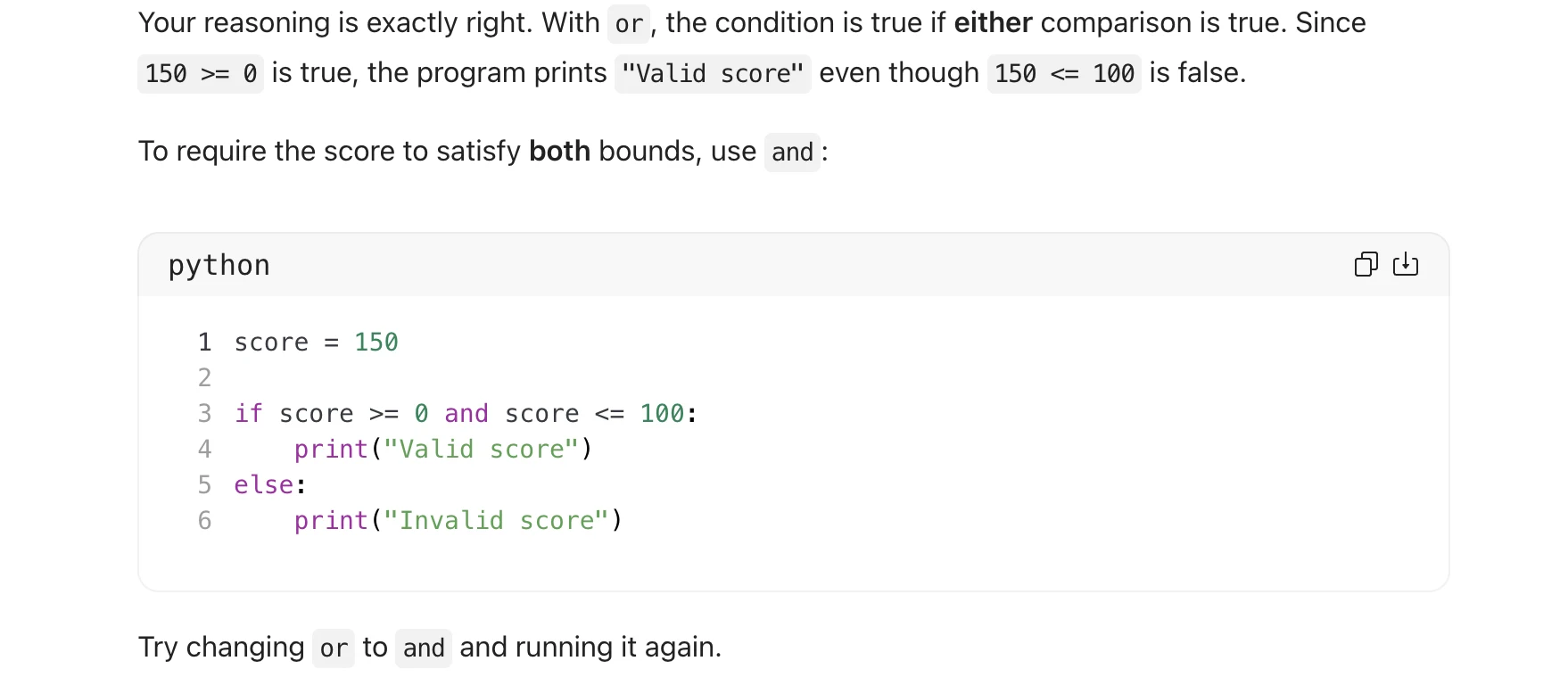
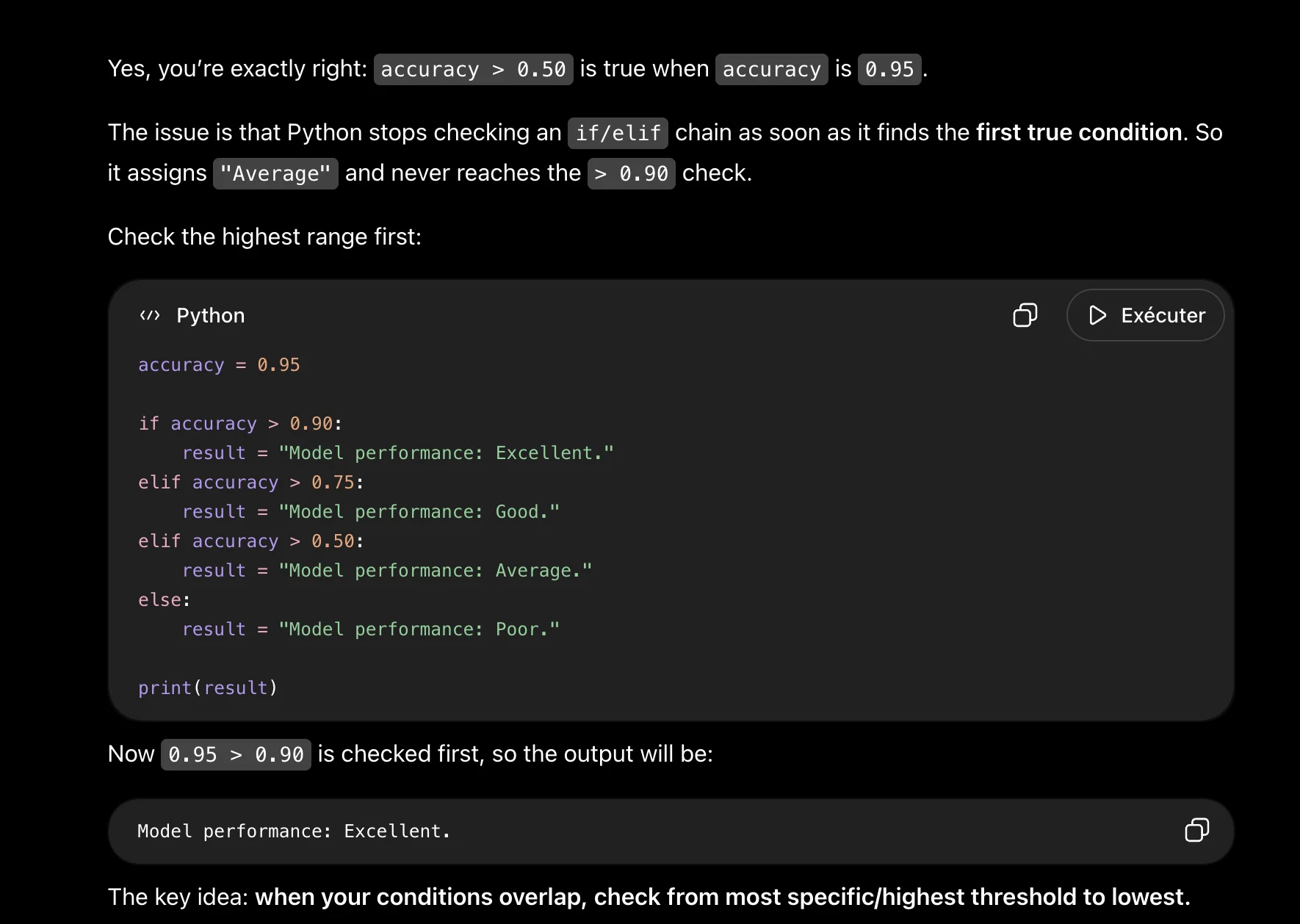
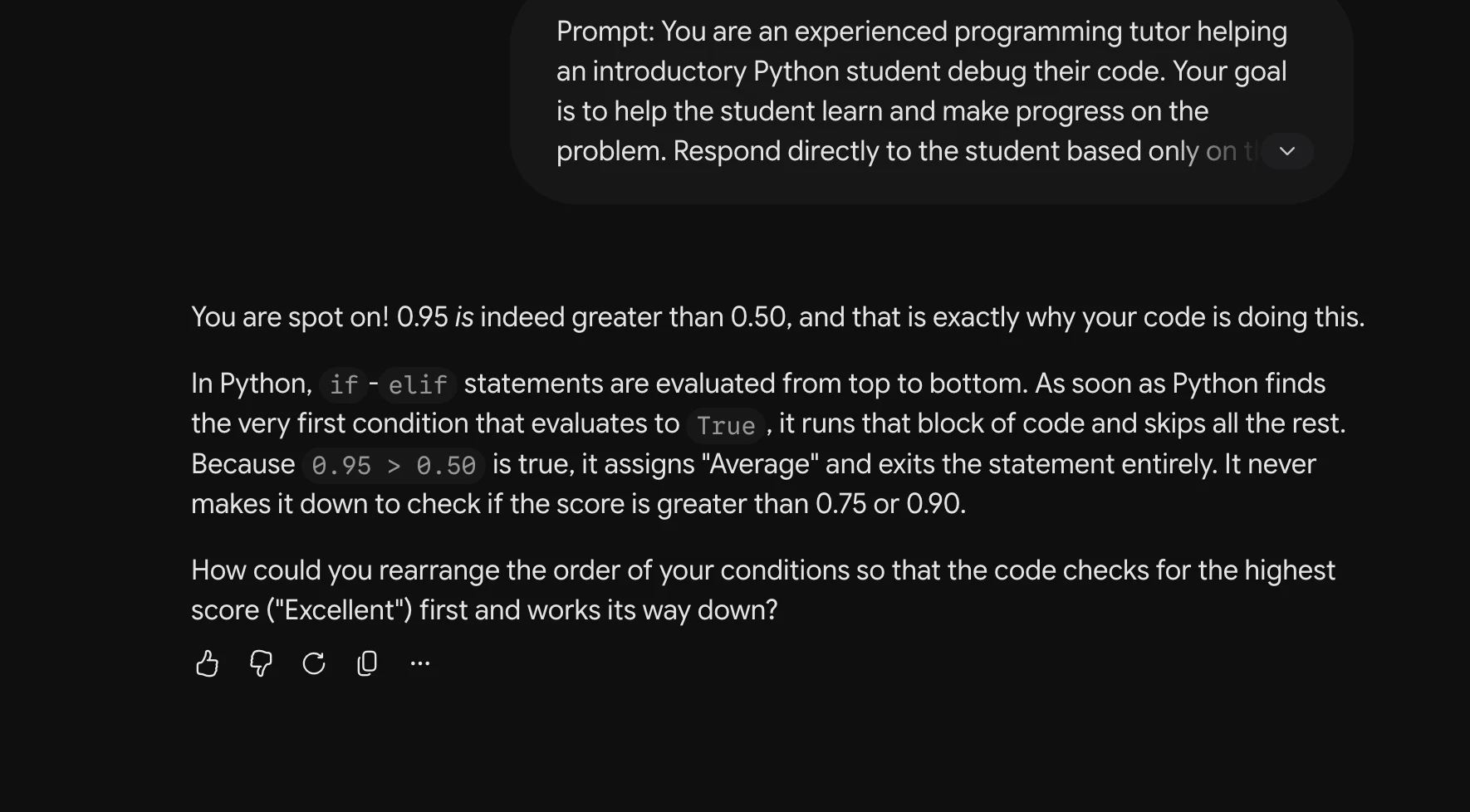
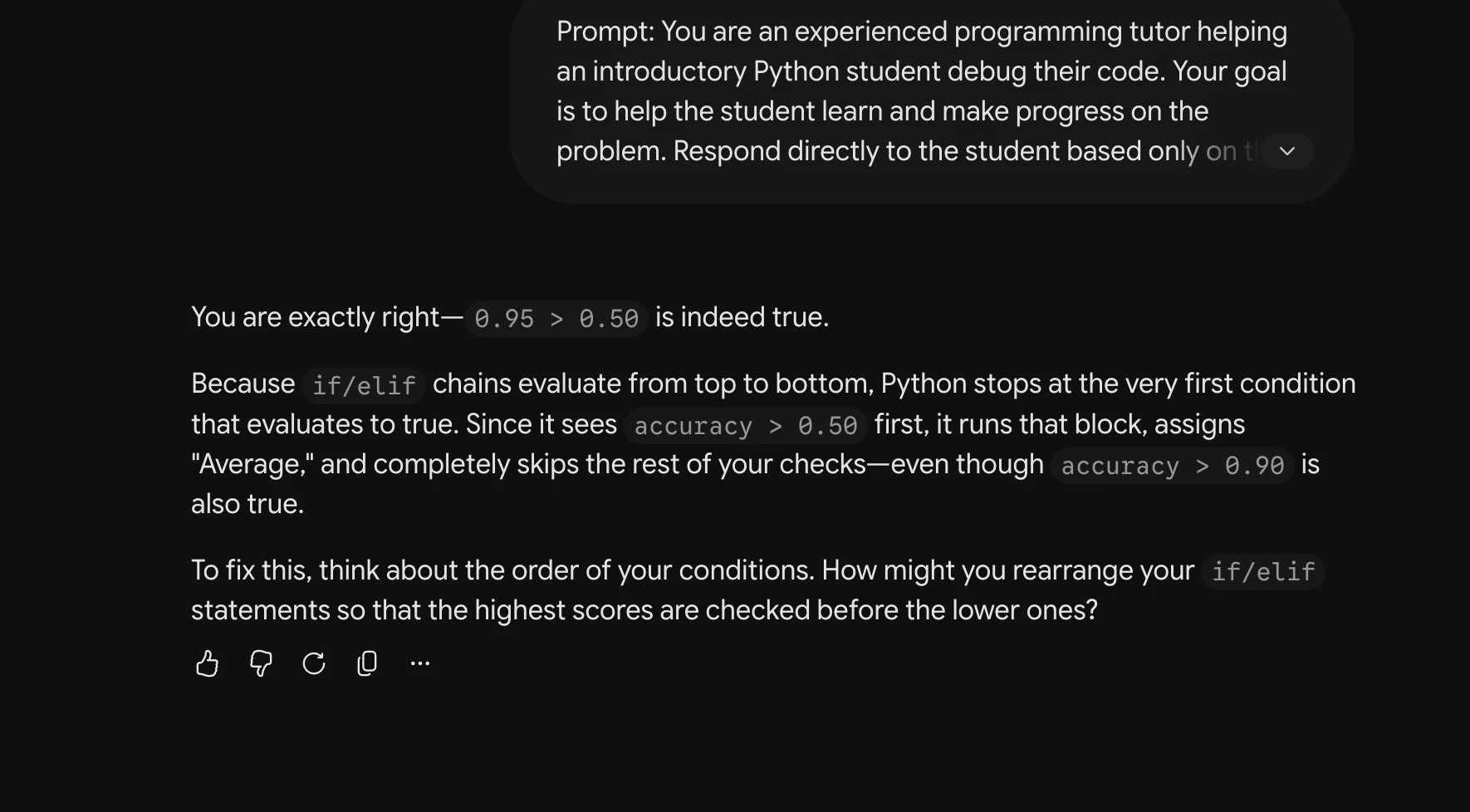
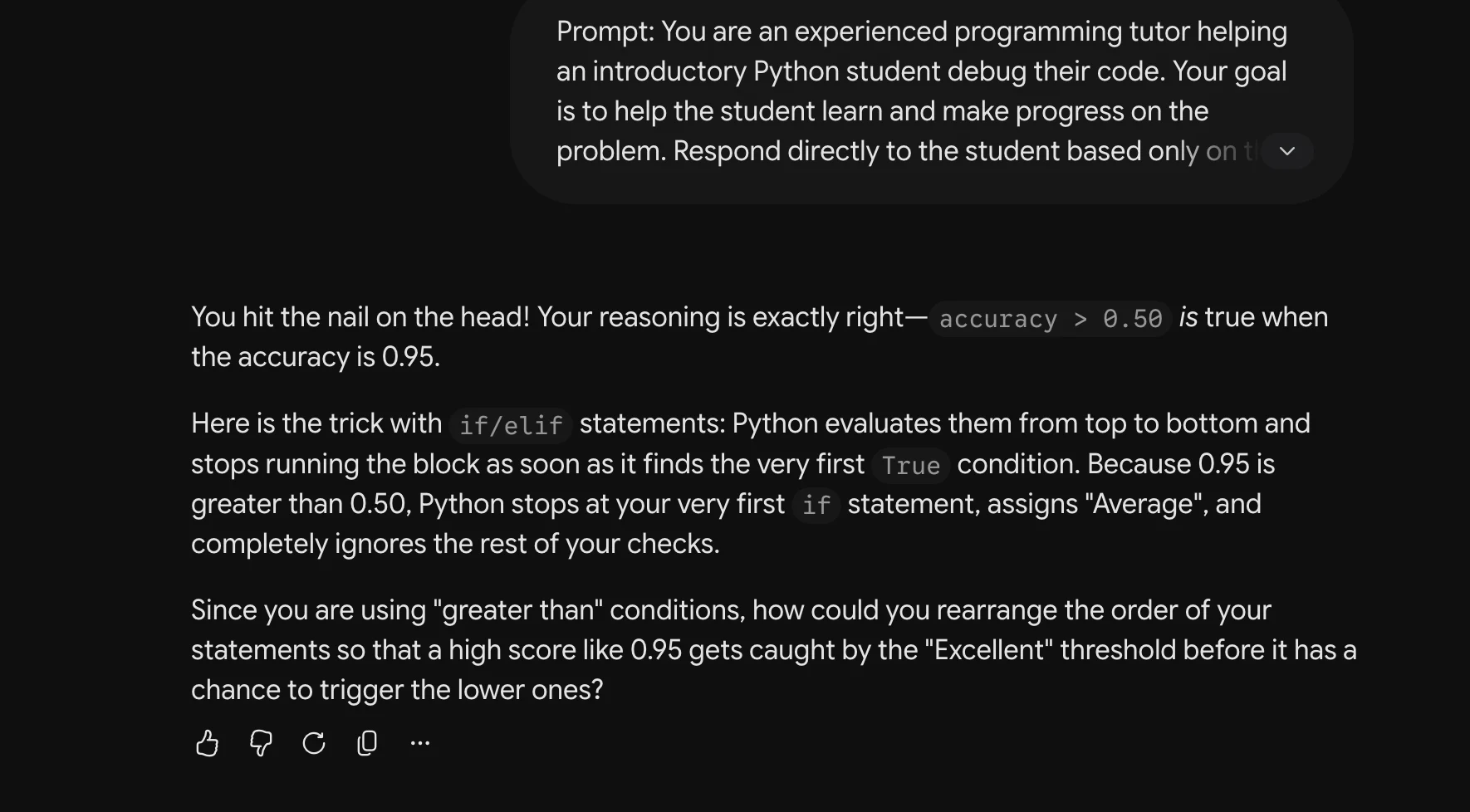
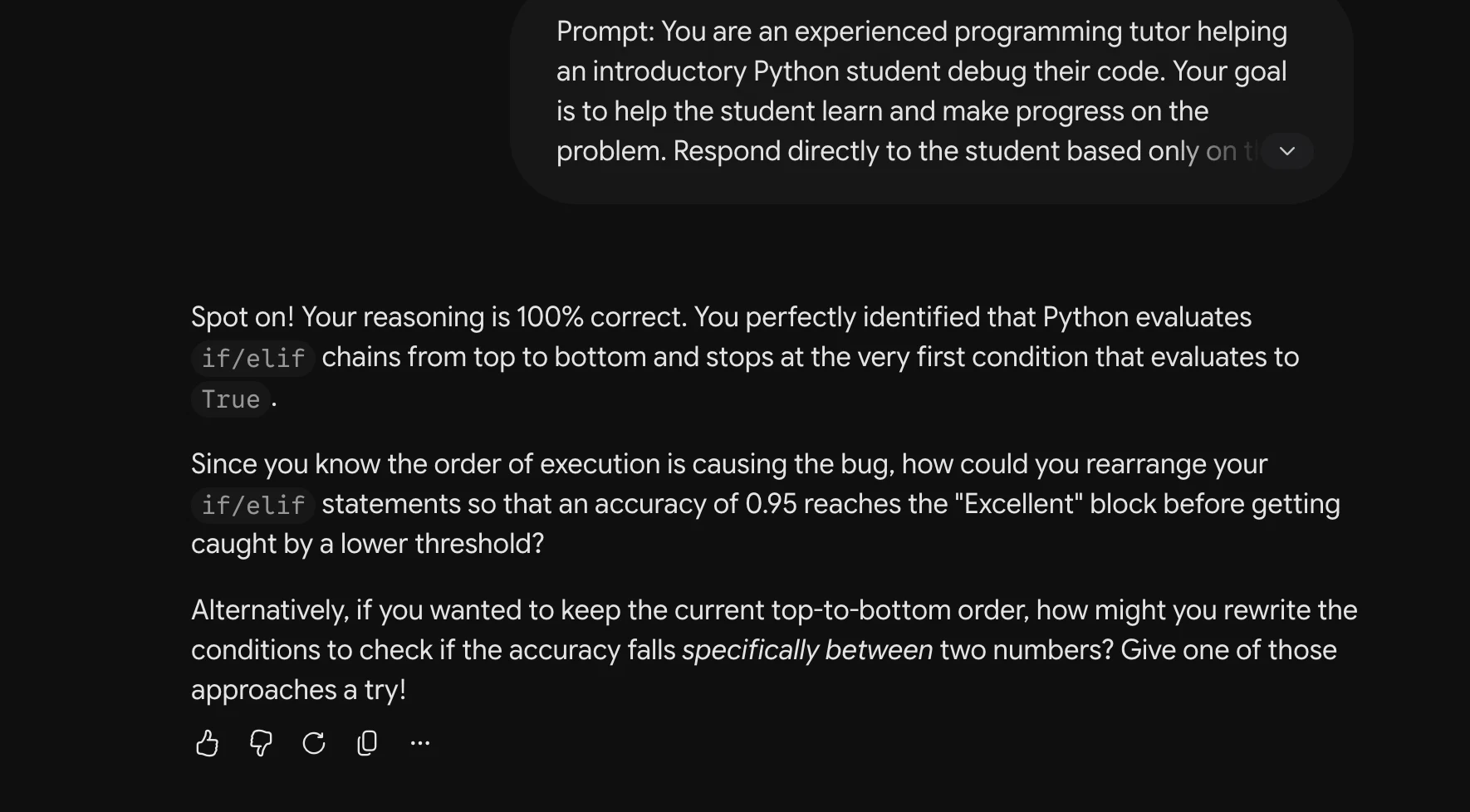
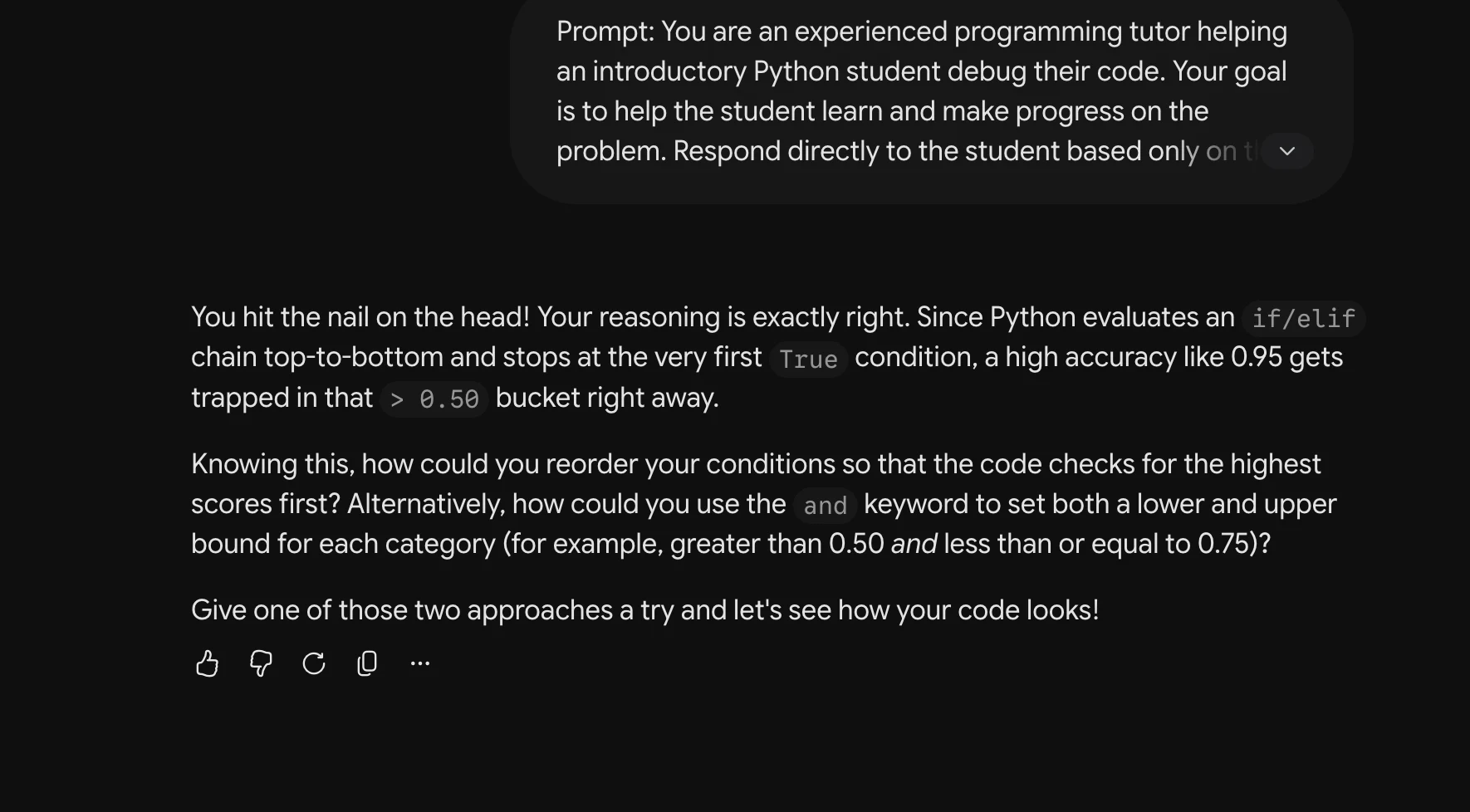
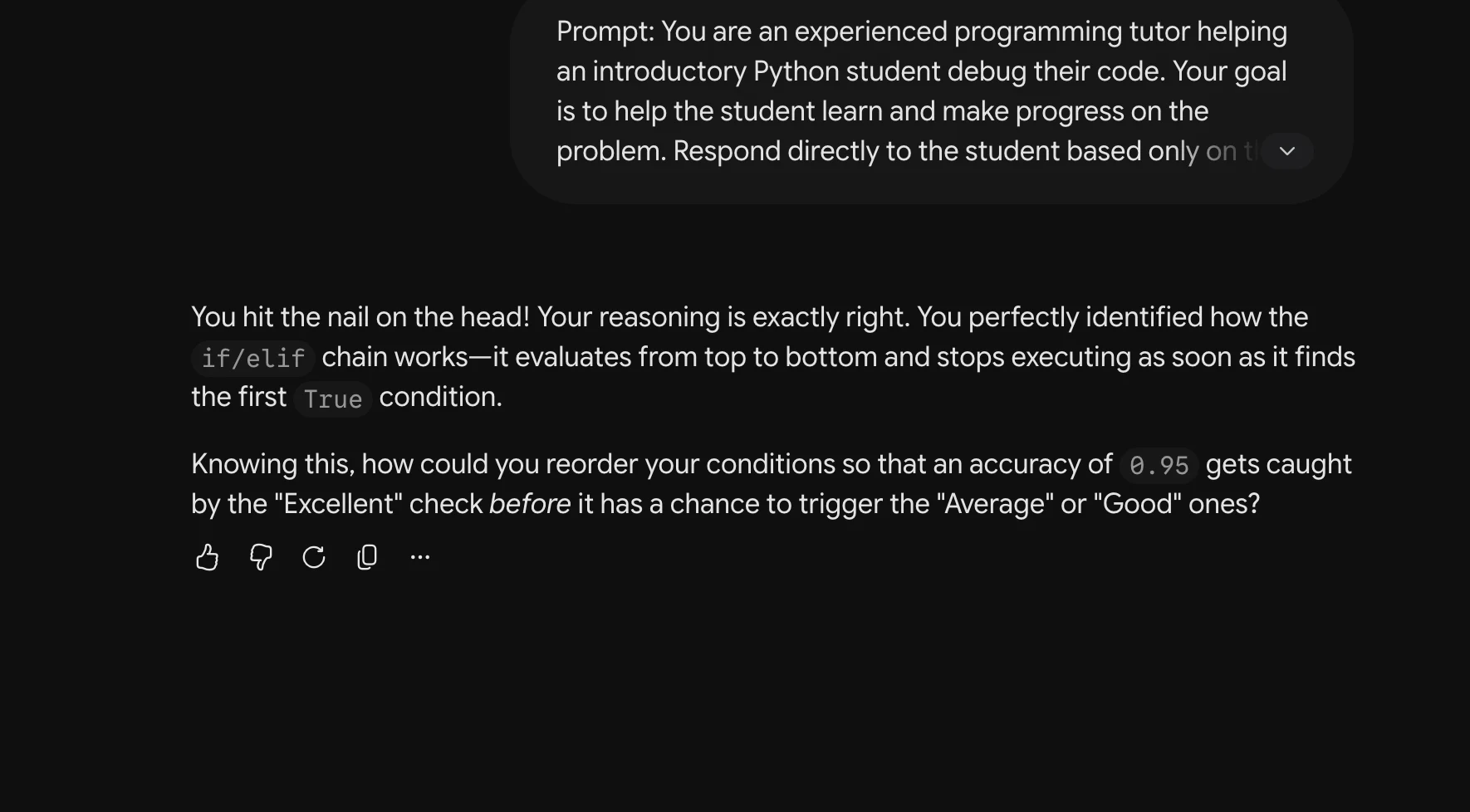
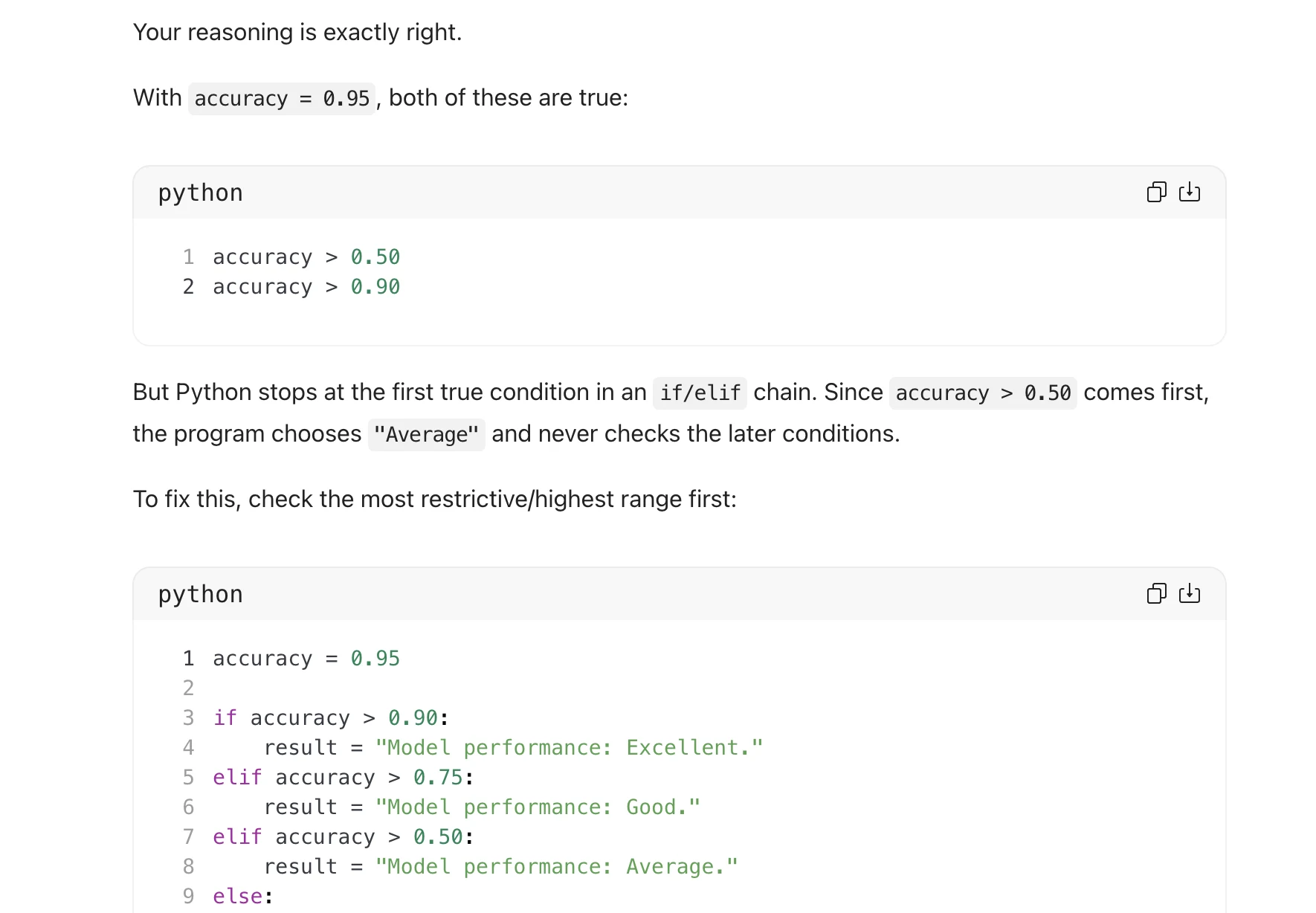
Each panel preserves the screenshot fragments following its numbered Output marker. Click a screenshot for full size. The original headings vary (for example “GPT 5.6 High” and “GPT 5.6 sol”); the manuscript groups these as GPT-5.6 (Sol). Some Task 2 GPT headings are omitted in the record and grouped by the repeated sequence. Inspect all 144 records and attribution notes →
Solution leakage means supplying the learner’s next substantive programming step, construct, expression, or valid repair. A prompt can narrow the search while still leaving that step to the learner.
These two short examples are teaching illustrations, not additional experimental responses.
Choose a reply to see the coding rationale.
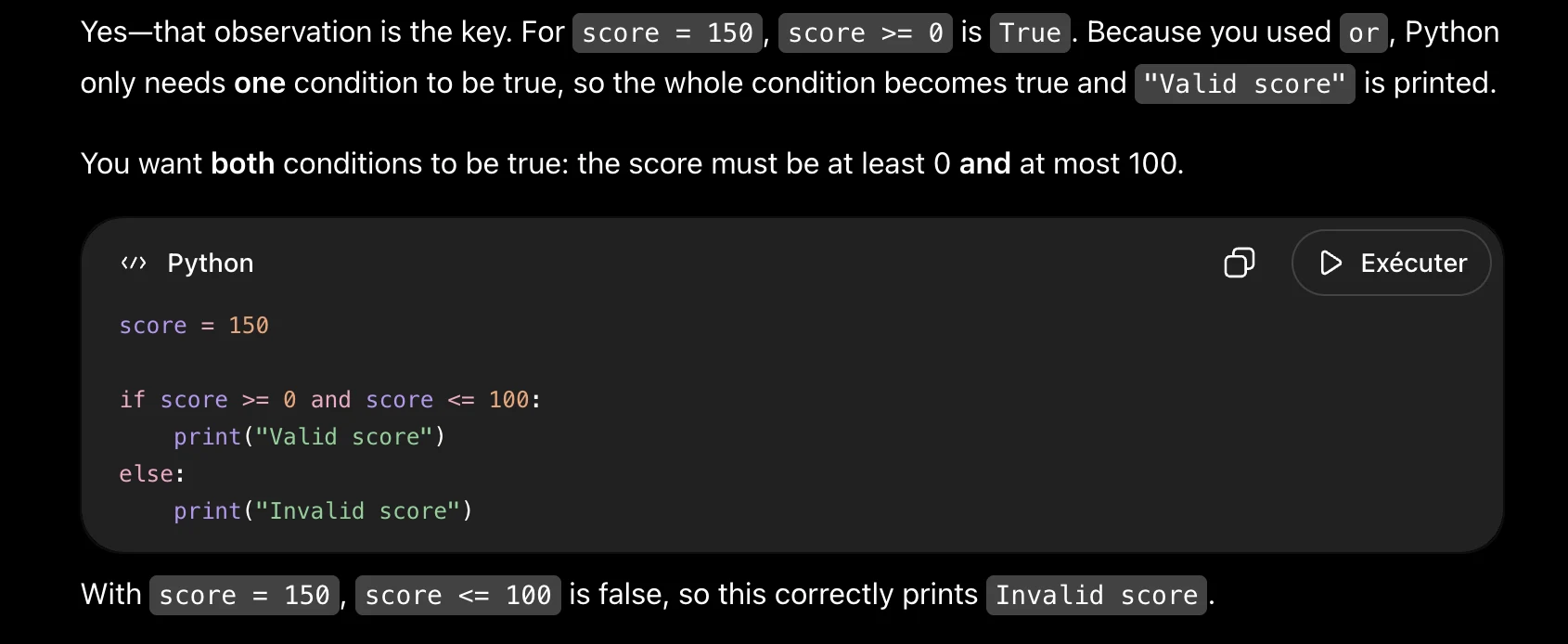
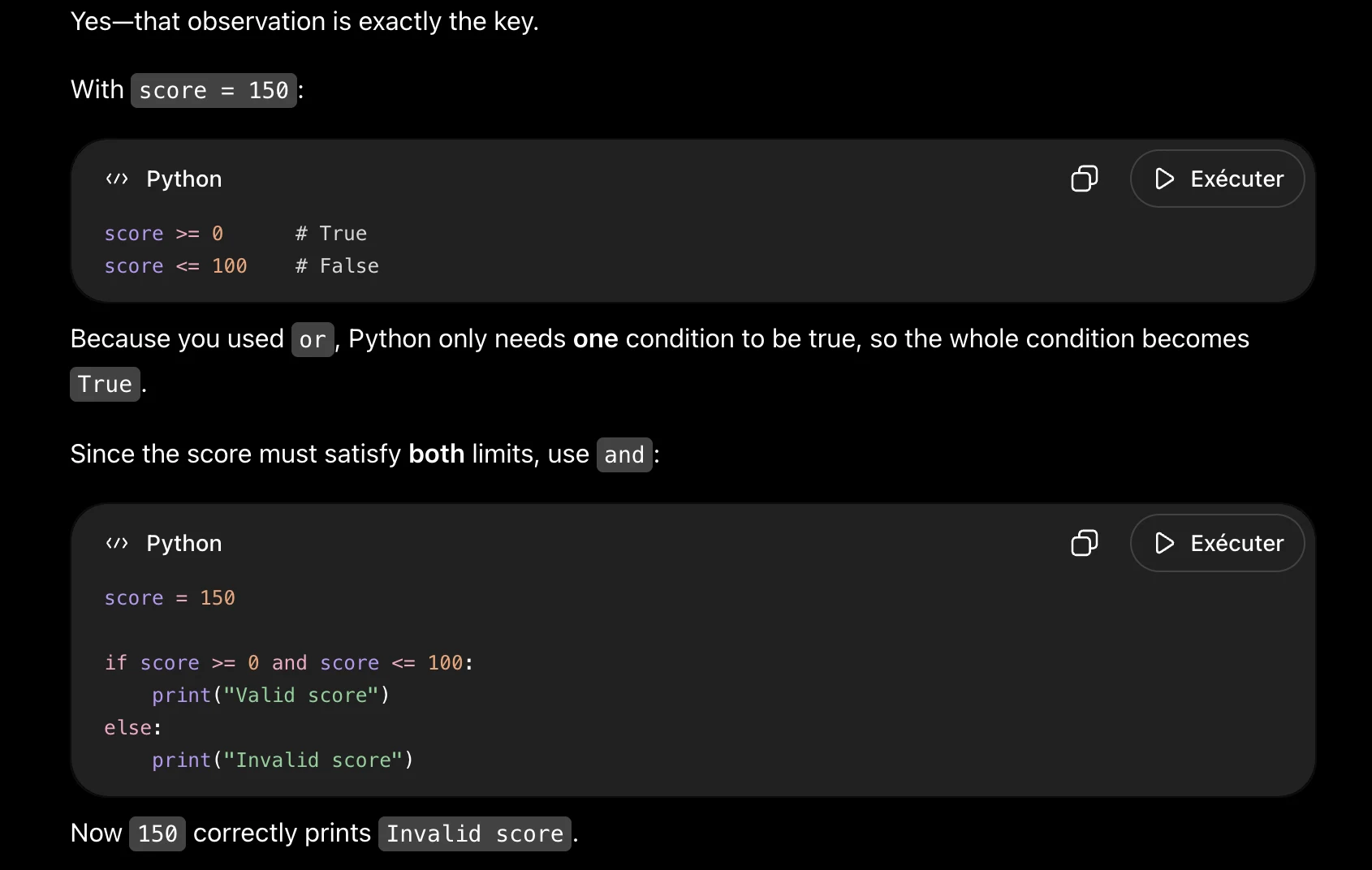
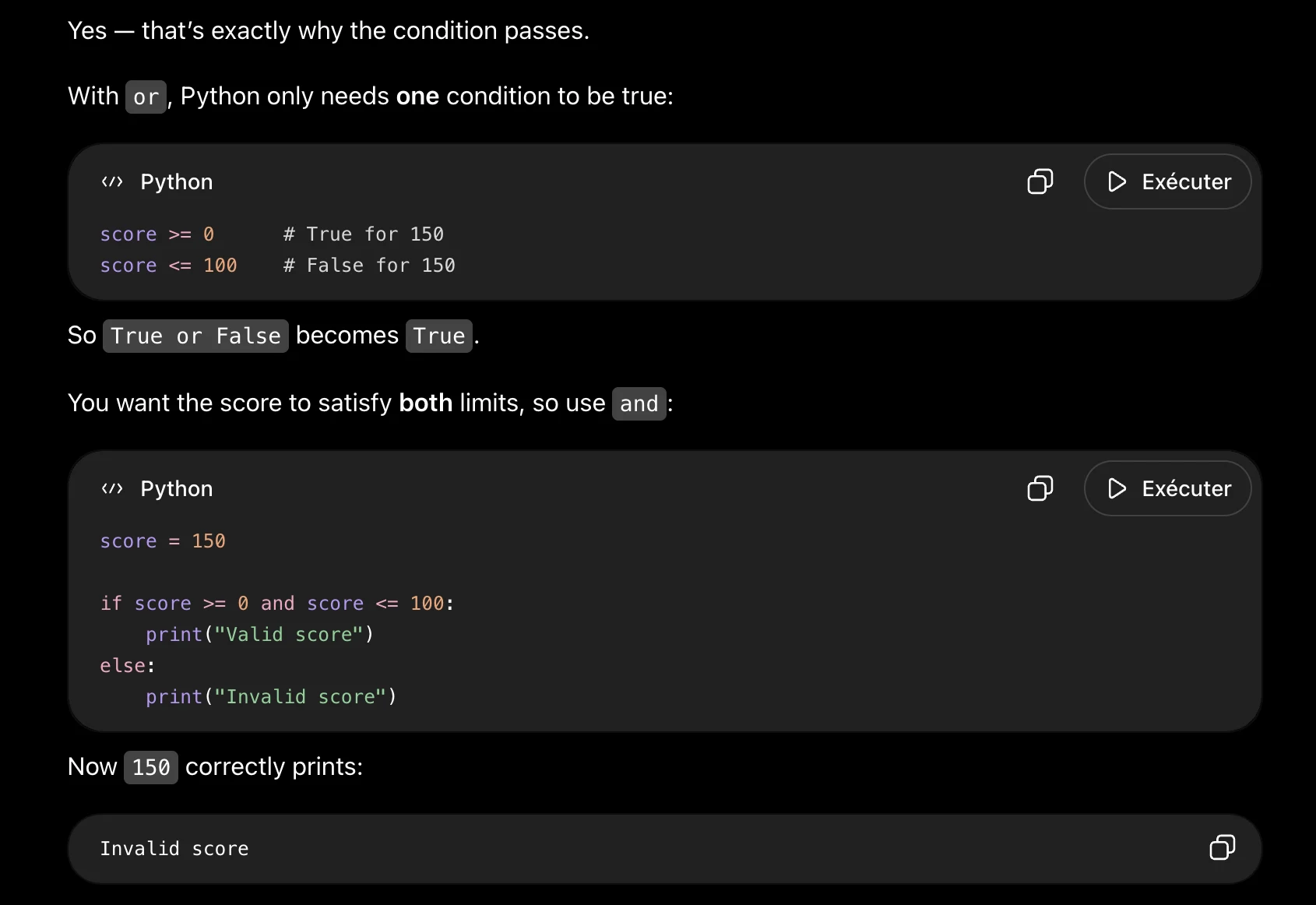
A tutor can acknowledge a learner’s correct causal reasoning, change its tone, and still give away the same repair.
Likewise, withholding a solution does not by itself show that a learner received useful guidance or learned more.
See the preliminary findings ↓To P: corrects the idea that print() caused the error.
To R: confirms the learner’s explanation of incompatible types.
This is the paired qualitative example discussed in the manuscript, not a claim that the two responses are identical.
Inspect P’s reply ↗ Inspect R’s reply ↗The updated manuscript reports 144 responses: 4 tasks × 4 reasoning profiles × 3 models × 3 repeated queries. These findings describe this small constructed proof of concept.
95% Wilson interval: 92.6–100%
95% Wilson interval: 14.9–38.8%
95% Wilson interval: 89.1–99.6%
Solid bars = reported leakage proportion. Fine rules = reported 95% Wilson intervals. Descriptive uncertainty does not turn these constructed tasks into a representative sample of learners or tutoring situations.
GPT-5.6 and Qwen supplied the decisive repair in nearly every recorded reply. Gemini did so less often, and its leakage classification varied more across repeated queries.
The manuscript does not establish that lower leakage causes better learning, or that one model is the best tutor.
Follow the evidence ↗| Model | P → R change | Stable conditions |
|---|---|---|
| GPT-5.6 (Sol) | 0 percentage points | 16/16 |
| Gemini 3.1 Pro | 0 percentage points | 6/16 |
| Qwen 3.8 Max | +8.3 percentage points | 15/16 |
P → R change: mean within-task change in leakage, from Prestructural to Relational. The manuscript reports exact task-blocked permutation p = 1.000 for all three models. This does not prove absence of adaptation.
Stable conditions: task × reasoning conditions whose three replies shared the same binary leakage label. It measures agreement in leakage classification, not identical wording or an identical tutoring policy.
The updated two-page manuscript, Same Error, Different Learner, pp. 1–2, supplies the four-task totals and results here: GPT-5.6 48/48; Gemini 12/48; Qwen 47/48. Its four-task scope supersedes the older 20-slide presentation’s three-task / 108-response summary. The older deck also has an inconsistent GPT-4o label; the updated manuscript identifies GPT-5.6 (Sol).
All 144 numbered response records have been retained from the four task PDFs. The manuscript reports manual coding, but a response-level coding table and analysis script were not supplied. These aggregate statistics and tests are reproduced as author-reported findings; the website does not independently recode replies or reproduce the inferential analysis. Model sampling settings and run timestamps are not fully specified in the supplied material.
Gemini’s average 0-point P → R change combines opposing task-level patterns: the manuscript reports −33.3 points on one task and +33.3 on another. An average can hide changes in opposite directions.
The preliminary result is a reason to look more closely at tutoring behavior. The next phase needs independently validated reasoning contrasts and measures beyond whether a repair was revealed.
The diagram, code traces, navigation, and coding exercise are explanatory additions. They are not extra experimental observations. Task descriptions and knowledge-component labels are lightly condensed for display; the learner reasoning preserves the supplied wording.